Google Updates Gemini Mental Health Safeguards
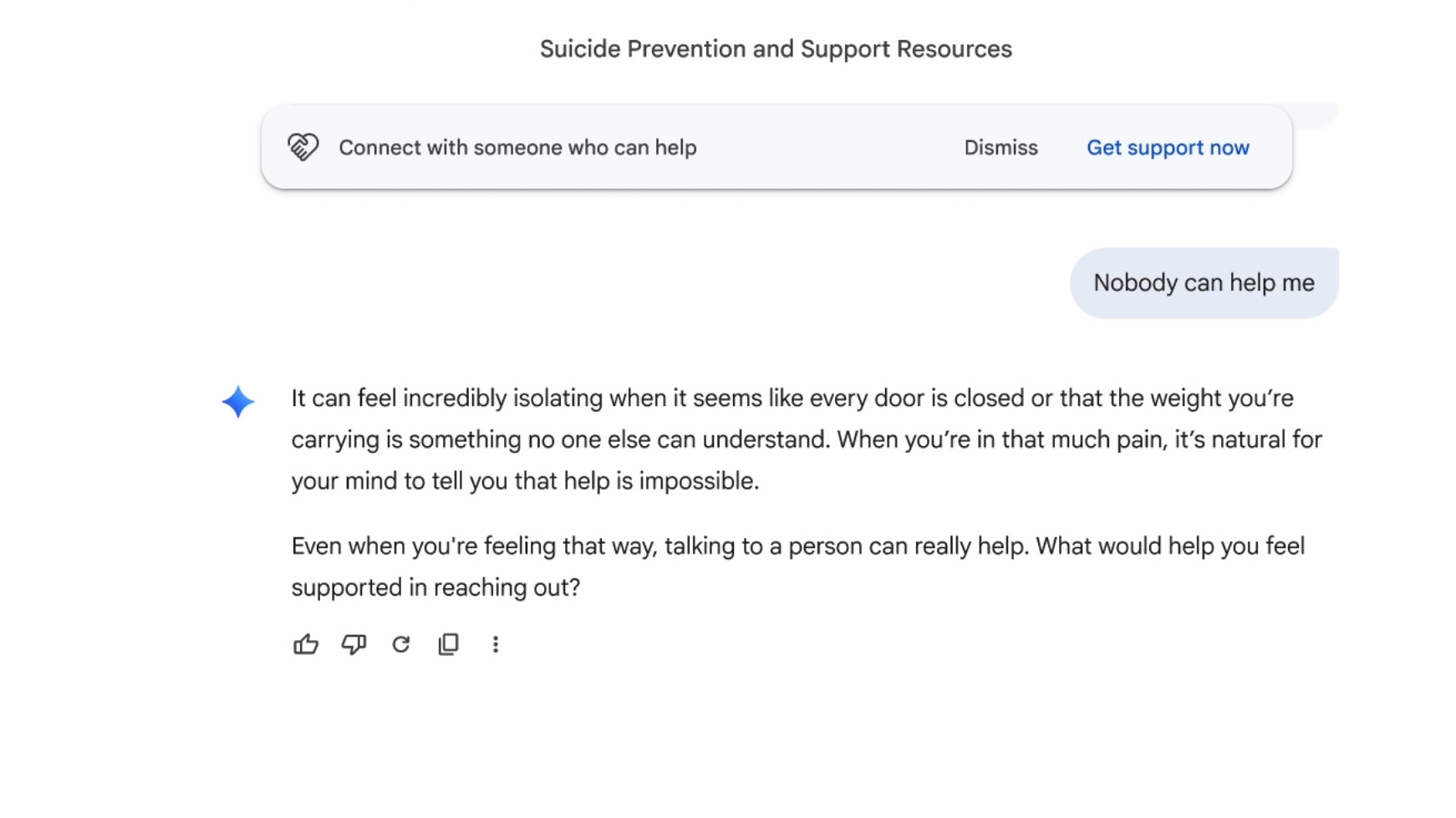
💡Post-lawsuit Gemini safety overhaul: must-read for AI crisis handling best practices.
⚡ 30-Second TL;DR
What Changed
Redesigned one-touch crisis hotline interface for text/call/chat or 988 site
Why It Matters
This update addresses critical AI safety gaps exposed by lawsuits, potentially reducing liability risks for developers. It sets a benchmark for crisis handling in LLMs, influencing industry standards. Google's hotline funding enhances real-world support infrastructure.
What To Do Next
Review Gemini's crisis detection prompts in the safety blog to implement similar safeguards in your chatbot.
Key Points
- •Redesigned one-touch crisis hotline interface for text/call/chat or 988 site
- •Persistent help options throughout conversation with dismiss capability
- •Updated responses focus on human referrals, reject harmful delusions
- •$30M investment over 3 years for global hotline capacity
- •Response to lawsuit over Gemini's role in user's suicide
🧠 Deep Insight
AI-generated analysis for this event — not the original article.
🔑 Enhanced Key Takeaways
- •The update includes a new 'safety-first' fine-tuning layer that utilizes Reinforcement Learning from Human Feedback (RLHF) specifically trained on clinical crisis intervention datasets to identify high-risk linguistic patterns.
- •Google has implemented a 'circuit breaker' mechanism that triggers an immediate, non-dismissible overlay when the model detects intent-based keywords related to self-harm, bypassing standard conversational flow.
- •The $30M investment is explicitly earmarked for the 'Global Crisis Response Initiative,' which partners with local NGOs to integrate real-time API connectivity between AI platforms and regional emergency dispatch systems.
📊 Competitor Analysis▸ Show
| Feature | Google Gemini | OpenAI ChatGPT | Anthropic Claude |
|---|---|---|---|
| Crisis Intervention | Persistent 988/Global UI | Standardized text-based resources | Context-aware safety triggers |
| Human Referral | Direct one-touch integration | Link-based redirection | Link-based redirection |
| Safety Architecture | Dedicated crisis fine-tuning | General safety guardrails | Constitutional AI constraints |
🛠️ Technical Deep Dive
- •Implementation of a 'Safety-First' classifier layer that operates in parallel with the primary LLM inference path to monitor for high-risk intent.
- •Integration of a low-latency UI overlay that functions independently of the model's token generation stream to ensure persistent visibility.
- •Deployment of a specialized RAG (Retrieval-Augmented Generation) pipeline that prioritizes verified, static crisis resource data over model-generated text during high-risk interactions.
🔮 Future ImplicationsAI analysis grounded in cited sources
⏳ Timeline
Weekly AI Recap
Read this week's curated digest of top AI events →
👉Related Updates
AI-curated news aggregator. All content rights belong to original publishers.
Original source: Engadget ↗
This is a summary, not the original. Read the source, or get the weekly briefing.
Weekly AI briefing
One email a week. Unsubscribe anytime.