🗾Stalecollected in 43m

Google TurboQuant Slashes LLM Memory 6x
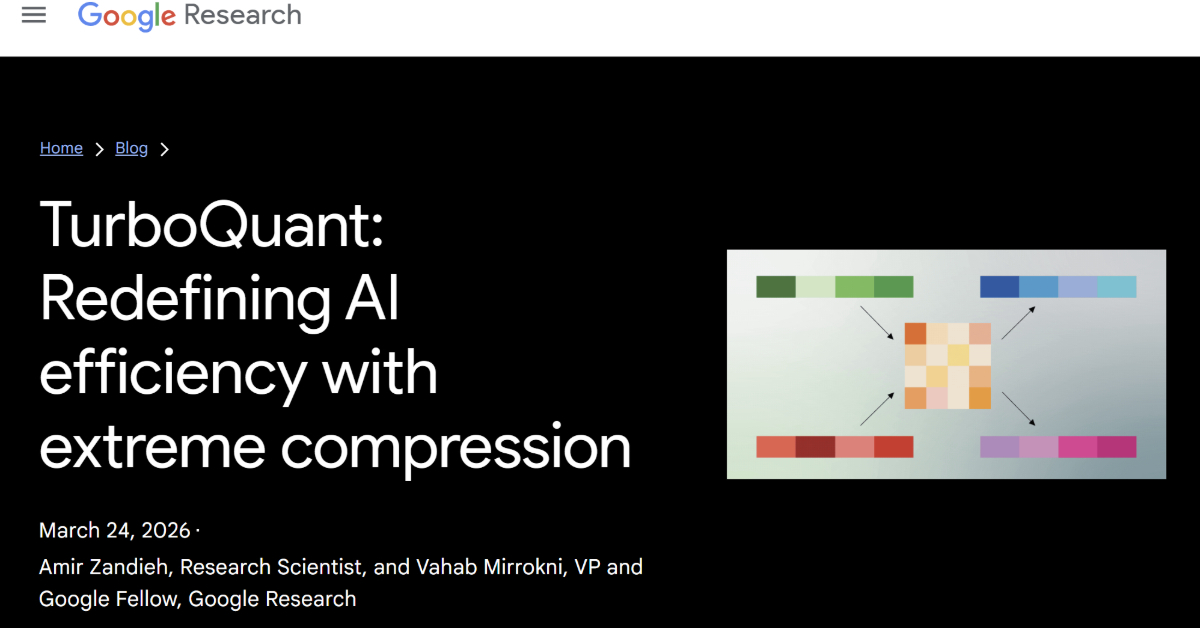
Google TurboQuant Slashes LLM Memory 6x
PostLinkedIn
🗾Read original on ITmedia AI+ (日本)

💡6x memory cut + 8x speed for LLMs like Gemini on H100

⚡ 30-Second TL;DR

What Changed

Reduces LLM memory consumption to 1/6th

Why It Matters

Dramatically lowers costs for deploying large LLMs and vector search, enabling broader access to high-performance AI on standard hardware.

What To Do Next

Benchmark TurboQuant on your LLM KV cache using H100 to cut memory costs.

Who should care:Developers & AI Engineers

🧠 Deep Insight

AI-generated analysis for this event.

🔑 Enhanced Key Takeaways

  • TurboQuant specifically targets the 'KV cache bottleneck' in long-context inference, which is the primary driver of memory overhead in models like Gemini 1.5 Pro.
  • The integration of PolarQuant (a rotation-based quantization technique) and QJL (Johnson-Lindenstrauss transform-based projection) allows for aggressive bit-width reduction without the typical perplexity degradation seen in standard 3-bit quantization.
  • The 8x speedup is achieved primarily through reduced memory bandwidth pressure, allowing the H100's high-bandwidth memory (HBM) to serve more tokens per second during the decoding phase.
📊 Competitor Analysis▸ Show
FeatureGoogle TurboQuantNVIDIA TensorRT-LLM (FP8/INT4)vLLM (PagedAttention)
KV Cache Compression3-bit (PolarQuant+QJL)4-bit/8-bitN/A (Memory Management)
Memory Reduction6x2x-4xN/A (Fragmentation focus)
Primary HardwareNVIDIA H100NVIDIA H100/A100Agnostic
Accuracy PreservationHigh (via Polar rotation)Moderate (Quantization noise)N/A

🛠️ Technical Deep Dive

  • PolarQuant Architecture: Utilizes a unitary rotation matrix to distribute the activation values more uniformly before quantization, mitigating the impact of outliers that typically cause accuracy loss in low-bit quantization.
  • QJL Integration: Applies a randomized Johnson-Lindenstrauss projection to the KV cache tensors, effectively reducing dimensionality while preserving pairwise distances between token embeddings.
  • Hardware Optimization: Custom CUDA kernels specifically tuned for the H100's Tensor Cores to handle the dequantization overhead of 3-bit weights on-the-fly, minimizing latency penalties.
  • Context Window Impact: Enables significantly larger effective context windows on existing hardware by freeing up HBM previously occupied by the KV cache.

🔮 Future ImplicationsAI analysis grounded in cited sources

TurboQuant will become the default inference engine for all Gemini-based API services.
The massive reduction in memory footprint allows Google to increase the number of concurrent users per GPU, significantly improving the unit economics of their LLM infrastructure.
On-device LLM capabilities on mobile hardware will see a 3x increase in context capacity.
By applying TurboQuant's compression techniques to mobile-optimized models, the memory constraints of consumer devices become less of a barrier for long-context tasks.

Timeline

2024-02
Google introduces Gemini 1.5 Pro with a 1-million token context window.
2025-06
Google researchers publish foundational work on PolarQuant for activation quantization.
2026-03
Official announcement of TurboQuant integration into Google's production inference stack.
📰

Weekly AI Recap

Read this week's curated digest of top AI events →

👉Related Updates
AI-curated news aggregator. All content rights belong to original publishers.
Original source: ITmedia AI+ (日本)