Google shifts AI agent focus from mobile to PC
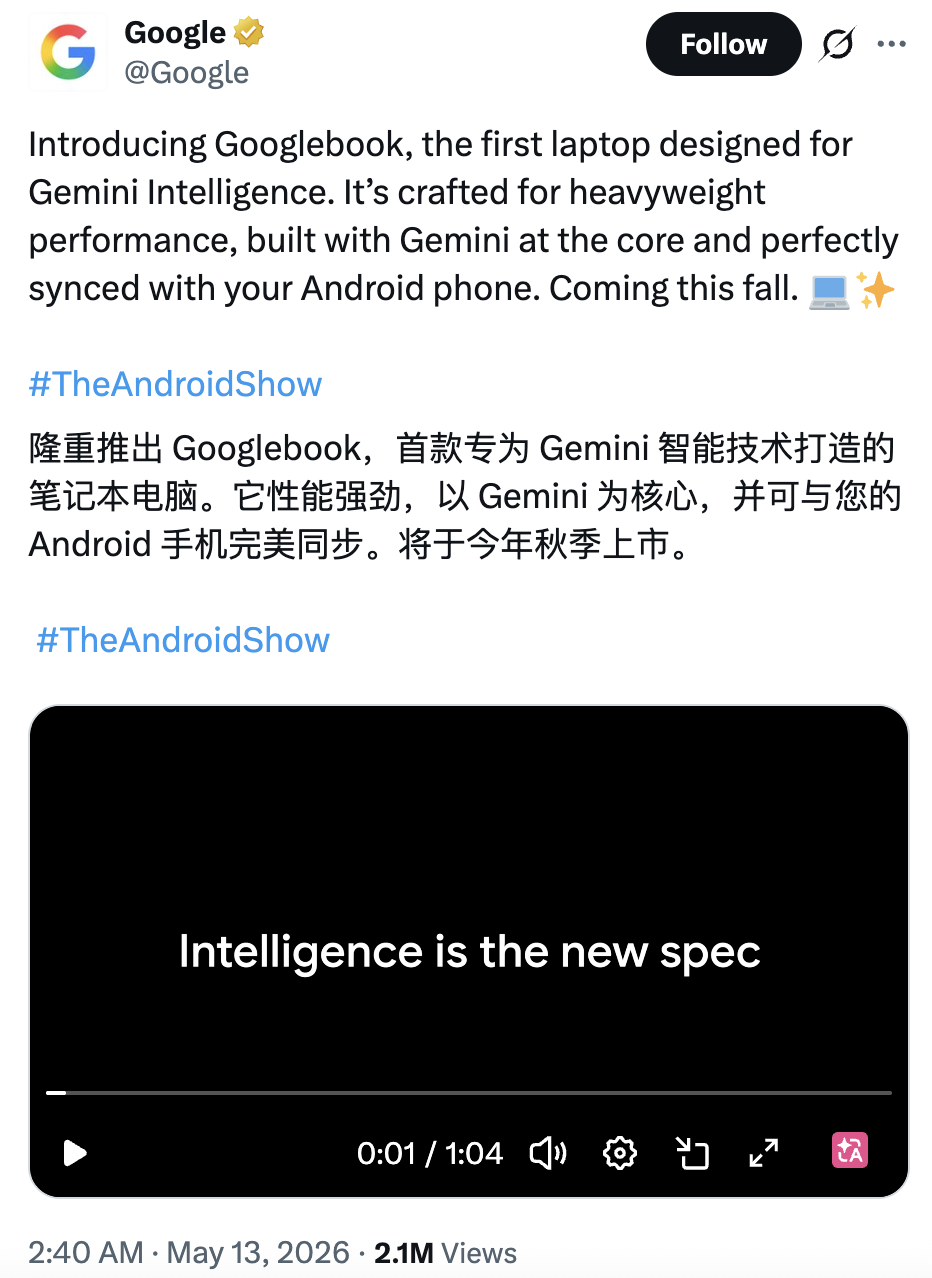
💡Google's pivot to PC for AI agents changes the hardware roadmap for developers building autonomous workflows.
⚡ 30-Second TL;DR
What Changed
Google identifies PC as the primary hardware for AI agents
Why It Matters
This signals a potential shift in how developers should prioritize platform-specific agent optimizations, favoring desktop-native AI applications.
What To Do Next
Evaluate your agent's compatibility with desktop environments and prioritize local OS integration features.
Key Points
- •Google identifies PC as the primary hardware for AI agents
- •Shift away from mobile-first AI agent strategy
- •PC environment offers better compute and workflow integration for agents
🧠 Deep Insight
Web-grounded analysis with 14 cited sources.
🔑 Enhanced Key Takeaways
- •The strategic pivot to PC for AI agents is driven by the demand for sophisticated Vision-Language-Action (VLA) models capable of complex reasoning, deep research, and autonomous multi-step task execution, evolving beyond basic natural language processing.
- •PC-based AI agents gain significant advantages by directly interacting with graphical user interfaces (GUIs) through interpreting screen states, mouse movements, and keyboard inputs, allowing automation of tasks even in legacy software without APIs.
- •Google's Gemini 2.5 Computer Use model, released in October 2025, is specifically engineered to enable agents to interact with user interfaces, demonstrating superior performance and lower latency in web and mobile control benchmarks compared to other models.
- •The Gemini Enterprise Agent Platform, launched in April 2026, provides a cloud-based, enterprise-grade environment for building, scaling, and governing AI agents, integrating with Google Cloud and Workspace services and featuring an Agent Sandbox for secure code execution.
- •Despite the PC focus for complex agentic tasks, Google continues to advance mobile AI, with Gemini Intelligence integrating deeply into Android to manage a wider range of everyday tasks across apps on upcoming Pixel and Samsung Galaxy phones.
📊 Competitor Analysis▸ Show
| Competitor/Product | Key Differentiator / Best For | Pricing |
|---|---|---|
| Manus My Computer | Hybrid cloud-to-local model, integrated productivity & content creation, strong security focus. | Freemium (with paid tiers) |
| Perplexity Computer | Multi-model orchestration for deep research & analysis. | Paid (Perplexity Pro, $20/month) |
| Claude Cowork (Anthropic) | Native Microsoft Office integration for document & data-heavy tasks. | Paid (Claude Pro, $20/month) |
| ChatGPT Agent (OpenAI Operator) | General purpose web tasks, seamless integration with ChatGPT ecosystem, uses remote browser. | Paid (ChatGPT Plus/Pro, $20/month) |
| Genspark | All-in-one autonomous work, mixture-of-agents architecture, can make phone calls. | Freemium (with paid tiers) |
| Microsoft Copilot (with Fara-7B) | Desktop & Office task automator, controls computer UI. | Integrated with Windows 11 and Microsoft 365 (specific pricing for agentic model not detailed) |
| AWS WorkSpaces | Enables AI agents to operate within secure virtual desktop environments for enterprise process automation without app modernization. | Service-based (pricing not detailed) |
🛠️ Technical Deep Dive
- AI agents typically operate in an Observation-Reasoning-Action loop, allowing them to handle long-running and multi-step workflows.
- They can interact with desktop environments by interpreting screenshots or UI states, moving the mouse, typing on the keyboard, and clicking buttons, enabling automation of software even without APIs.
- Google's Gemini 2.5 Computer Use model is built upon the visual understanding and reasoning capabilities of Gemini 2.5 Pro.
- This model incorporates built-in safety features to mitigate risks like misuse, unexpected behavior, and prompt injections, often requiring user confirmation for high-risk actions such as purchases or logins.
- The Gemini Enterprise Agent Platform utilizes a 'Universal Intelligence' concept, feeding agents with business context from an organization's internal systems and data for enhanced reasoning.
- It includes an Agent Sandbox, a hardened environment for securely executing model-generated code and performing computer use tasks without compromising host systems.
- The platform supports agent-to-agent orchestration, allowing agents to delegate tasks to one another for complex, multi-step workflows.
- Agent integration with Google Cloud and Workspace services is facilitated by supporting the Model Context Protocol (MCP).
🔮 Future ImplicationsAI analysis grounded in cited sources
⏳ Timeline
📎 Sources (14)
Factual claims are grounded in the sources below. Forward-looking analysis is AI-generated interpretation.
Weekly AI Recap
Read this week's curated digest of top AI events →
👉Related Updates

AI-curated news aggregator. All content rights belong to original publishers.
Original source: 钛媒体 ↗