SourceThe Register - AI/ML•Stalecollected in 5m
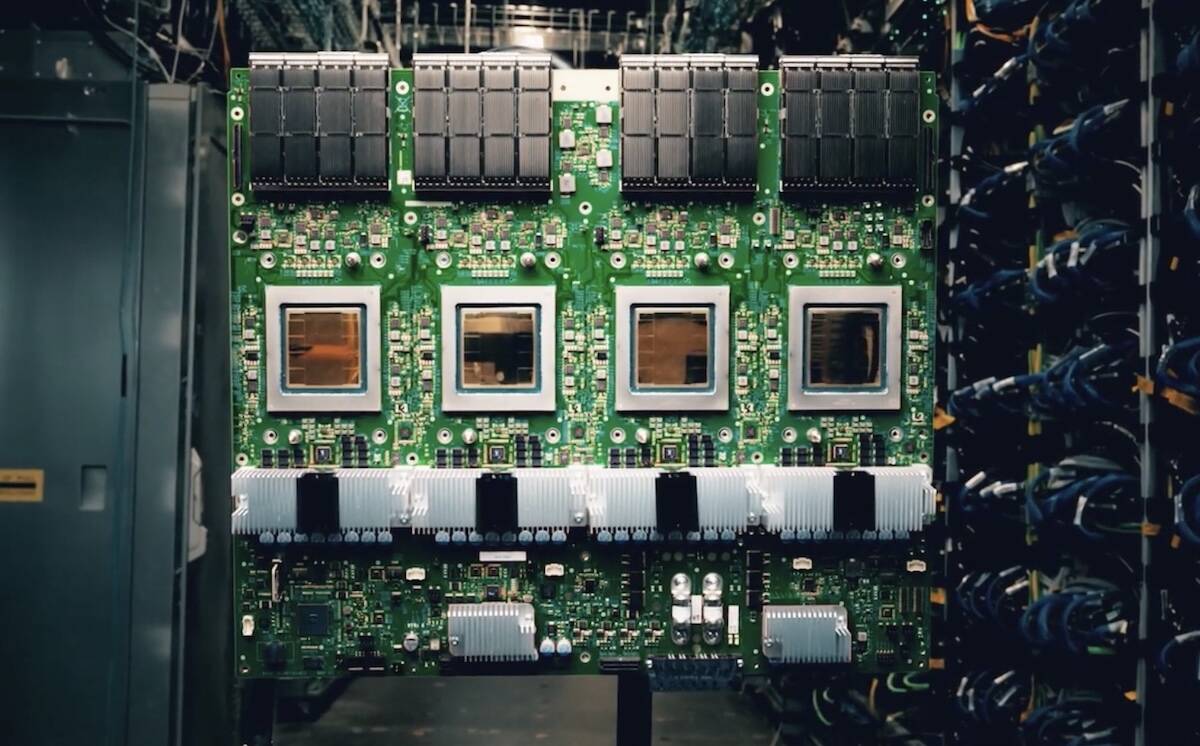
Google Launches TPU 8 AI Accelerators
#ai-accelerators#arm-cores#cloud-nexttpu-8googletpu-8axion
💡TPU 8 + Axion slashes AI training/serving costs—key for scaling infra
⚡ 30-Second TL;DR
What Changed
TPU 8 designed for faster AI model training
Why It Matters
Advances Google's position in AI hardware race. Enables cheaper, faster AI inference for practitioners scaling models.
What To Do Next
Benchmark TPU 8 on Google Cloud for your next training workload.
Who should care:Developers & AI Engineers
Key Points
- •TPU 8 designed for faster AI model training
- •Second accelerator reduces model serving costs
- •Integration with Arm Axion cores boots x86 architecture
- •Announced at Google Cloud Next in Las Vegas
🧠 Deep Insight
AI-generated analysis for this event — not the original article.
🔑 Enhanced Key Takeaways
- •The TPU 8 architecture utilizes a proprietary high-bandwidth interconnect fabric that enables a 40% reduction in inter-node communication latency compared to the TPU v5p generation.
- •Google has transitioned to a custom-designed liquid cooling solution for the TPU 8 pods, allowing for higher clock speeds and increased power density within the data center racks.
- •The integration of Axion CPUs allows Google to bypass traditional PCIe bottlenecks by implementing a direct memory access (DMA) path between the Arm cores and the TPU 8 tensor cores.
📊 Competitor Analysis▸ Show
| Feature | Google TPU 8 | NVIDIA Blackwell (B200) | AWS Trainium2 |
|---|---|---|---|
| Architecture | Custom ASIC + Arm Axion | Blackwell GPU + Grace CPU | Custom ASIC + Graviton |
| Interconnect | Proprietary Fabric | NVLink Switch System | Elastic Fabric Adapter |
| Primary Focus | Vertical Integration | General Purpose AI/HPC | Cloud Cost Optimization |
🛠️ Technical Deep Dive
- •TPU 8 utilizes a 3nm process node, significantly improving performance-per-watt over the 5nm TPU v5p.
- •Features a redesigned Matrix Multiply Unit (MXU) optimized specifically for FP8 and INT8 precision, targeting transformer-based LLM inference.
- •The Axion CPU integration utilizes the Neoverse V2 core design, providing a 30% improvement in energy efficiency for control-plane tasks compared to previous x86-based host processors.
- •Supports a unified memory architecture that allows the TPU 8 to access host memory directly, reducing data copy overhead during large-scale model training.
🔮 Future ImplicationsAI analysis grounded in cited sources
Google will achieve a 25% reduction in total cost of ownership (TCO) for large-scale model training by 2027.
The shift to in-house Arm-based Axion processors eliminates licensing fees and power overhead associated with third-party x86 CPUs.
Third-party cloud providers will face increased pressure to develop proprietary silicon to remain price-competitive with Google Cloud.
Google's vertical integration of TPU 8 and Axion creates a performance-per-dollar barrier that standard GPU-based cloud instances struggle to match.
⏳ Timeline
2016-05
Google announces the first generation Tensor Processing Unit (TPU) at Google I/O.
2018-02
Google makes TPU v2 available to the public via Google Cloud Platform.
2021-05
Google introduces TPU v4, featuring significant improvements in interconnect bandwidth.
2023-12
Google announces TPU v5p, the most powerful TPU to date, optimized for large-scale model training.
2024-04
Google unveils Axion, its first custom Arm-based CPU for data centers.
2026-04
Google launches TPU 8 at Cloud Next, integrating Axion cores for the first time.
📰 Event Coverage
📰
Weekly AI Recap
Read this week's curated digest of top AI events →
👉Related Updates
AI-curated news aggregator. All content rights belong to original publishers.
Original source: The Register - AI/ML ↗
This is a summary, not the original. Read the source, or get the weekly briefing.
The weekly digest
One email a week. Unsubscribe anytime.