Google Launches Android Gemini Intelligence
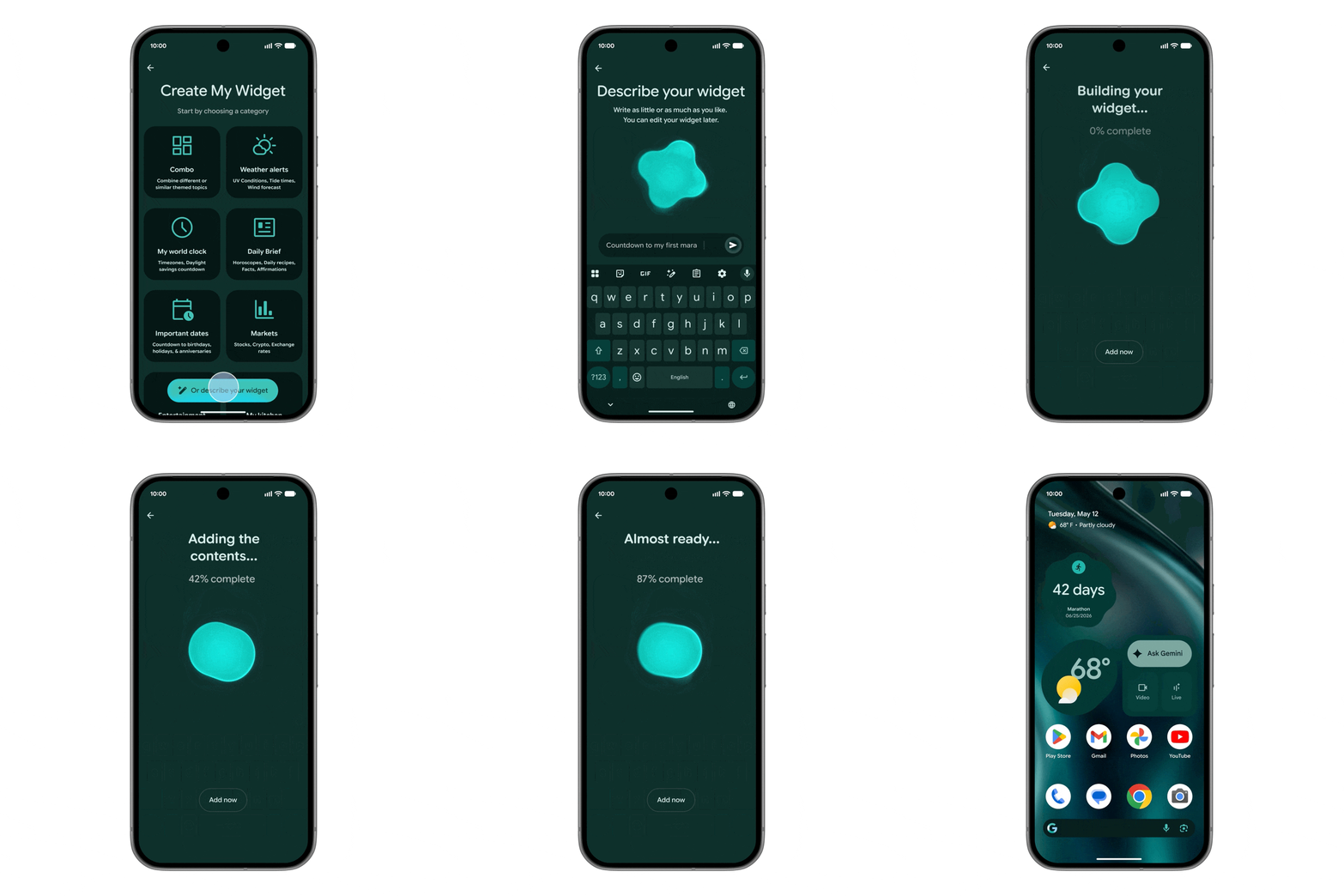
💡Google's AI OS auto-fills, builds widgets, automates tasks—redefines Android dev workflows.
⚡ 30-Second TL;DR
What Changed
Android evolves into proactive Intelligence System via Gemini Intelligence
Why It Matters
Google's deep AI integration positions Android as a leader in proactive mobile intelligence, challenging iOS and attracting developers to AI-native ecosystems. It expands Gemini's reach to PCs via Googlebook, unifying mobile and laptop experiences.
What To Do Next
Download Android 17 developer preview to prototype Gemini Intelligence multi-step tasks in your apps.
Key Points
- •Android evolves into proactive Intelligence System via Gemini Intelligence
- •Gboard auto-fills from photos, chats, emails using multi-modal AI
- •Create my widget generates custom AI-powered desktop widgets
- •Rambler enables intelligent voice input without punctuation commands
- •Googlebook introduces shake-cursor AI activation and Android app compatibility
🧠 Deep Insight
AI-generated analysis for this event.
🔑 Enhanced Key Takeaways
- •The transition to 'Android Intelligence' marks a shift from a traditional OS kernel-based architecture to a Gemini-native 'Agentic OS' layer that prioritizes on-device inference to reduce latency for multi-step task automation.
- •The 'Rambler' voice input system utilizes a new lightweight, low-power audio processing unit (APU) integrated into the Tensor G6 chipset, allowing for continuous, low-latency natural language processing without cloud round-trips.
- •Googlebook hardware utilizes a custom-designed 'Neural Bridge' interconnect, enabling the 'magic pointer' to maintain state awareness across both ChromeOS and native Android application environments simultaneously.
📊 Competitor Analysis▸ Show
| Feature | Google Android Intelligence | Apple Intelligence (iOS 20) | Samsung One UI AI |
|---|---|---|---|
| Core Architecture | Agentic OS (Gemini-native) | Hybrid (On-device/Private Cloud) | App-layer AI integration |
| Task Automation | Multi-step cross-app | Limited app-specific | Limited app-specific |
| Hardware Integration | Tensor G6 Neural Bridge | A-series Neural Engine | Exynos/Snapdragon NPU |
| Pricing | Free (OS level) | Free (OS level) | Free (OS level) |
🛠️ Technical Deep Dive
- Gemini Intelligence utilizes a 'Distilled-to-Device' model architecture, specifically optimized for the Tensor G6 NPU to handle multi-modal inputs (text, image, audio) locally.
- The 'Magic Pointer' utilizes a spatial-temporal awareness engine that maps UI elements in real-time, allowing the AI to 'see' and interact with non-API-exposed elements in legacy Android apps.
- Android 17 introduces a new 'Contextual Memory' API, allowing apps to securely share user-permitted state data with the Gemini agent to facilitate cross-app task completion.
🔮 Future ImplicationsAI analysis grounded in cited sources
⏳ Timeline
Weekly AI Recap
Read this week's curated digest of top AI events →
👉Related Updates

AI-curated news aggregator. All content rights belong to original publishers.
Original source: 虎嗅 ↗