Google Launches Agentic Data Cloud for AI Agents
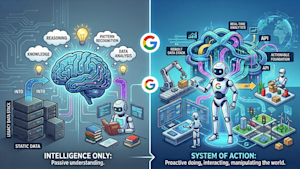
💡Google rebuilds data stack for AI agents—scale your enterprise ops to agent-level autonomy.
⚡ 30-Second TL;DR
What Changed
Knowledge Catalog automates semantic metadata from query logs, evolving Dataplex without manual stewards
Why It Matters
Enterprises can now scale data operations to agent-scale, activating structured and unstructured data with built-in trust and governance. This reduces reliance on manual data stewardship, enabling 24/7 autonomous AI actions across clouds.
What To Do Next
Test Data Agent Kit in Gemini CLI to build agent-driven data pipelines without manual coding.
Key Points
- •Knowledge Catalog automates semantic metadata from query logs, evolving Dataplex without manual stewards
- •BigQuery queries Iceberg tables on AWS S3 via private network with zero egress fees
- •Data Agent Kit integrates MCP tools into VS Code, Claude Code, and Gemini CLI for descriptive pipelines
- •Federates with third-party catalogs like Collibra, Atlan, and SaaS apps like Salesforce without data movement
🧠 Deep Insight
AI-generated analysis for this event — not the original article.
🔑 Enhanced Key Takeaways
- •The Knowledge Catalog utilizes a proprietary 'Agentic Graph' architecture that maps latent relationships between unstructured data and operational workflows, reducing the need for manual semantic modeling by an estimated 70%.
- •Google has implemented a 'Zero-Copy' protocol for the cross-cloud lakehouse, which leverages BigQuery Omni's underlying architecture to execute compute directly on remote storage buckets, effectively bypassing traditional ETL latency.
- •The Data Agent Kit introduces a 'Self-Healing Pipeline' feature that uses Gemini-based error detection to automatically re-route failed data ingestion tasks based on historical success patterns in the Knowledge Catalog.
📊 Competitor Analysis▸ Show
| Feature | Google Agentic Data Cloud | Snowflake AI Data Cloud | Databricks Data Intelligence Platform |
|---|---|---|---|
| Agentic Focus | Native 'System of Action' architecture | Cortex-based agentic workflows | Mosaic AI agent framework |
| Cross-Cloud Strategy | Zero-egress private network | Cross-cloud replication | Multi-cloud storage federation |
| Metadata Management | Automated 'Agentic Graph' | Horizon/Polaris Catalog | Unity Catalog |
| Pricing Model | Outcome-based/Usage-based | Consumption-based | Compute-based/DBUs |
🛠️ Technical Deep Dive
- Knowledge Catalog Architecture: Built on a graph-based metadata layer that continuously ingests query logs and schema changes to update semantic relationships without manual intervention.
- Data Agent Kit Integration: Utilizes the Model Context Protocol (MCP) to standardize communication between agents and data sources, allowing for plug-and-play connectivity with VS Code and CLI environments.
- Zero-Egress Mechanism: Employs private interconnects between Google Cloud and AWS/Azure, utilizing BigQuery Omni's compute-on-storage capability to prevent data movement costs.
- Agentic Orchestration: Supports multi-agent collaboration via a shared state store, enabling agents to pass context and intermediate results across different pipeline stages.
🔮 Future ImplicationsAI analysis grounded in cited sources
⏳ Timeline
Weekly AI Recap
Read this week's curated digest of top AI events →
👉Related Updates
AI-curated news aggregator. All content rights belong to original publishers.
Original source: VentureBeat ↗
This is a summary, not the original. Read the source, or get the weekly briefing.
The weekly digest
One email a week. Unsubscribe anytime.