Google introduces Magic Pointer for AI-driven desktop interaction
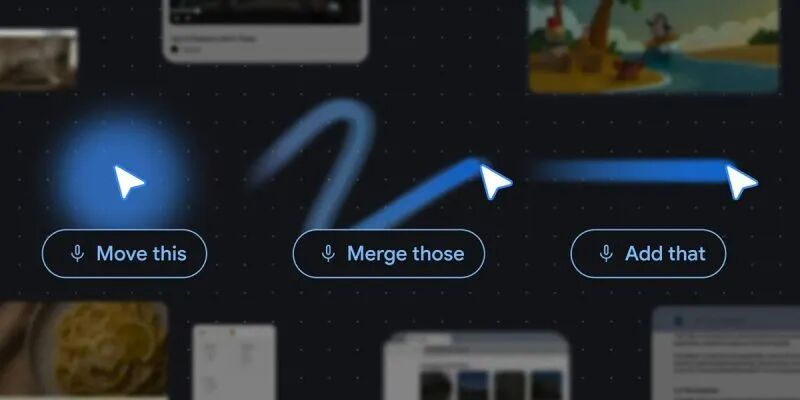
💡Google's new AI cursor could kill traditional prompt engineering by making UI interaction as simple as pointing.
⚡ 30-Second TL;DR
What Changed
Magic Pointer allows AI to 'see' and interact with specific screen elements via natural language.
Why It Matters
This shift towards 'intent-based' UI could fundamentally change how desktop OSs are designed, moving away from static menus toward dynamic, AI-assisted interaction layers.
What To Do Next
Explore the Gemini API's multimodal capabilities to prototype similar 'visual-to-action' workflows for your own applications.
Key Points
- •Magic Pointer allows AI to 'see' and interact with specific screen elements via natural language.
- •Designed to maintain user 'flow' by reducing the need for context switching between apps.
- •Integrated into Chrome and the new Googlebook operating system.
- •Supports cross-device interaction between Android and Googlebook.
🧠 Deep Insight
Web-grounded analysis with 19 cited sources.
🔑 Enhanced Key Takeaways
- •Magic Pointer, developed by Google DeepMind and powered by Gemini, aims to eliminate the 'AI detour' by allowing users to interact with on-screen elements using natural shorthand commands like 'fix this' or 'move that here,' without needing to switch applications or write complex prompts.
- •The technology transforms ordinary pixels into 'actionable entities' such as dates, places, or objects, enabling direct AI interaction; for example, pointing at a PDF to request a summary, hovering over a table for a chart, or selecting a recipe to double ingredients.
- •An early version of the AI-enabled pointer experience is currently available in Google AI Studio for interactive demos (e.g., image editing and map search) and is rolling out in Chrome for web page interactions, such as comparing products.
- •The Googlebook operating system, which will deeply integrate Magic Pointer, is internally referred to as 'Aluminium OS,' a merged version of Android 17 and ChromeOS, designed from the ground up for AI-agent interaction with native multitasking and a custom window manager.
- •Google is positioning Magic Pointer as a fundamental shift in human-computer interaction, contrasting it with competitors like Apple's app-embedded intelligence and Microsoft's Copilot sidebar by integrating AI directly into the pointing device itself.
🛠️ Technical Deep Dive
- Magic Pointer is powered by Google's Gemini AI model and developed by Google DeepMind.
- It addresses the technical gap where traditional Large Language Model (LLM) interfaces are primarily text-in, text-out, lacking real-time awareness of the screen state.
- The system captures real-time visual and semantic context from the cursor's position and hover state, allowing the AI to 'see' and understand what the user is pointing at and its relevance.
- It transforms on-screen pixels into structured, actionable entities like dates, places, or objects, enabling natural language commands to directly manipulate these elements.
- The underlying interaction principles include maintaining user flow, enabling 'show and tell' interactions, and leveraging 'deictic language' (words like 'this' and 'that') for intuitive communication.
- Googlebook devices, which will feature Magic Pointer, will run on 'Aluminium OS,' a re-engineered Android 17 with a custom window manager and native multitasking, and are expected to feature Intel, Qualcomm, and MediaTek chips.
🔮 Future ImplicationsAI analysis grounded in cited sources
⏳ Timeline
📎 Sources (19)
Factual claims are grounded in the sources below. Forward-looking analysis is AI-generated interpretation.
- Google Search Source
- Google Search Source
- Google Search Source
- Google Search Source
- Google Search Source
- Google Search Source
- Google Search Source
- Google Search Source
- Google Search Source
- Google Search Source
- Google Search Source
- Google Search Source
- Google Search Source
- Google Search Source
- Google Search Source
- Google Search Source
- Google Search Source
- Google Search Source
- Google Search Source
Weekly AI Recap
Read this week's curated digest of top AI events →
👉Related Updates
AI-curated news aggregator. All content rights belong to original publishers.
Original source: 虎嗅 ↗