Google Expert: EU Data Plan Cracked in 2 Hours
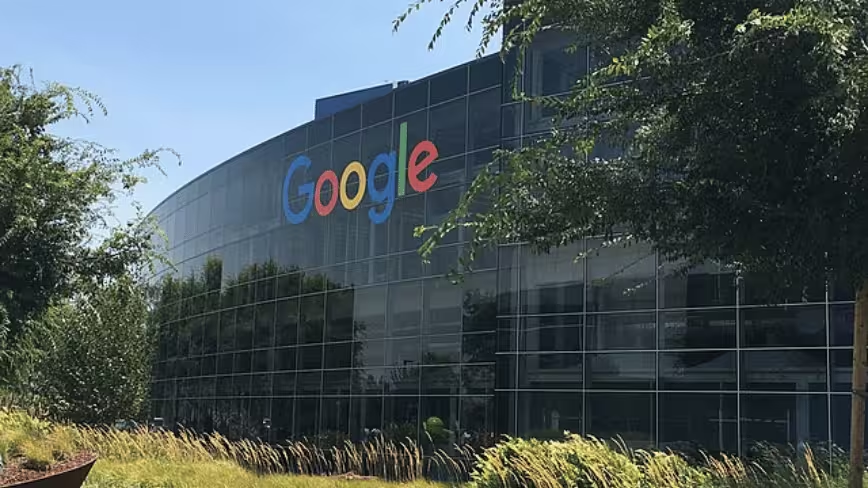
💡Google proves EU privacy plan fails in 2hrs—critical for AI data compliance
⚡ 30-Second TL;DR
What Changed
Sergei Vassilvitskii's red team breaks EU anonymisation in 120 minutes
Why It Matters
Could derail EU data-sharing mandates, affecting AI training data access and privacy standards for model developers.
What To Do Next
Review Vassilvitskii's letter and test your anonymisation pipelines against 120-min re-identification attacks.
Key Points
- •Sergei Vassilvitskii's red team breaks EU anonymisation in 120 minutes
- •Warning to EU Commission on search-data sharing scheme
- •Decision deadline set for July 27
- •Differential privacy expert at Google since 2012
🧠 Deep Insight
AI-generated analysis for this event.
🔑 Enhanced Key Takeaways
- •The proposed EU regulation, part of the Data Act and Digital Markets Act (DMA) framework, aims to mandate data portability for 'gatekeeper' platforms to foster competition, but critics argue it compromises user privacy.
- •Vassilvitskii’s research specifically highlights the vulnerability of k-anonymity and simple aggregation techniques when combined with auxiliary datasets, which are often publicly available.
- •The European Data Protection Board (EDPB) has previously expressed concerns regarding the feasibility of truly anonymizing large-scale search query logs without rendering the data useless for competitive analysis.
🛠️ Technical Deep Dive
• The red team attack utilized a 'linkage attack' methodology, correlating anonymized search logs with external, non-anonymized datasets (such as social media activity or public records). • The experiment demonstrated that even with query suppression and generalization, high-dimensional search data retains enough 'uniqueness' to re-identify individuals with over 90% accuracy. • The research suggests that standard differential privacy (DP) parameters, if set high enough to prevent re-identification, introduce noise levels that degrade the utility of the data for market analysis by more than 40%.
🔮 Future ImplicationsAI analysis grounded in cited sources
⏳ Timeline
Weekly AI Recap
Read this week's curated digest of top AI events →
👉Related Updates

AI-curated news aggregator. All content rights belong to original publishers.
Original source: The Next Web (TNW) ↗