Gold price logic shifts back to Fed control
💡Understand why capital is rotating from gold to AI chips and how Fed policy impacts your tech investment strategy.
⚡ 30-Second TL;DR
What Changed
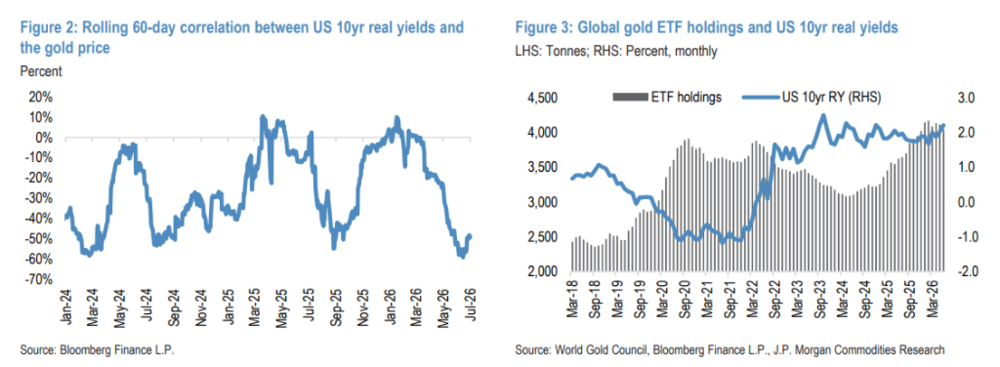
Gold price correlation with US real interest rates has returned, making it sensitive to Fed policy.
Why It Matters
The shift of capital from gold to AI-related assets suggests a broader market rotation where investors prioritize high-growth tech sectors over traditional safe-haven hedges.
What To Do Next
Monitor the correlation between 10-year Treasury yields and AI sector stock performance to gauge shifts in risk appetite.
Key Points
- •Gold price correlation with US real interest rates has returned, making it sensitive to Fed policy.
- •JPMorgan lowered Q3 and Q4 gold price forecasts by 20-25% due to cooling demand.
- •Investors are shifting capital toward AI chip sectors, reducing gold's appeal as a 'devaluation trade'.
- •Long-term bullish outlook remains for 2027, driven by structural central bank accumulation.
🧠 Deep Insight
AI-generated analysis for this event — not the original article.
🔑 Enhanced Key Takeaways
- •JPMorgan's analysis highlights a specific divergence where gold's traditional role as a geopolitical hedge is being temporarily eclipsed by high-yield opportunities in the AI-driven equity market.
- •The shift in ETF flows is attributed to a 'risk-on' sentiment among institutional investors who are reallocating capital from non-yielding assets like gold into high-growth technology sectors.
- •Market data indicates that real interest rates have reached a threshold where the opportunity cost of holding gold outweighs the benefits of its safe-haven status, prompting the downward revision in price targets.
- •Central bank buying, while still structurally positive, has transitioned from an aggressive accumulation phase to a more tactical, opportunistic buying pattern in response to price volatility.
- •The Federal Reserve's 'higher for longer' interest rate stance is creating a liquidity drain that disproportionately affects gold compared to other commodities, as investors prioritize USD-denominated yield.
🔮 Future ImplicationsAI analysis grounded in cited sources
⏳ Timeline
Weekly AI Recap
Read this week's curated digest of top AI events →
👉Related Updates


AI-curated news aggregator. All content rights belong to original publishers.
Original source: 虎嗅 ↗
This is a summary, not the original. Read the source, or get the weekly briefing.
Weekly AI briefing
One email a week. Unsubscribe anytime.