GMO Builds Sprinting Humanoid from Athlete Mocap
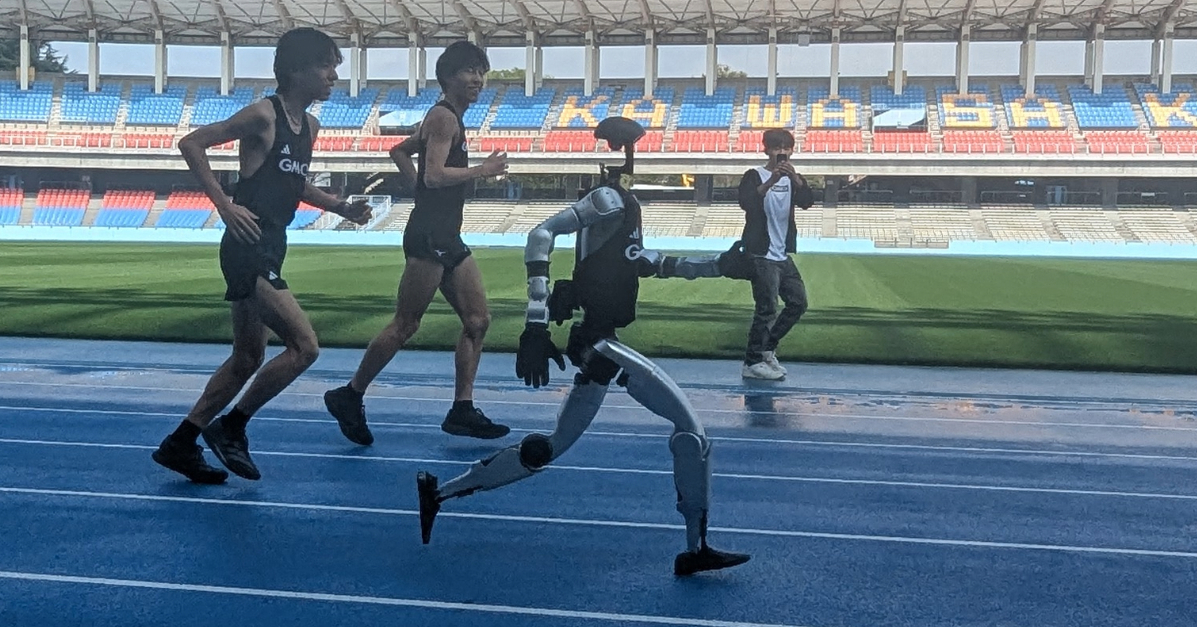
Humanoids sprinting via real athlete mocap: leap in robot athletics R&D
30-Second TL;DR
What Changed
GMO AIR challenges humanoid robots to mimic land track athletes' running
Why It Matters
Pushes boundaries in humanoid locomotion, blending sports science with robotics for real-world agility. Could spur competitions accelerating embodied AI training datasets and benchmarks.
What To Do Next
Download public mocap datasets like GMO's to fine-tune humanoid gait models.
Key Points
- •GMO AIR challenges humanoid robots to mimic land track athletes' running
- •Motion capture from GMO's own track and field department runners
- •Aims to enable robots for 'Robot World Athletics' events
- •Part of GMO Internet Group's robotics business expansion
Deep Insight
AI-generated analysis for this event — not the original article.
Enhanced Key Takeaways
- •The project leverages GMO Internet Group's existing 'GMO Athletes' professional track and field team, utilizing high-fidelity biomechanical data captured from elite sprinters to train the humanoid's gait and balance controllers.
- •The initiative is part of a broader strategic pivot by GMO Internet Group to integrate AI-driven robotics into their 'Internet Infrastructure' and 'Online Advertising' business segments, aiming to create new revenue streams in physical automation.
- •The development focuses on overcoming the 'actuator density' challenge, requiring custom high-torque, high-speed motor designs that can withstand the extreme impact forces generated during bipedal sprinting, which differ significantly from standard walking-gait humanoid designs.
Competitor Analysis
- GMO AIR Humanoid
- High-speed sprinting/Athletics
- Boston Dynamics (Atlas)
- General purpose/Industrial
- Figure AI (Figure 02)
- General purpose/Human-robot interaction
- GMO AIR Humanoid
- Pro-athlete Mocap
- Boston Dynamics (Atlas)
- Physics-based simulation/RL
- Figure AI (Figure 02)
- Large-scale imitation learning
- GMO AIR Humanoid
- Sprint speed/Gait fidelity
- Boston Dynamics (Atlas)
- Manipulation/Dynamic mobility
- Figure AI (Figure 02)
- Task completion/Autonomy
| Feature | GMO AIR Humanoid | Boston Dynamics (Atlas) | Figure AI (Figure 02) |
|---|---|---|---|
| Primary Focus | High-speed sprinting/Athletics | General purpose/Industrial | General purpose/Human-robot interaction |
| Data Source | Pro-athlete Mocap | Physics-based simulation/RL | Large-scale imitation learning |
| Benchmark | Sprint speed/Gait fidelity | Manipulation/Dynamic mobility | Task completion/Autonomy |
Technical Deep Dive
- •Architecture: Employs a hierarchical control system where a high-level policy (trained via Reinforcement Learning) maps Mocap data to low-level joint torque commands.
- •Actuation: Utilizes proprietary high-bandwidth, quasi-direct drive actuators designed to minimize impedance and maximize power-to-weight ratios for explosive movement.
- •Sensor Fusion: Integrates high-frequency IMU data with visual-inertial odometry to maintain balance during high-velocity transitions and rapid directional changes.
- •Simulation: Uses a custom physics engine environment that mimics the specific friction coefficients and surface elasticity of professional track materials (e.g., synthetic rubber tracks).
Future ImplicationsAI analysis grounded in cited sources
Timeline
- 2016-04GMO Internet Group establishes the 'GMO Athletes' professional track and field team.
- 2024-09GMO Internet Group announces the formal establishment of its robotics business division.
- 2026-03GMO AIR completes initial successful high-speed bipedal running tests using athlete motion capture data.
Weekly AI Recap
Read this week's curated digest of top AI events →
Related Updates
AI-curated news aggregator. All content rights belong to original publishers.
Original source: ITmedia AI+ (日本) ↗
This is a summary, not the original. Read the source, or get the weekly briefing.
The weekly digest
One email a week. Unsubscribe anytime.