GM installs robots at flagship EV factory after layoffs
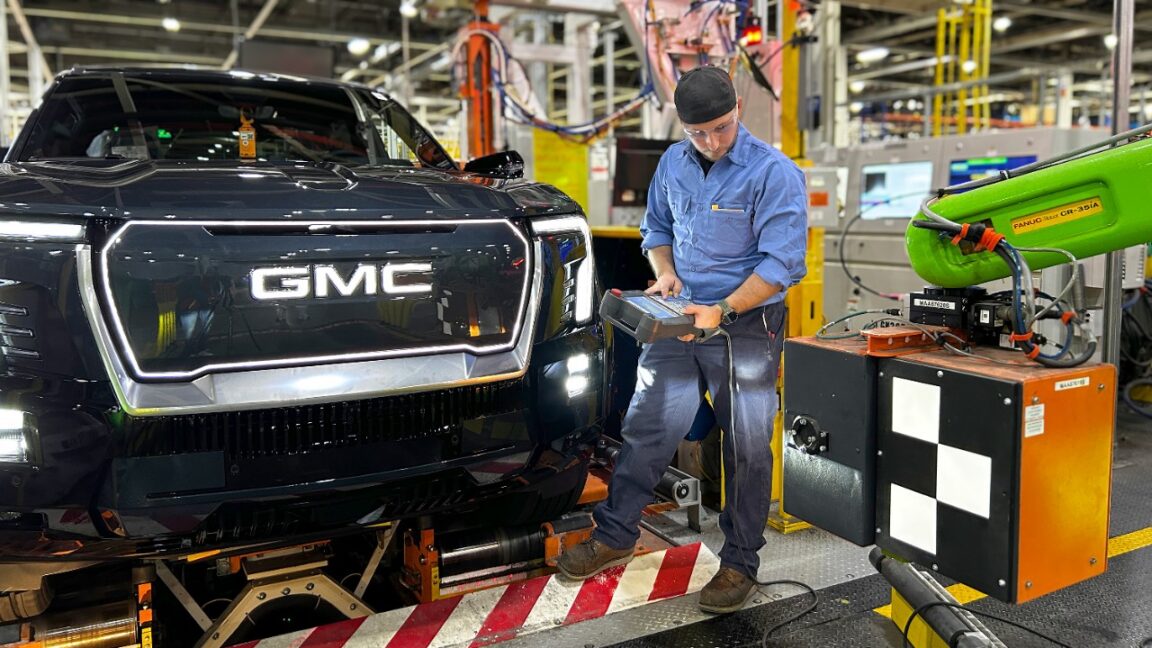
A critical look at how embodied AI and robotics are displacing human labor in major industrial manufacturing sectors.
30-Second TL;DR
What Changed
GM replaced 1,300 human roles with robotic automation at its flagship EV facility.
Why It Matters
This transition accelerates the shift toward 'dark factories' where AI-driven robotics operate without human intervention. It serves as a case study for AI practitioners on the socio-economic friction caused by embodied AI in traditional labor sectors.
What To Do Next
Monitor the UAW's policy responses to automation to understand the regulatory landscape for future robotics deployment in manufacturing.
Key Points
- •GM replaced 1,300 human roles with robotic automation at its flagship EV facility.
- •The US autoworkers union is raising alarms regarding the 'dark factory' trend.
- •This shift signals a broader industry move toward fully autonomous manufacturing environments.
Deep Insight
AI-generated analysis for this event — not the original article.
Enhanced Key Takeaways
- •The layoffs primarily impacted the Orion Assembly plant in Michigan, which has been undergoing a multi-year conversion process to support Ultium-based EV production.
- •GM's investment in robotics is part of a broader $7 billion capital expenditure plan aimed at reducing per-vehicle manufacturing costs by 20% by 2027.
- •The UAW (United Auto Workers) has specifically cited this automation shift as a violation of the spirit of the 2023 contract negotiations, which included provisions for job security during the EV transition.
- •The new robotic systems utilize AI-driven predictive maintenance and computer vision to manage quality control, reducing the need for manual inspection stations.
- •Industry analysts note that GM is leveraging 'digital twin' technology to simulate and optimize these robotic workflows before physical implementation to minimize downtime.
Competitor Analysis
- GM (Orion Assembly)
- Retrofitted legacy plant
- Tesla (Giga Texas)
- Greenfield 'Unboxed' process
- Ford (BlueOval City)
- Hybrid modular assembly
- GM (Orion Assembly)
- Ultium Platform scaling
- Tesla (Giga Texas)
- High-volume Model Y/Cybertruck
- Ford (BlueOval City)
- F-Series EV integration
- GM (Orion Assembly)
- High union friction
- Tesla (Giga Texas)
- Non-unionized workforce
- Ford (BlueOval City)
- Mixed union/non-union
- GM (Orion Assembly)
- High (Post-retrofit)
- Tesla (Giga Texas)
- Very High (Native)
- Ford (BlueOval City)
- Moderate (Phased)
| Feature | GM (Orion Assembly) | Tesla (Giga Texas) | Ford (BlueOval City) |
|---|---|---|---|
| Automation Strategy | Retrofitted legacy plant | Greenfield 'Unboxed' process | Hybrid modular assembly |
| Primary Focus | Ultium Platform scaling | High-volume Model Y/Cybertruck | F-Series EV integration |
| Labor Relations | High union friction | Non-unionized workforce | Mixed union/non-union |
| Robotics Integration | High (Post-retrofit) | Very High (Native) | Moderate (Phased) |
Technical Deep Dive
- Implementation of Fanuc and KUKA industrial robotic arms for high-precision battery module assembly.
- Integration of proprietary AI-based vision systems for real-time weld inspection and chassis alignment.
- Deployment of Automated Guided Vehicles (AGVs) for material handling, replacing traditional conveyor belt systems.
- Utilization of Digital Twin software (likely Siemens or NVIDIA Omniverse) to synchronize robotic movements with supply chain logistics.
- Adoption of modular assembly cells that allow for rapid reconfiguration of production lines without full factory shutdowns.
Future ImplicationsAI analysis grounded in cited sources
Timeline
- 2022-01GM announces $7 billion investment in Michigan EV manufacturing facilities.
- 2023-10UAW reaches a new labor agreement with GM following a targeted strike.
- 2024-12GM delays production targets at Orion Assembly due to supply chain and scaling challenges.
- 2026-05GM confirms workforce reduction of 1,300 employees at the Orion facility.
Weekly AI Recap
Read this week's curated digest of top AI events →
Related Updates

AI-curated news aggregator. All content rights belong to original publishers.
Original source: Ars Technica AI ↗
This is a summary, not the original. Read the source, or get the weekly briefing.
The weekly digest
One email a week. Unsubscribe anytime.