GluFormer Predicts Diabetes 11 Years Ahead
💡First CGM foundation model beats HbA1c for 11yr diabetes prediction—time-series AI breakthrough
⚡ 30-Second TL;DR
What Changed
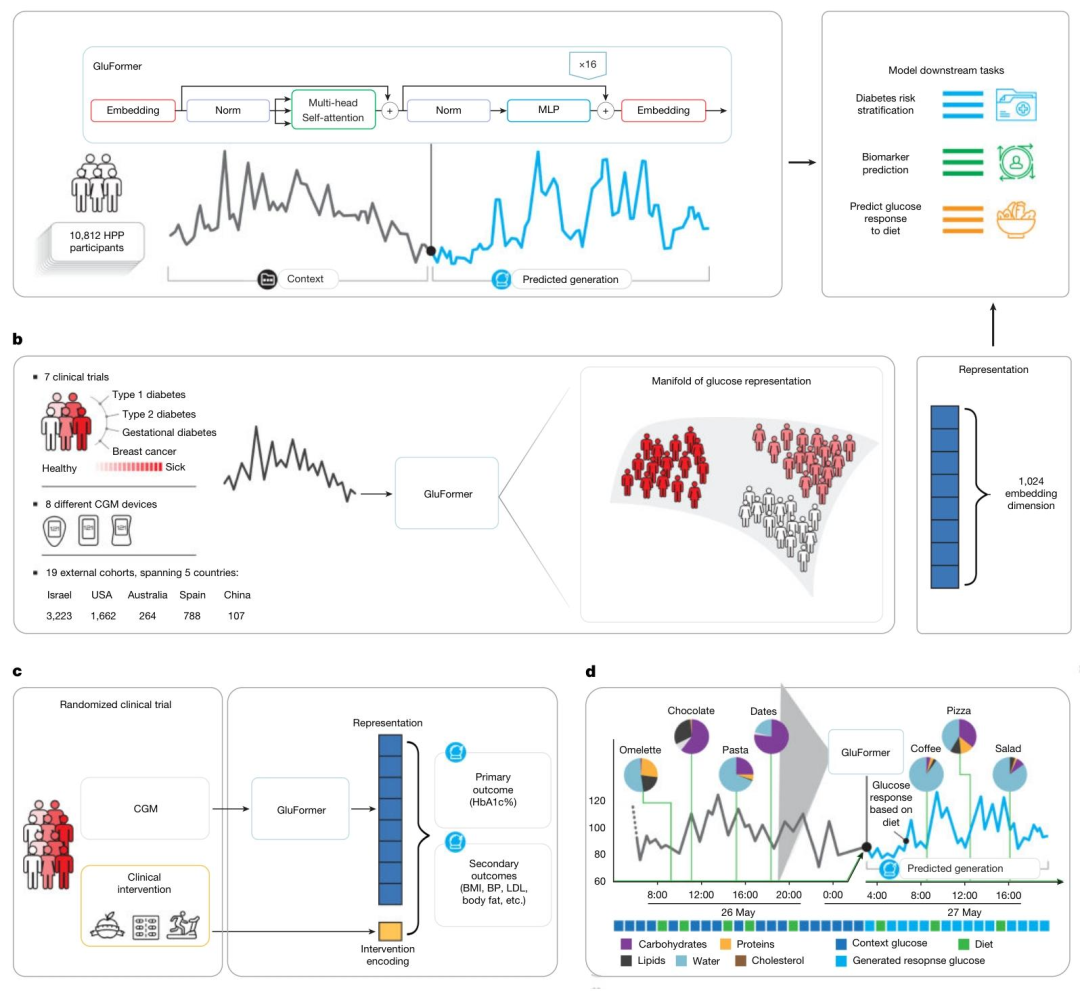
Self-supervised training: predicts next glucose token from history on tokenized 40-500mg/dl data.
Why It Matters
Shifts diabetes management from reactive snapshots to proactive dynamic predictions, unlocking 90% wasted CGM data value. Accelerates personalized medicine and clinical trials via pre-intervention efficacy forecasting.
What To Do Next
Implement GluFormer's tokenization and next-token prediction on your CGM/time-series dataset via PyTorch.
Key Points
- •Self-supervised training: predicts next glucose token from history on tokenized 40-500mg/dl data.
- •1024-dim metabolic embedding captures dynamics, enables risk stratification outperforming HbA1c.
- •Validated across 5 countries, 8 CGM devices, diverse groups with 0.8+ correlation.
- •Multi-modal version integrates diet for post-meal glucose fluctuation prediction.
🧠 Deep Insight
Background and context from public sources — not the original article. 5 sources cited.
🔑 Enhanced Key Takeaways
- •GluFormer was co-led by researchers at Mohamed bin Zayed University of Artificial Intelligence (MBZUAI) and leverages data from the Human Phenotype Project (HPP).[1]
- •Evaluated across 19 external cohorts (n=6,044) spanning diverse populations, GluFormer improved predictions for fasting glucose, visceral fat, liver attenuation, kidney markers, and lipid levels over baseline CGM metrics.[1][2]
- •In prediabetes cases, GluFormer stratified individuals likely to see significant HbA1c increases over 2 years, surpassing baseline HbA1c and common CGM metrics.[2][3]
🛠️ Technical Deep Dive
- •Autoregressive prediction via self-supervised learning on tokenized glucose measurements (mainly from 10,812 non-diabetic adults).[2]
- •1024-dimensional metabolic embeddings derived from Transformer architecture for risk stratification and outcome forecasting up to 12 years.[1][2]
- •Open-source implementation available on GitHub, including benchmarks showing higher ROC AUC for diabetes prediction versus clinical metrics.[5]
🔮 Future ImplicationsAI analysis grounded in cited sources
⏳ Timeline
📎 Sources (5)
Factual claims are grounded in the sources below. Forward-looking analysis is AI-generated interpretation.
Weekly AI Recap
Read this week's curated digest of top AI events →
👉Related Updates
AI-curated news aggregator. All content rights belong to original publishers.
Original source: 虎嗅 ↗
This is a summary, not the original. Read the source, or get the weekly briefing.
Weekly AI briefing
One email a week. Unsubscribe anytime.