GitLab Turns AWS Into a GitOps Control Plane
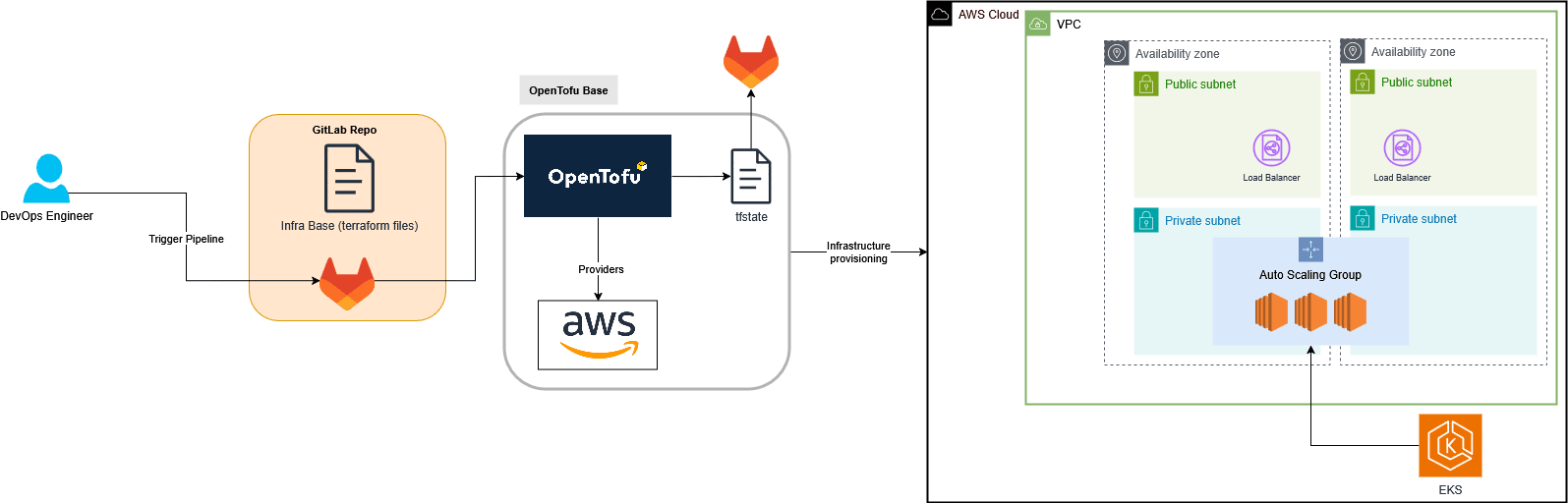
💡See how GitLab, OpenTofu, and Argo CD automate AWS-to-Kubernetes delivery.
⚡ 30-Second TL;DR
What Changed
OpenTofu provisions the AWS network and EKS environment through GitLab CI/CD pipelines.
Why It Matters
The approach can reduce manual configuration drift and improve reproducibility for teams operating Kubernetes-based AI services or other cloud workloads. It also establishes Git-based approvals and rollback workflows without requiring developers to access clusters directly.
What To Do Next
Prototype the workflow by deploying a non-production EKS cluster with OpenTofu, then configure Argo CD to reconcile one application manifest from a GitLab repository.
Key Points
- •OpenTofu provisions the AWS network and EKS environment through GitLab CI/CD pipelines.
- •Argo CD continuously reconciles Kubernetes application state from Git repositories.
- •The tutorial automates installation of Kubernetes tools including Argo CD and CertManager.
- •GitLab provides source control, CI/CD, Terraform state storage, and a container registry in one workflow.
🧠 Deep Insight
AI-generated analysis for this event.
🔑 Enhanced Key Takeaways
- •The integration leverages the OpenTofu provider for GitLab, which simplifies state management by using GitLab's built-in HTTP backend instead of requiring external S3 buckets.
- •This workflow utilizes the GitLab Agent for Kubernetes (KAS) to establish a secure, pull-based connection between the GitLab instance and the EKS cluster, eliminating the need for long-lived static credentials.
- •The architecture promotes a 'GitOps-native' approach by separating the infrastructure provisioning layer (OpenTofu) from the application deployment layer (Argo CD) while maintaining a single source of truth in Git.
- •GitLab's CI/CD components now include pre-built templates for OpenTofu that automatically handle plan, apply, and destroy operations, reducing the boilerplate code required for AWS resource management.
- •The solution addresses the 'secret sprawl' issue by utilizing GitLab CI/CD variables and OIDC (OpenID Connect) to authenticate with AWS, removing the need to store AWS_ACCESS_KEY_ID in repository settings.
📊 Competitor Analysis▸ Show
| Feature | GitLab (OpenTofu/Argo) | GitHub (Actions/Terraform) | HashiCorp (Terraform Cloud) |
|---|---|---|---|
| Primary Workflow | Integrated CI/CD + GitOps | CI/CD + External GitOps | Infrastructure-focused SaaS |
| State Management | Built-in HTTP Backend | External (S3/GCS/Azure) | Managed State Service |
| Kubernetes Connectivity | Agent for Kubernetes (Pull) | Self-hosted Runners (Push) | Terraform Cloud Agents |
| Pricing Model | Per-user subscription | Per-minute/User | Per-resource/Managed |
🛠️ Technical Deep Dive
- The GitLab Agent for Kubernetes (KAS) acts as a reverse proxy, allowing the cluster to initiate connections to GitLab, which enhances security by not requiring inbound firewall rules.
- OpenTofu state is managed via the GitLab Managed Terraform State feature, which locks the state file during operations to prevent concurrent modification conflicts.
- The integration uses OIDC tokens generated by GitLab CI/CD to assume IAM roles in AWS, ensuring temporary, short-lived credentials for infrastructure provisioning.
- Argo CD is deployed via a Helm chart managed by the GitLab CI/CD pipeline, which then points to a specific Git repository path containing the application manifests.
- The workflow supports 'Environment' tracking in GitLab, allowing users to visualize which version of the infrastructure and application is currently deployed to the EKS cluster.
🔮 Future ImplicationsAI analysis grounded in cited sources
⏳ Timeline
Weekly AI Recap
Read this week's curated digest of top AI events →
👉Related Updates
AI-curated news aggregator. All content rights belong to original publishers.
Original source: GitLab Blog ↗