GenOffice Brings AI Directly Into Editable Office Files
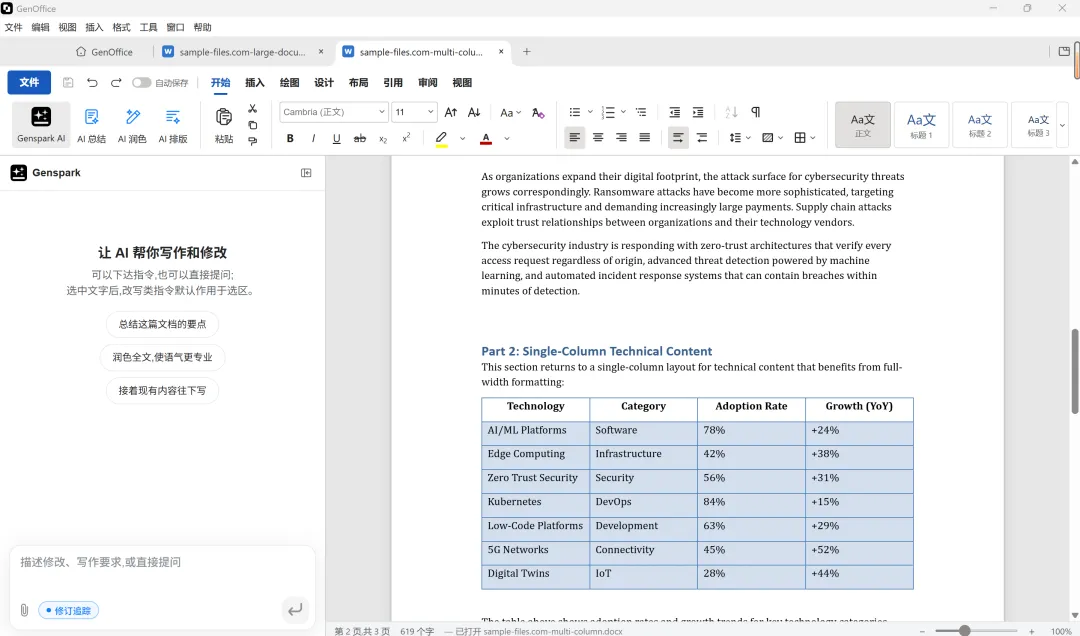
💡See whether GenOffice can turn AI output into editable Office deliverables—and where compatibility still breaks.
⚡ 30-Second TL;DR
What Changed
GenOffice can directly manipulate complex Office file formats and generate editable Word and PPT deliverables.
Why It Matters
GenOffice demonstrates a new AI-native approach to office software: models operate on structured document formats rather than merely producing plain text. If its compatibility and stability improve, it could reduce the gap between AI-generated content and production-ready office deliverables.
What To Do Next
Download the GenOffice Alpha and test it against a representative corpus of complex Word and PPT files, then compare template-constrained workflows with one-shot generation before integrating it into production.
Key Points
- •GenOffice can directly manipulate complex Office file formats and generate editable Word and PPT deliverables.
- •Its AI formatting successfully reconstructed a 20,000-character academic paper, including headings, tables, footnotes, and reference formatting.
- •The Alpha version is open-source and free, reportedly built by one engineer in one week with about $10,000 in AI token costs.
- •Word and PPT compatibility is still weak, with text reflow errors, broken tables, layout shifts, rendering freezes, and inconsistent slide styling.
- •Template-constrained, step-by-step workflows may produce better PPT results than one-shot generation.
🧠 Deep Insight
AI-generated analysis for this event.
🔑 Enhanced Key Takeaways
- •GenOffice utilizes a proprietary 'document-as-code' intermediate representation layer that translates LLM-generated JSON structures directly into OpenXML formats.
- •The project leverages a custom-built lightweight rendering engine to bypass the overhead of traditional Office automation APIs, which contributes to its reported stability issues.
- •Genspark's strategy involves open-sourcing the Alpha to crowdsource edge-case training data for complex document layout parsing, a notoriously difficult task for standard vision-language models.
- •The $10,000 token expenditure was primarily driven by high-context window usage required to maintain document-wide consistency during the reconstruction of long-form academic papers.
- •Early developer feedback indicates that GenOffice's architecture is designed to be model-agnostic, allowing users to swap between different LLM backends via API keys.
📊 Competitor Analysis▸ Show
| Feature | GenOffice (Alpha) | Microsoft 365 Copilot | Gamma AI |
|---|---|---|---|
| Core Approach | Direct File Manipulation | API/Plugin Integration | Proprietary Web Format |
| Pricing | Free (Open Source) | Subscription ($30/mo) | Freemium |
| Editing | Native Editable Files | Native Editable Files | Web-based (Export to PPT) |
| Stability | Low (Alpha) | High (Enterprise) | High (Web-native) |
🛠️ Technical Deep Dive
- Architecture: Utilizes a modular pipeline where the LLM acts as a structural architect, outputting a schema that a secondary Python-based parser converts into .docx and .pptx files.
- Rendering Engine: Implements a custom XML-to-Office-Object mapping layer that avoids heavy COM (Component Object Model) automation, aiming for cross-platform compatibility.
- Token Efficiency: Employs a hierarchical prompting strategy to break down large documents into smaller, manageable chunks to fit within standard context windows while preserving cross-reference integrity.
- Dependency Stack: Built primarily on Python with heavy reliance on lxml for XML manipulation and custom wrappers for OpenXML SDK standards.
🔮 Future ImplicationsAI analysis grounded in cited sources
⏳ Timeline
Weekly AI Recap
Read this week's curated digest of top AI events →
👉Related Updates
AI-curated news aggregator. All content rights belong to original publishers.
Original source: 极客公园 ↗