Genesis AI unveils Eno, a wheeled humanoid-alternative robot
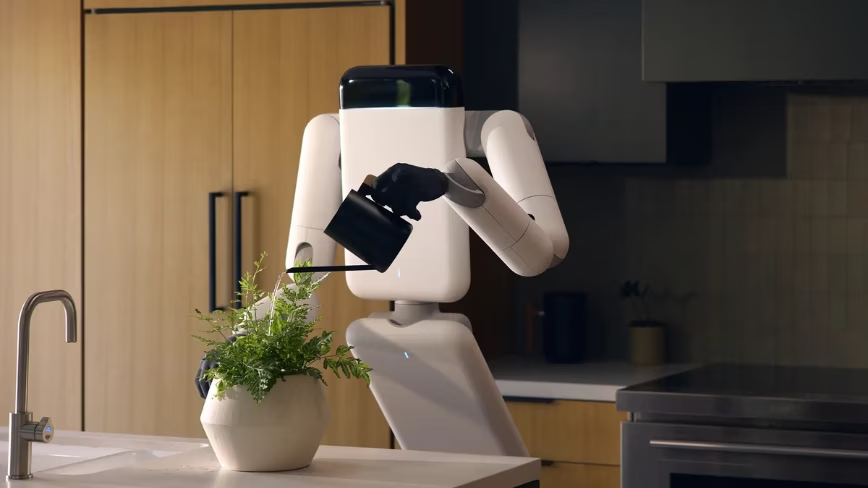
💡A direct challenge to the humanoid hype cycle—see why this startup is betting on wheels over legs.
⚡ 30-Second TL;DR
What Changed
Eno utilizes a wheeled base instead of legs to prioritize efficiency over human-like walking.
Why It Matters
This launch signals a potential shift in robotics strategy, moving away from complex bipedal locomotion toward more practical, task-oriented wheeled designs.
What To Do Next
Evaluate whether your automation use cases require bipedal mobility or if a wheeled, high-manipulation platform like Eno offers better ROI.
Key Points
- •Eno utilizes a wheeled base instead of legs to prioritize efficiency over human-like walking.
- •The robot features a foldable tower design for versatile height and reach.
- •A proprietary foundation model enables high-precision, human-level object manipulation.
🧠 Deep Insight
Background and context from public sources — not the original article. 13 sources cited.
🔑 Enhanced Key Takeaways
- •Genesis AI has secured $105 million in seed funding from prominent investors, including Eclipse, Khosla Ventures, and former Google CEO Eric Schmidt.
- •Eno is designed as a general-purpose robot with two arms and a unique three-panel body that can adjust its height and fold down for compact storage, emphasizing functionality over a fully human appearance.
- •The company is developing a comprehensive full-stack solution, encompassing its proprietary AI model (GENE), specialized training gloves for data collection, a high-fidelity simulator (Genesis World 1.0), and the robot hardware itself.
- •Genesis AI plans to initiate production and targeted customer deployments of Eno by the end of 2026, initially focusing on industrial sectors like manufacturing, logistics, and laboratories, with future expansion into service industries and homes.
- •Eno's highly dexterous hands feature 22 actuated degrees of freedom, with individually sized fingers, and are equipped with an onboard camera and tactile sensors to enable human-level precision in object manipulation.
📊 Competitor Analysis▸ Show
Competitor Analysis: Wheeled vs. Bipedal Robots
| Feature/Company | Genesis AI (Eno) | Hello Robot (Stretch 4) | Figure AI (Figure 03) | Boston Dynamics (Atlas) | Agility Robotics (Digit) | Tesla (Optimus) |
|---|---|---|---|---|---|---|
| Locomotion | Wheeled base | Wheeled base | Bipedal humanoid | Bipedal humanoid | Bipedal humanoid | Bipedal humanoid |
| Design Philosophy | Function over human form; "calm intelligence"; foldable tower | Practical, single-armed, telescoping arm; safety and accessibility | Humanoid form | Humanoid form | Humanoid form | Humanoid form |
| Manipulation | Dexterous hands (22 DoF), onboard camera, tactile sensors; GENE foundation model for human-level manipulation | Telescoping arm with pinchers | Humanoid manipulation capabilities | Advanced manipulation capabilities | Advanced manipulation capabilities | Humanoid manipulation capabilities |
| Target Market | Manufacturing, logistics, labs, service industry, homes | Researchers, enterprise, individuals (home assistance) | Distribution & logistics networks | Factories | Logistics (Amazon, GXO) | Undisclosed (general purpose) |
| Deployment Status | Targeted customer deployments by end of 2026 | First production run sold out; manufacturing 200-300 units | Deploying in Catalyst Brands warehouses | Plans for factory deployment by 2028 | Already deployed with customers | Few details shared |
| Funding/Valuation | $105 million seed funding | N/A (Stretch 4 costs $30,000) | $39 billion private valuation | N/A (Hyundai-owned) | N/A | N/A |
| Key Differentiator | Wheeled base for efficiency, full-stack development (AI, data, hardware), transparent cognitive interface | Cost-effective, easy to ship, human-in-the-loop design for home assistance | High valuation, early deployment in logistics | Robust, dynamic bipedal locomotion | Bipedal, designed for logistics | High-profile backing, long-term vision |
🛠️ Technical Deep Dive
- Foundation Model: Eno is powered by GENE (also referred to as GENE-26.5), Genesis AI's proprietary robotics-native AI foundation model, designed to enable human-level dexterous manipulation and manage complex, long-horizon tasks.
- Data Collection: Genesis AI employs a novel data collection method using wireless gloves that track individual finger movements, sense touch through the palm, and record hand movements via a small camera. These gloves are significantly cheaper than traditional teleoperation setups and collect more usable training data.
- Simulation Platform: The company utilizes Genesis World 1.0, a proprietary physics simulation engine, to generate high-fidelity synthetic training data. This platform can run simulations up to 430,000 times faster than real-time and has demonstrated a 0.8996 correlation with real-world results, compressing 200 hours of physical testing into 30 minutes.
- Robot Hardware: Eno features a wheeled base for efficient mobility, a three-panel body that can adjust height and fold for compact storage, and two arms equipped with proprietary dexterous robotic hands.
- Dexterous Hands: The robot's hands possess 22 actuated degrees of freedom, with each finger designed to mimic human finger lengths. They integrate an onboard camera and tactile sensors, allowing for both visual and haptic feedback during manipulation.
- Cognitive Interface: An optional screen version of Eno provides a cognitive interface that can display the robot's real-time thought processes and actions, aiming to build trust through transparency.
- Full-Stack Development: Genesis AI is developing the entire technology stack in-house, including the AI model, training data collection tools, simulation environment, and the robot hardware, to ensure an optimized and integrated system.
🔮 Future ImplicationsAI analysis grounded in cited sources
⏳ Timeline
📎 Sources (13)
Factual claims are grounded in the sources below. Forward-looking analysis is AI-generated interpretation.
Weekly AI Recap
Read this week's curated digest of top AI events →
👉Related Updates

AI-curated news aggregator. All content rights belong to original publishers.
Original source: The Next Web (TNW) ↗
This is a summary, not the original. Read the source, or get the weekly briefing.
Weekly AI briefing
One email a week. Unsubscribe anytime.