Generalist Robotics AI Hits Production Success
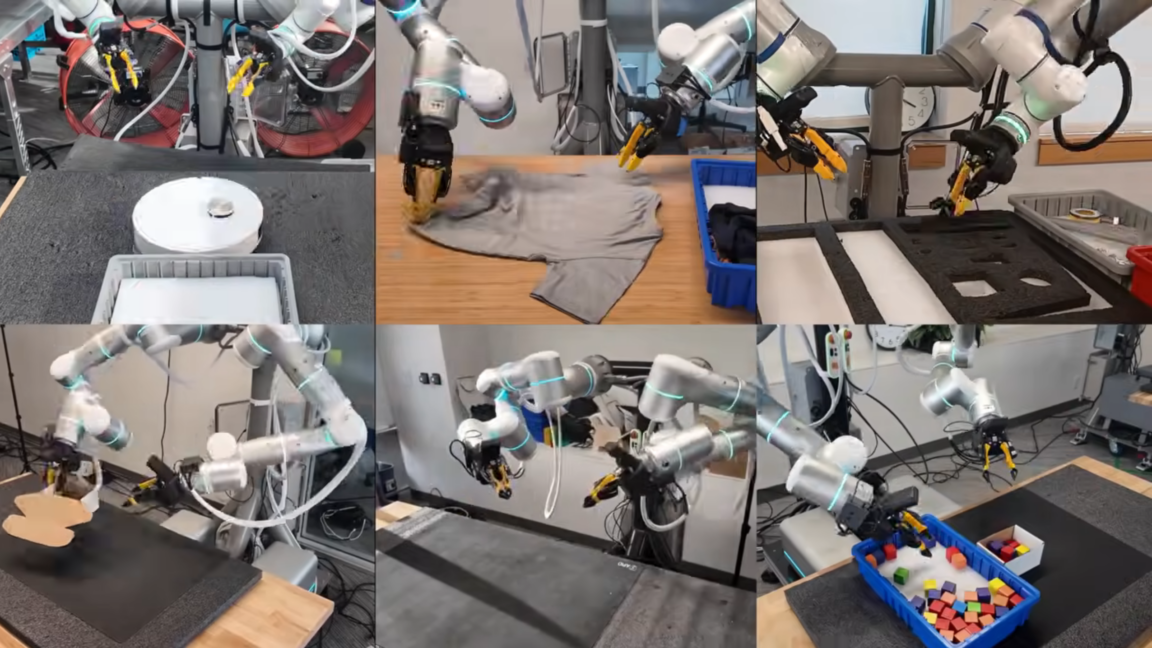
Production-ready robotics AI tackles disruptions & untrained moves – vital for embodied AI builders.
30-Second TL;DR
What Changed
Achieves 'production-level' success rates in physical tasks
Why It Matters
This model pushes embodied AI toward scalable production use, potentially accelerating adoption in manufacturing and logistics. It highlights progress in generalization, reducing reliance on exhaustive training.
What To Do Next
Test Generalist robotics AI demos on your hardware setup for disruption handling benchmarks.
Key Points
- •Achieves 'production-level' success rates in physical tasks
- •Responds effectively to unexpected disruptions
- •Improvise moves beyond training data
- •Designed for robust real-world robotics applications
Deep Insight
Background and context from public sources — not the original article. 3 sources cited.
Enhanced Key Takeaways
- •Generalist's GEN-1 model achieves a 99% average success rate on physical tasks, a significant improvement over the 64% success rate achieved by its predecessor, GEN-0.
- •The model is trained on a dataset of half a million hours of real-world data collected using proprietary 'data hands'—wearable devices that capture human manipulation of everyday objects—rather than relying on traditional teleoperation or simulation datasets.
- •GEN-1 demonstrates high data efficiency, requiring only one hour of task-specific robot data to achieve its performance benchmarks, and executes tasks approximately three times faster than prior state-of-the-art models.
Competitor Analysis
- Generalist (GEN-1)
- Proprietary 'data hands' wearables
- Physical Intelligence
- Primarily teleoperation
- Generalist (GEN-1)
- Foundation model trained on human activity data
- Physical Intelligence
- Transformer-based models on off-the-shelf hardware
- Generalist (GEN-1)
- 99% success rate (claimed)
- Physical Intelligence
- N/A (High-valuation competitor)
- Generalist (GEN-1)
- $140M raised (2025)
- Physical Intelligence
- Reportedly raising $1B (2026)
| Feature | Generalist (GEN-1) | Physical Intelligence |
|---|---|---|
| Data Collection | Proprietary 'data hands' wearables | Primarily teleoperation |
| Training Approach | Foundation model trained on human activity data | Transformer-based models on off-the-shelf hardware |
| Performance | 99% success rate (claimed) | N/A (High-valuation competitor) |
| Funding/Status | $140M raised (2025) | Reportedly raising $1B (2026) |
Technical Deep Dive
- •Model Architecture: Large multimodal model designed to emit actions in real-time.
- •Training Data: Pretrained from scratch on a dataset of 500,000 hours of real-world human activity data; no robot data used in initial pretraining.
- •Inference Optimization: Utilizes custom kernels and invented new forms of paged attention to enable real-time execution.
- •Control Systems: Hardened controls for increased precision and smoothness in physical manipulation.
- •Data Efficiency: Capable of achieving target performance with only one hour of task-specific robot data.
Future ImplicationsAI analysis grounded in cited sources
Timeline
- 2024-03Generalist AI founded and secures inception round funding.
- 2025-06Company emerges from stealth mode and releases initial research preview.
- 2025-11Release of GEN-0 model, demonstrating scaling laws in robotics.
- 2026-04Launch of GEN-1 model, achieving 99% success rates on physical tasks.
Sources (3)
Factual claims are grounded in the sources below. Forward-looking analysis is AI-generated interpretation.
Weekly AI Recap
Read this week's curated digest of top AI events →
Related Updates


AI-curated news aggregator. All content rights belong to original publishers.
Original source: Ars Technica AI ↗
This is a summary, not the original. Read the source, or get the weekly briefing.
The weekly digest
One email a week. Unsubscribe anytime.