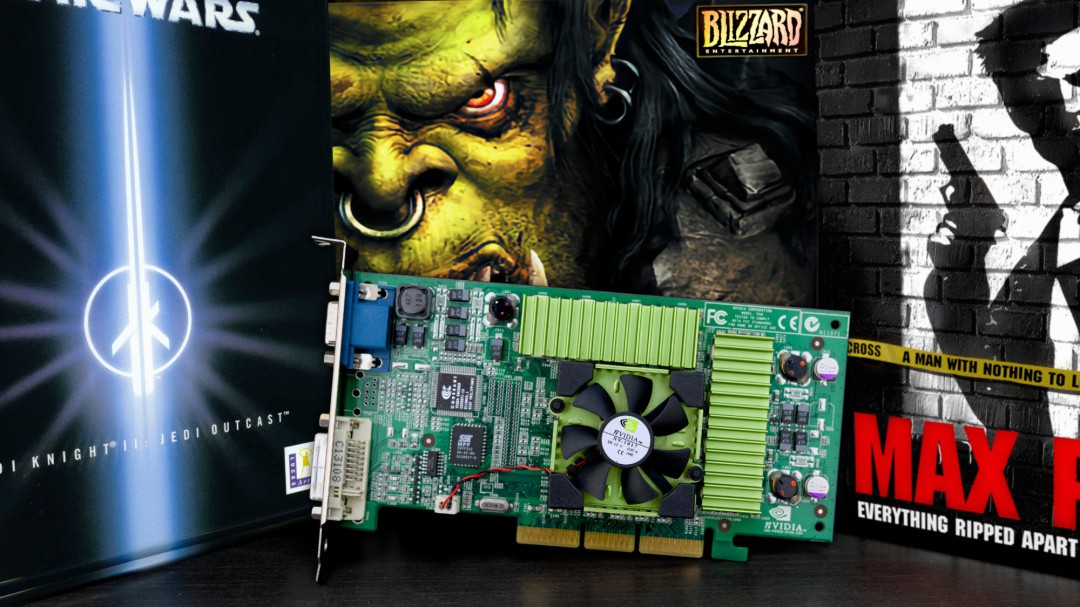
GeForce 3 Marks 25 Years of GPU Innovation
💡Shader milestone evolved into GPU compute powering AI training
⚡ 30-Second TL;DR
What Changed
GeForce 3 launched on February 27, 2001
Why It Matters
Pioneered programmable GPUs, foundational for modern compute shaders in AI and graphics workloads.
What To Do Next
Review GeForce 3 docs to trace shader evolution to modern AI compute APIs like CUDA.
Key Points
- •GeForce 3 launched on February 27, 2001
- •Industry-first support for programmable shaders
- •Sparked the golden age of PC gaming
🧠 Deep Insight
Background and context from public sources — not the original article. 8 sources cited.
🔑 Enhanced Key Takeaways
- •The GeForce3 (NV20) contained 57 million transistors built on a 150nm process, exceeding Intel's Pentium 4 CPU transistor count at launch and enabling hardware-accelerated vertex and pixel processing that freed developers from CPU-bound geometry calculations[3][4].
- •GeForce3 introduced Quincunx anti-aliasing technology, which achieved high-quality anti-aliasing by sampling five pixels with only two samples—delivering visual quality comparable to 4x oversampling at twice the performance[3].
- •The architecture supported higher-order surface evaluation (Bézier, B-spline, Catmull-Rom splines) with water-tight tessellation and continuous level-of-detail rendering, enabling real-time patch-based surface rendering without visual popping artifacts[1][3].
- •GeForce3 maintained backward compatibility with DirectX 7.0 through retained fixed-function T&L hardware alongside the new programmable vertex shader, allowing legacy applications to run without performance degradation[2].
📊 Competitor Analysis▸ Show
| Feature | GeForce3 | GeForce2 Ultra | Gloria III | Synergy III |
|---|---|---|---|---|
| Programmable Shaders | Yes (VS 1.1, PS 1.1) | No | No | No |
| Transistor Count | 57M | N/A | N/A | N/A |
| Memory | 64 MB DDR | N/A | N/A | N/A |
| Core Clock (MHz) | 200 | ~250 | N/A | N/A |
| 3ds Max Benchmark (fps) | 45 | N/A | 48 | 42 |
| DirectX Support | 8.0 | 7.0 | N/A | N/A |
🛠️ Technical Deep Dive
- Vertex Shader Architecture: Programmable geometry processor enabling per-vertex operations including deformations (facial animation, skinning), lighting, bump mapping, motion blur, and realistic fur rendering[3]
- Pixel Shader Pipeline: Four pixel pipelines with dual texture sampling per clock cycle; full single-precision floating-point support for per-pixel shading calculations and dependent texture reads[1][2]
- Texture Shaders: Programmable per-pixel shading with dot product operations and dependent texture addressing for effects like true reflective bump mapping[1]
- Memory Architecture: 64 MB DDR memory on 128-bit interface with 8 GB/s bandwidth; Lightspeed Memory Architecture (LMA) optimization[4][6]
- Fabrication: TSMC 150nm process; die size and thermal design requiring dual heatsinks and active cooling[3]
- API Support: DirectX 8.0, OpenGL 1.3; support for 3D textures, shadow buffers, and occlusion culling[2]
🔮 Future ImplicationsAI analysis grounded in cited sources
⏳ Timeline
📎 Sources (8)
Factual claims are grounded in the sources below. Forward-looking analysis is AI-generated interpretation.
Weekly AI Recap
Read this week's curated digest of top AI events →
👉Related Updates

AI-curated news aggregator. All content rights belong to original publishers.
Original source: cnBeta (Full RSS) ↗
This is a summary, not the original. Read the source, or get the weekly briefing.
Weekly AI briefing
One email a week. Unsubscribe anytime.