GeForce 3 Marks 25 Years as First Programmable Shader GPU
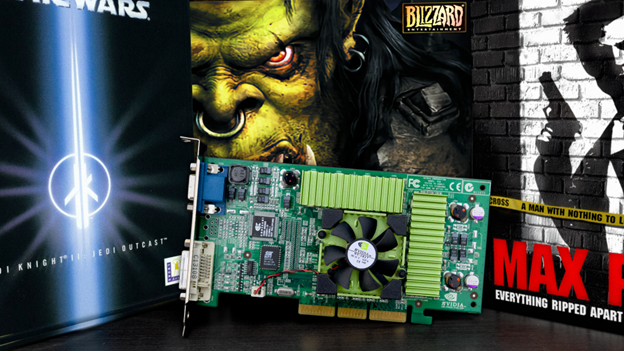
💡Shader milestone birthed GPU programmability essential for AI compute shaders today.
⚡ 30-Second TL;DR
What Changed
NVIDIA high-profile anniversary for GeForce 3
Why It Matters
Highlights GPU evolution critical for today's AI training and inference on programmable hardware. Reinforces NVIDIA's legacy in compute acceleration beyond gaming.
What To Do Next
Explore NVIDIA's early shader docs to inform custom compute shader designs for AI visualization tasks.
Key Points
- •NVIDIA high-profile anniversary for GeForce 3
- •First GPU enabling programmable shaders
- •Historic shift to programmable graphics pipelines
- •Foundational for modern games like Morrowind and Doom 3
🧠 Deep Insight
Background and context from public sources — not the original article. 6 sources cited.
🔑 Enhanced Key Takeaways
- •GeForce 3 was unveiled at Macworld Tokyo by Steve Jobs and NVIDIA's David Kirk, introducing the nFinite FX Engine to a live audience.[4]
- •Built on a 150 nm process with 57 million transistors and a 128 mm² die, it featured four pixel shaders and one vertex shader supporting DirectX 8.0 and Shader Model 1.1.[1][2][4]
- •It introduced Lightspeed Memory Architecture (LMA), a crossbar memory controller that boosted effective bandwidth, and multisample anti-aliasing (MSAA) superior to prior super-sampled methods.[2][3]
- •Launched three months after NVIDIA acquired 3dfx assets, it supported features like 3D textures, EMBM, and shadow buffers while retaining fixed-function T&L for legacy DirectX 7 compatibility.[2]
🛠️ Technical Deep Dive
- •Codename NV20, fabricated on TSMC 150 nm process with 57 million transistors and 128 mm² die size.[1][2][4]
- •Four pixel pipelines, each sampling two textures per clock, matching GeForce 2 Pro fillrate but with programmable shaders (Vertex Shader 1.1, Pixel Shader 1.1).[1][2][3]
- •64-bit DDR memory on 128-bit bus interface; core clocks varied by model (e.g., Ti 200: 175 MHz core, 400 MHz memory).[2]
- •nFinite FX Engine compliant with DirectX 8.0; included Lightspeed Memory Architecture (LMA), multisample anti-aliasing (MSAA), 3D textures, EMBM, and shadow buffers.[2]
- •Retained GeForce 2 fixed-function T&L hardware for DirectX 7 apps, as single vertex shader insufficient for full emulation.[2]
🔮 Future ImplicationsAI analysis grounded in cited sources
⏳ Timeline
📎 Sources (6)
Factual claims are grounded in the sources below. Forward-looking analysis is AI-generated interpretation.
- leavcom.com — Jpr F090825
- en.wikipedia.org — Geforce 3 Series
- Tom's Hardware — The Geforce3 Launched 25 Years Ago Underappreciated at Launch Its Impact Shaped the Industry
- jonpeddie.com — Happy Birthday Geforce 3
- abit.ee — Nvidia Geforce3 25th Anniversary Programmable Shaders GPU History Nvidia Milestone Max Payne Warcraf En
- forum.vcfed.org — Index
Weekly AI Recap
Read this week's curated digest of top AI events →
👉Related Updates


AI-curated news aggregator. All content rights belong to original publishers.
Original source: cnBeta (Full RSS) ↗
This is a summary, not the original. Read the source, or get the weekly briefing.
Weekly AI briefing
One email a week. Unsubscribe anytime.