Gartner: 90% LLM Inference Cost Drop by 2030
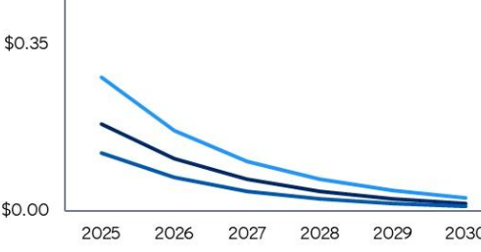
💡Gartner's forecast: 90% cheaper 1T-LLM inference by 2030—plan scaling now.
⚡ 30-Second TL;DR
What Changed
Gartner forecasts >90% inference cost reduction for 1T-param LLMs by 2030 vs 2025
Why It Matters
This could make trillion-parameter models affordable for widespread use, accelerating AI adoption across industries and reducing barriers for smaller players.
What To Do Next
Factor Gartner's 90% cost reduction into your 2030 AI inference budget projections.
Key Points
- •Gartner forecasts >90% inference cost reduction for 1T-param LLMs by 2030 vs 2025
- •Applies specifically to large language models
- •Prediction from US research firm Gartner
🧠 Deep Insight
AI-generated analysis for this event — not the original article.
🔑 Enhanced Key Takeaways
- •Gartner's projection is driven by the rapid maturation of specialized AI hardware, including custom ASICs and NPU architectures that optimize memory bandwidth for massive parameter models.
- •The forecast assumes a shift toward model quantization, pruning, and architectural innovations like Mixture-of-Experts (MoE) becoming standard, which decouple model size from active compute requirements.
- •Industry analysts note that this cost reduction is critical for the transition from experimental AI pilots to widespread enterprise-grade autonomous agents, which require high-frequency, low-latency inference.
🛠️ Technical Deep Dive
- •Inference cost reduction is primarily targeted at reducing the 'memory wall' bottleneck, where data movement between HBM (High Bandwidth Memory) and compute units consumes the majority of energy and time.
- •Techniques include 4-bit and 8-bit quantization (e.g., INT8, FP8) which significantly reduce the VRAM footprint required to load 1T-parameter models, allowing for higher throughput on existing hardware.
- •Implementation of speculative decoding is expected to play a major role, using smaller 'draft' models to predict tokens, which are then verified by the larger 1T-parameter model to accelerate inference speed.
🔮 Future ImplicationsAI analysis grounded in cited sources
⏳ Timeline
Weekly AI Recap
Read this week's curated digest of top AI events →
👉Related Updates
AI-curated news aggregator. All content rights belong to original publishers.
Original source: ITmedia AI+ (日本) ↗
This is a summary, not the original. Read the source, or get the weekly briefing.
The weekly digest
One email a week. Unsubscribe anytime.