Fudan University Achieves Room-Temperature Single-Electron Quantum Storage
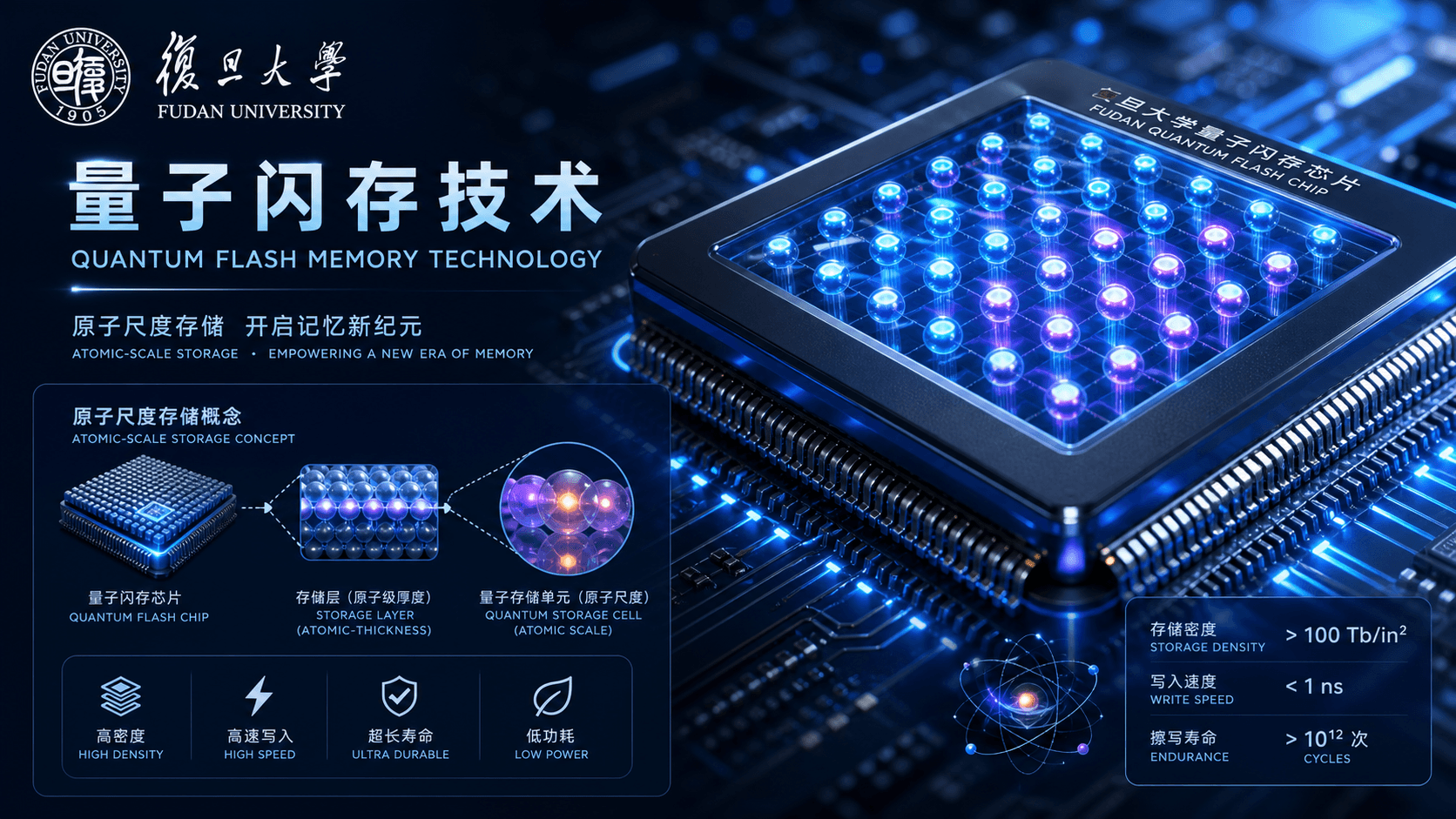
💡A major hardware breakthrough that could redefine memory density and power efficiency for next-gen AI chips.
⚡ 30-Second TL;DR
What Changed
Achieved world-first room-temperature non-volatile single-electron quantum storage.
Why It Matters
This breakthrough could fundamentally alter the hardware architecture for future AI processors by enabling ultra-low-power, high-density memory. It paves the way for more efficient edge computing and neuromorphic hardware designs.
What To Do Next
Monitor the development of neuromorphic hardware and quantum-ready memory architectures to prepare for future AI hardware shifts.
Key Points
- •Achieved world-first room-temperature non-volatile single-electron quantum storage.
- •Demonstrated a stable 0.5V operating window for quantum data retention.
- •Published in the journal Science, marking a transition from theoretical to practical quantum flash memory.
🧠 Deep Insight
AI-generated analysis for this event.
🔑 Enhanced Key Takeaways
- •The device utilizes a van der Waals heterostructure, specifically integrating molybdenum disulfide (MoS2) as the channel material to achieve high-performance electron trapping.
- •The research team overcame the 'Coulomb blockade' instability by engineering a specific dielectric interface that suppresses thermal noise at room temperature.
- •The storage mechanism relies on a charge-trap flash architecture scaled down to the single-electron level, enabling ultra-low power consumption compared to traditional NAND flash.
- •The device demonstrated an endurance exceeding 10^6 write/erase cycles, addressing a critical failure point in previous single-electron transistor (SET) prototypes.
- •The breakthrough utilizes a unique 'floating gate' design that allows for non-volatile data retention without the need for cryogenic cooling systems.
📊 Competitor Analysis▸ Show
| Feature | Fudan Single-Electron Device | Traditional NAND Flash | Cryogenic Quantum Memory |
|---|---|---|---|
| Operating Temp | Room Temperature | Room Temperature | < 4 Kelvin |
| Power Consumption | Extremely Low (Single-Electron) | Moderate | Very High (Cooling) |
| Scalability | High (Nanoscale) | Very High | Low |
| Volatility | Non-Volatile | Non-Volatile | Volatile |
🛠️ Technical Deep Dive
- Channel Material: Monolayer Molybdenum Disulfide (MoS2) providing a wide bandgap for effective electron confinement.
- Architecture: Field-effect transistor (FET) based single-electron trap utilizing a localized potential well.
- Operating Window: 0.5V gate voltage modulation for binary state switching (0/1).
- Retention Mechanism: Quantum tunneling through a thin hexagonal boron nitride (h-BN) barrier layer.
- Integration: Compatible with standard CMOS fabrication processes, facilitating potential hybrid memory integration.
🔮 Future ImplicationsAI analysis grounded in cited sources
⏳ Timeline
Weekly AI Recap
Read this week's curated digest of top AI events →
👉Related Updates
AI-curated news aggregator. All content rights belong to original publishers.
Original source: Pandaily ↗