FOMC Preview: Market Outlook and Interest Rate Analysis
💡Understand how macro-financial shifts and Fed policy impact the capital-intensive AI infrastructure landscape.
⚡ 30-Second TL;DR
What Changed
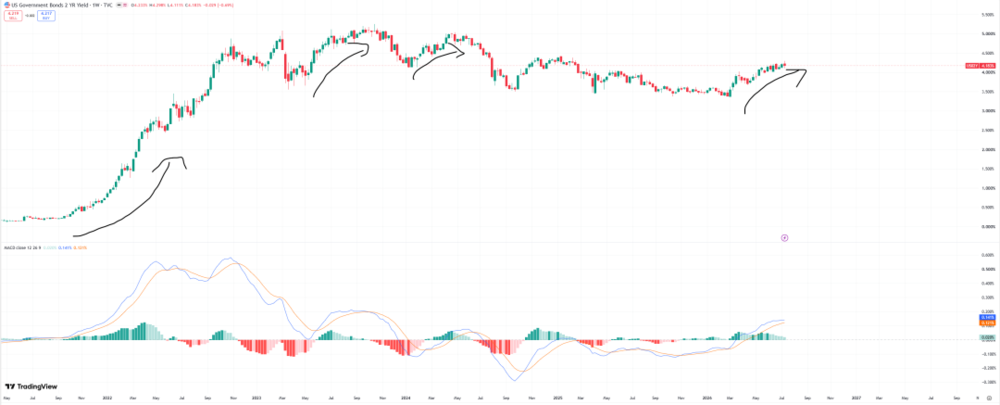
Short-term interest rates are rising with a flattening slope, suggesting policy fine-tuning rather than a full-scale hike cycle.
Why It Matters
The analysis highlights how macroeconomic policy and geopolitical instability create a volatile environment for capital-intensive AI investments. Practitioners should monitor Fed policy shifts as they directly influence the cost of capital for AI infrastructure.
What To Do Next
Monitor the upcoming FOMC meeting minutes and Fed statements for signals on interest rate trajectories to adjust your AI project's financial planning.
Key Points
- •Short-term interest rates are rising with a flattening slope, suggesting policy fine-tuning rather than a full-scale hike cycle.
- •Long-term interest rates are pressured by US fiscal deficits and geopolitical uncertainty, mirroring 1970s narratives.
- •Geopolitical risks, specifically in the Strait of Hormuz, could force a 25bp rate hike despite current market expectations.
- •Gold is currently pricing in a potential rate-hike cycle, reflecting market hedging against monetary policy shifts.
🧠 Deep Insight
AI-generated analysis for this event.
🔑 Enhanced Key Takeaways
- •The Federal Reserve's 'wait-and-see' stance is increasingly influenced by the 'neutral rate' (r*) debate, with recent FOMC minutes suggesting uncertainty over whether current policy is sufficiently restrictive to anchor inflation at 2%.
- •US Treasury issuance patterns in mid-2026 have shifted toward shorter-duration bills to manage liquidity, inadvertently complicating the Fed's quantitative tightening (QT) efforts.
- •Market volatility indices (VIX) have shown a decoupling from equity performance, indicating that investors are pricing in 'tail risk' events related to energy supply shocks rather than standard recessionary fears.
- •The correlation between gold prices and real interest rates has weakened in 2026, suggesting that central bank diversification and geopolitical hedging have become more significant drivers than traditional opportunity cost models.
- •Recent labor market data indicates a 'soft landing' paradox where wage growth remains sticky despite cooling job openings, limiting the Fed's flexibility to cut rates even if growth slows.
🔮 Future ImplicationsAI analysis grounded in cited sources
⏳ Timeline
Weekly AI Recap
Read this week's curated digest of top AI events →
👉Related Updates
AI-curated news aggregator. All content rights belong to original publishers.
Original source: 虎嗅 ↗