Flight Recorder Tackles NCCL Watchdog Timeouts
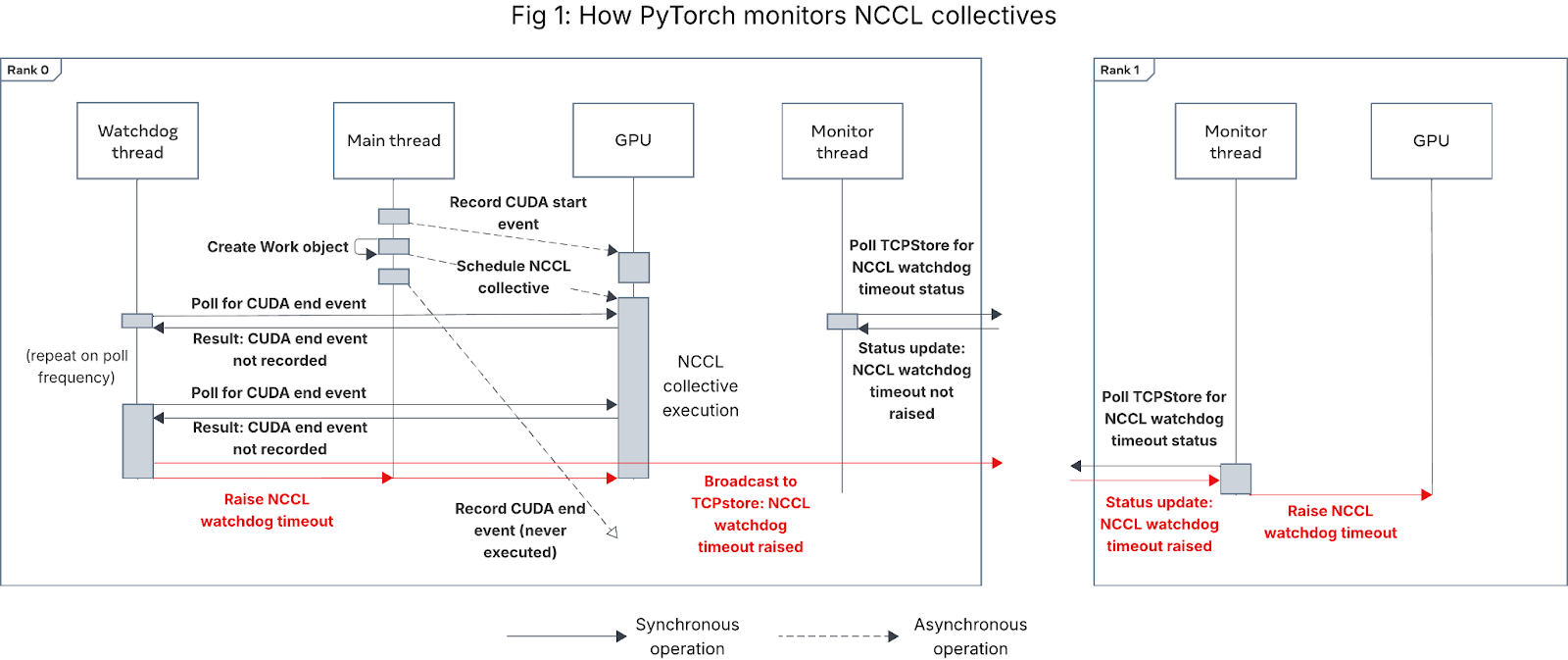
💡Debug NCCL hangs in PyTorch training 10x faster with new Flight Recorder traces
⚡ 30-Second TL;DR
What Changed
Introduces Flight Recorder for NCCL timeout analysis
Why It Matters
Saves hours of debugging time for AI teams facing mysterious NCCL hangs in scaled training. Improves reliability of PyTorch distributed jobs on clusters. Critical for practitioners training LLMs or vision models at scale.
What To Do Next
Enable Flight Recorder in PyTorch via TORCH_NCCL_FLIGHT_RECORDER env var for your next multi-node training run.
Key Points
- •Introduces Flight Recorder for NCCL timeout analysis
- •Targets errors like 'Watchdog caught collective operation timeout'
- •Records details: SeqNum, OpType (e.g., ALLREDUCE), Numel, runtime
- •Aids debugging in multi-GPU large model training
🧠 Deep Insight
AI-generated analysis for this event — not the original article.
🔑 Enhanced Key Takeaways
- •Flight Recorder operates as a circular buffer within the NCCL communication backend, capturing a rolling window of recent collective operations to minimize memory overhead during normal execution.
- •The tool specifically addresses the 'silent failure' problem in distributed training where NCCL timeouts often mask underlying network congestion, hardware faults, or deadlocks caused by mismatched collective calls across ranks.
- •Integration with PyTorch's distributed package allows for automated dumping of the trace buffer upon detection of a timeout, enabling post-mortem analysis without requiring manual reproduction of non-deterministic hangs.
🛠️ Technical Deep Dive
- •Implements a ring buffer mechanism to store metadata for the last N collective operations, where N is configurable to balance memory footprint and diagnostic depth.
- •Captures per-rank state including sequence numbers (SeqNum), operation types (AllReduce, AllGather, ReduceScatter, Broadcast), input/output tensor shapes (numel), and timestamps for latency tracking.
- •Utilizes the NCCL 'Watchdog' thread to trigger the dump, ensuring that the trace is captured at the exact moment the timeout threshold is exceeded.
- •Designed to be low-overhead, utilizing atomic operations for buffer updates to ensure minimal impact on the critical path of high-performance collective communications.
🔮 Future ImplicationsAI analysis grounded in cited sources
⏳ Timeline
Weekly AI Recap
Read this week's curated digest of top AI events →
👉Related Updates
AI-curated news aggregator. All content rights belong to original publishers.
Original source: PyTorch Blog ↗
This is a summary, not the original. Read the source, or get the weekly briefing.
The weekly digest
One email a week. Unsubscribe anytime.