🔍Google AI Blog•Freshcollected in 30m
Five New Ways to Learn with Google Search
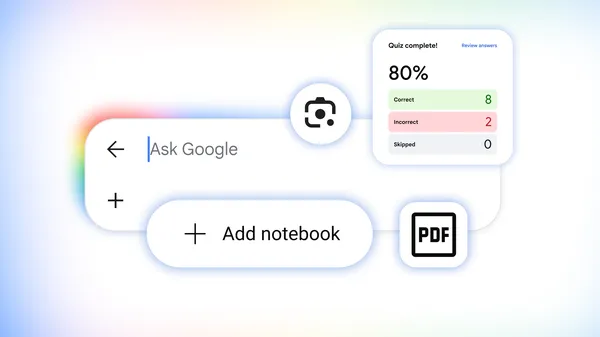
💡See how Google is shaping Search into a more practical study assistant for classes and tests.
⚡ 30-Second TL;DR
What Changed
Introduces five new approaches to using Google Search for learning.
Why It Matters
The update could make Google Search more useful in education and study-assistance scenarios. For AI practitioners, it signals continued investment in intelligent search experiences for learning workflows.
What To Do Next
Review the five Google Search learning workflows and assess which could be integrated into your education-focused AI product.
Who should care:Developers & AI Engineers
Key Points
- •Introduces five new approaches to using Google Search for learning.
- •Targets students studying for classes and standardized tests.
- •Frames Search as a practical tool for structured study and exam preparation.
🧠 Deep Insight
AI-generated analysis for this event.
🔑 Enhanced Key Takeaways
- •The integration leverages Google's Multimodal Model (Gemini) to allow students to upload images of complex diagrams or handwritten notes for instant step-by-step explanations.
- •New 'Practice Problems' features utilize generative AI to create personalized quizzes based on specific curriculum standards, such as Common Core or AP-level requirements.
- •Google has implemented a 'Study Mode' that filters search results to prioritize educational domains (.edu, .org) and peer-reviewed academic databases over commercial content.
- •The update includes a 'NotebookLM' integration, allowing students to synthesize information from multiple search results into a unified study guide or flashcard set.
- •Search now supports 'Socratic Tutoring' prompts, where the AI is restricted from giving direct answers, instead guiding students through the logic required to solve the problem themselves.
📊 Competitor Analysis▸ Show
| Feature | Google Search (Learning) | Perplexity AI | Khan Academy (Khanmigo) |
|---|---|---|---|
| Core Focus | General Search Integration | Research & Citation | Structured Curriculum |
| Pricing | Free (Ad-supported) | Freemium (Pro tier) | Subscription/Institutional |
| AI Model | Gemini (Multimodal) | Model Agnostic (GPT-4o/Claude) | GPT-4o (Customized) |
🛠️ Technical Deep Dive
- Utilizes a Retrieval-Augmented Generation (RAG) architecture to ground AI responses in verified educational sources.
- Employs a specialized 'Educational Safety Filter' layer that prevents the model from generating direct solutions to active homework assignments.
- Uses multimodal embeddings to map visual inputs (diagrams) to textual concepts within the Knowledge Graph.
- Implements low-latency inference paths specifically for mobile devices to ensure real-time interaction during study sessions.
🔮 Future ImplicationsAI analysis grounded in cited sources
Google will transition Search from an information retrieval engine to an active pedagogical agent.
The shift toward Socratic tutoring and personalized practice problems indicates a strategic move to capture the EdTech market share.
Standardized test preparation platforms will see a decline in market valuation.
Free, high-quality AI-driven study tools integrated into the primary search interface reduce the barrier to entry for premium test prep services.
⏳ Timeline
2023-05
Google introduces Search Generative Experience (SGE) at I/O.
2023-12
Launch of Gemini models, enabling more advanced reasoning capabilities in Search.
2024-05
Google integrates AI Overviews into mainstream Search results.
2025-02
Expansion of NotebookLM features for educational synthesis.
2026-08
Official rollout of the 'Five New Ways to Learn' suite.
📰
Weekly AI Recap
Read this week's curated digest of top AI events →
👉Related Updates
AI-curated news aggregator. All content rights belong to original publishers.
Original source: Google AI Blog ↗