🗾ITmedia AI+ (日本)•Stalecollected in 84m
Figma Enables AI Agents for Direct Canvas Design
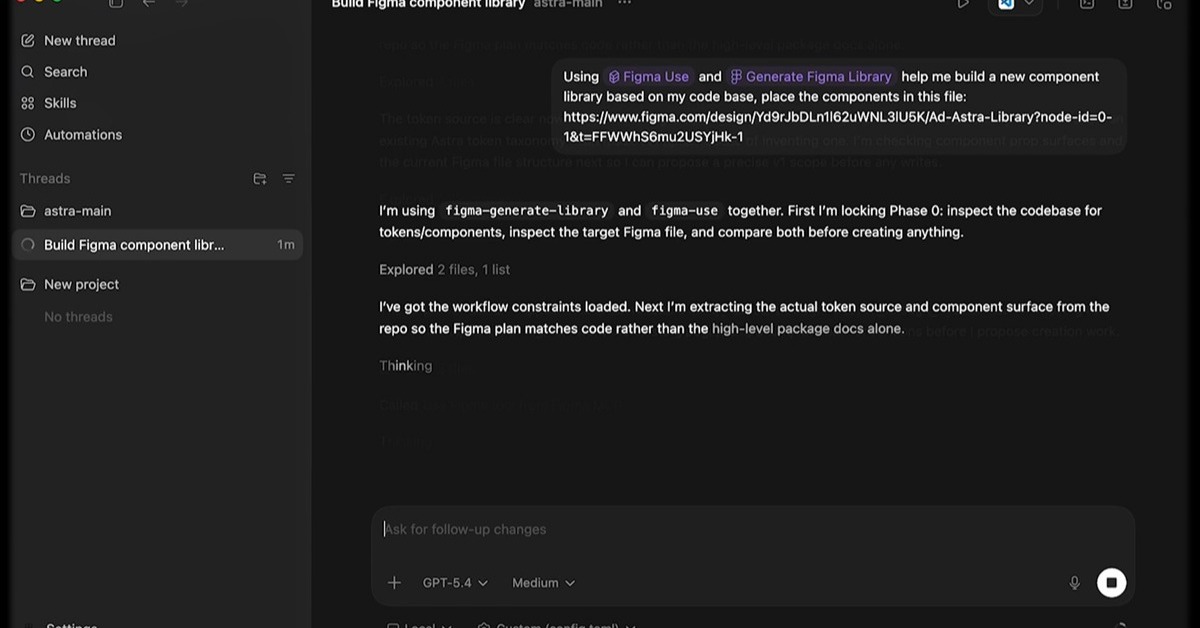
💡AI agents now edit Figma designs directly—unlock faster prototyping!
⚡ 30-Second TL;DR
What Changed
AI agents can now create designs directly on Figma canvas
Why It Matters
This streamlines AI-assisted design workflows, enabling faster prototyping for creators building AI-powered apps. It reduces errors in automated UI tasks, boosting productivity.
What To Do Next
Test Figma's AI agent canvas editing in your next UI prototype project.
Who should care:Creators & Designers
Key Points
- •AI agents can now create designs directly on Figma canvas
- •AI agents enabled for editing existing designs
- •Safeguards prevent unintended UI generation
🧠 Deep Insight
AI-generated analysis for this event.
🔑 Enhanced Key Takeaways
- •The integration utilizes Figma's 'AI-powered design system' architecture, allowing agents to interpret design tokens and constraints to ensure generated UI remains consistent with existing brand libraries.
- •Figma has introduced a 'Human-in-the-loop' verification layer, requiring developers or designers to approve agent-generated changes before they are committed to the master design file.
- •The feature leverages a specialized multimodal model trained on Figma's proprietary design graph, enabling agents to understand spatial relationships and layer hierarchies better than general-purpose LLMs.
📊 Competitor Analysis▸ Show
| Feature | Figma (AI Agents) | Adobe Firefly/Express | Canva Magic Studio |
|---|---|---|---|
| Direct Canvas Manipulation | High (Native API access) | Moderate (Layer-based) | Low (Template-based) |
| Design System Integration | Native (Tokens/Variables) | Limited | Minimal |
| Pricing Model | Enterprise/Pro Add-on | Subscription/Credit-based | Subscription-based |
| Target Audience | Professional Product Teams | Creative Professionals | General/SMB Users |
🛠️ Technical Deep Dive
- •Architecture: Utilizes a proprietary 'Design-to-Code' transformer model that maps natural language prompts directly to Figma's internal JSON-based file format (Figma File Format).
- •Safety Layer: Implements a 'Constraint-Satisfaction Engine' that cross-references generated UI elements against the project's defined design variables (colors, typography, spacing) to prevent 'hallucinated' styles.
- •API Access: Agents operate via the Figma REST API and Plugin API, allowing them to manipulate nodes, properties, and auto-layout settings in real-time.
- •Context Window: Employs a RAG (Retrieval-Augmented Generation) pipeline to ingest the current file's design system documentation and component library as context for the agent.
🔮 Future ImplicationsAI analysis grounded in cited sources
Figma will transition from a design tool to an autonomous UI engineering platform.
The ability for agents to directly manipulate the canvas suggests a future where design and front-end implementation are unified through AI-driven synchronization.
Design system maintenance will become an automated background task.
AI agents capable of editing existing designs can automatically apply global updates to components, reducing manual labor for design system teams.
⏳ Timeline
2023-06
Figma acquires Diagram to accelerate AI-powered design features.
2024-06
Figma introduces 'Figma AI' suite at Config, focusing on search and asset organization.
2025-09
Figma expands AI capabilities to include automated prototyping and design system documentation.
2026-05
Figma launches AI agents for direct canvas design and editing.
📰
Weekly AI Recap
Read this week's curated digest of top AI events →
👉Related Updates
AI-curated news aggregator. All content rights belong to original publishers.
Original source: ITmedia AI+ (日本) ↗