Faster Diffusion on Blackwell with MXFP8 & NVFP4
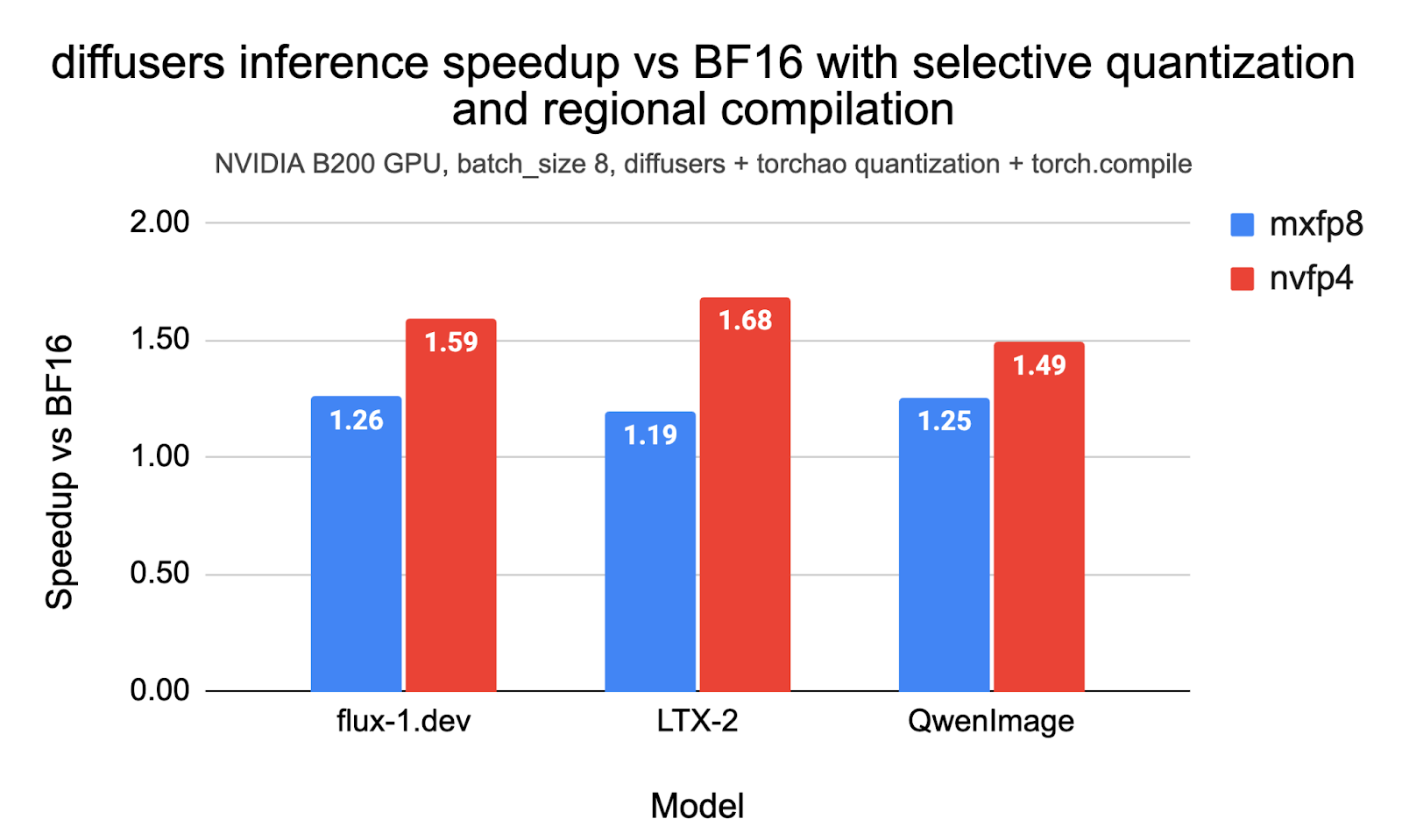
Speed up diffusion models 2-3x on Blackwell GPUs via PyTorch's MXFP8/NVFP4 support.
30-Second TL;DR
What Changed
MXFP8 and NVFP4 formats accelerate diffusion on Blackwell GPUs
Why It Matters
This feature significantly reduces resource demands for diffusion models, enabling larger-scale training and faster inference on next-gen NVIDIA hardware. AI practitioners can now deploy realistic generative models more efficiently, accelerating innovation in visual media.
What To Do Next
Install PyTorch nightly and enable MXFP8 in Diffusers for Blackwell GPUs.
Key Points
- •MXFP8 and NVFP4 formats accelerate diffusion on Blackwell GPUs
- •Integration with Hugging Face Diffusers library
- •TorchAO enables memory and compute optimizations
- •Targets bottlenecks in image/video generation models
Deep Insight
AI-generated analysis for this event — not the original article.
Enhanced Key Takeaways
- •The integration leverages the Blackwell architecture's Transformer Engine, which natively supports micro-scaling formats like MXFP8 to reduce precision without significant loss in model fidelity.
- •TorchAO (PyTorch Architecture Optimization) provides the necessary quantization kernels to map these low-precision formats to the underlying hardware, effectively bypassing traditional FP16/BF16 memory bandwidth bottlenecks.
- •These optimizations specifically target the U-Net and Transformer-based denoising backbones common in Stable Diffusion 3 and Flux models, enabling higher batch sizes on single-GPU configurations.
Technical Deep Dive
- •MXFP8 (Micro-scaling Formats): Utilizes a shared exponent across a vector of values to maintain dynamic range while reducing mantissa bits, optimized for Blackwell's tensor cores.
- •NVFP4: A proprietary 4-bit floating-point format designed for inference-heavy workloads, offering higher throughput than FP8 at the cost of reduced precision, managed via TorchAO's quantization API.
- •Memory Footprint: By switching from BF16 to MXFP8/NVFP4, the weight storage requirement is reduced by 2x to 4x, allowing larger models to fit entirely within the GPU's high-bandwidth memory (HBM3e).
- •Kernel Fusion: TorchAO implements fused quantization-dequantization kernels that minimize global memory access during the forward pass of the diffusion model's transformer blocks.
Future ImplicationsAI analysis grounded in cited sources
Timeline
- 2024-03NVIDIA announces the Blackwell GPU architecture with support for new micro-scaling formats.
- 2024-06PyTorch introduces TorchAO (Architecture Optimization) library to simplify quantization and model optimization.
- 2025-02NVIDIA releases initial software stack support for MXFP8 in the TensorRT-LLM and PyTorch ecosystem.
- 2026-04PyTorch Blog announces specific optimizations for diffusion models using MXFP8 and NVFP4 on Blackwell.
Weekly AI Recap
Read this week's curated digest of top AI events →
AI-curated news aggregator. All content rights belong to original publishers.
Original source: PyTorch Blog ↗
This is a summary, not the original. Read the source, or get the weekly briefing.
The weekly digest
One email a week. Unsubscribe anytime.