🔥36氪•Stalecollected in 6m
Ex-DLR Engineer Launches AI Hardware Platform
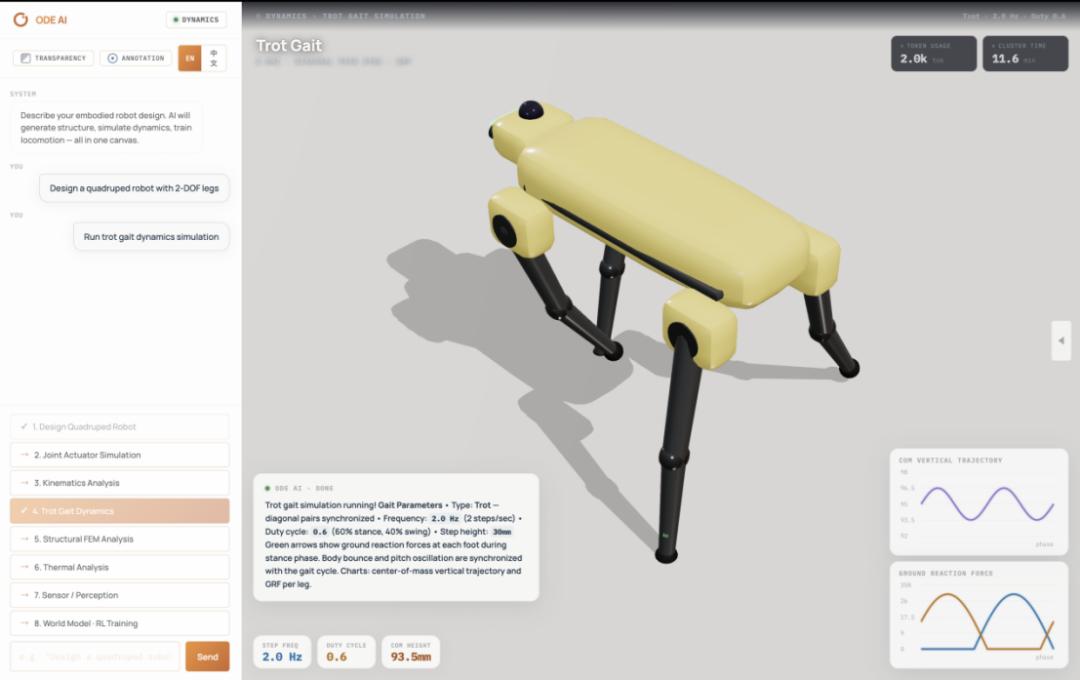
💡AI platform makes hardware dev as easy as 'vibe coding'—5-10x faster sims for builders
⚡ 30-Second TL;DR
What Changed
AI understands physics equations to auto-build models for motors, robots, rockets
Why It Matters
Democratizes complex hardware design for SMEs and hobbyists, accelerating AI-era prototyping and challenging industrial software giants.
What To Do Next
Sign up for ODE at orthogonal.dev to test natural language robot design prompts.
Who should care:Developers & AI Engineers
Key Points
- •AI understands physics equations to auto-build models for motors, robots, rockets
- •Dual UI: natural language for users, debug mode for engineers
- •Token-based pricing disrupts high-license traditional software
- •Performance surpasses ANSYS/Dassault in core simulations
🧠 Deep Insight
AI-generated analysis for this event.
🔑 Enhanced Key Takeaways
- •Orthogonal utilizes a proprietary 'Physics-Informed Neural Operator' (PINO) architecture that bypasses traditional finite element method (FEM) meshing, significantly reducing computational overhead for complex fluid dynamics and structural stress analysis.
- •The platform integrates a 'Hardware-in-the-Loop' (HIL) feedback loop that allows real-time synchronization between the digital twin and physical prototypes, enabling automated iterative design adjustments based on sensor telemetry.
- •The company has secured a strategic partnership with NVIDIA to leverage Blackwell-architecture GPUs, specifically optimizing their inference engine for high-fidelity, real-time simulation workloads.
📊 Competitor Analysis▸ Show
| Feature | Orthogonal (ODE) | Dassault Systèmes (SIMULIA) | ANSYS (Discovery) |
|---|---|---|---|
| Primary Interface | Natural Language / LLM | GUI / Scripting (Python) | GUI / Scripting (Python) |
| Simulation Engine | Physics-Informed Neural Operator | Finite Element Method (FEM) | Finite Element Method (FEM) |
| Pricing Model | Token-based / Consumption | Annual Enterprise License | Annual Enterprise License |
| Simulation Speed | 5-10x faster (claimed) | Baseline | Baseline |
🛠️ Technical Deep Dive
- Architecture: Employs a transformer-based backbone trained on multi-modal engineering datasets (CAD geometry, material properties, and historical physics simulation data).
- Solver Mechanism: Replaces traditional iterative solvers with a learned surrogate model that predicts steady-state and transient physics outcomes directly from latent space representations.
- Integration: Supports standard CAD formats (STEP, IGES) and provides an API-first approach for CI/CD pipelines in hardware manufacturing.
- Latency: Achieves sub-second inference for complex structural simulations that typically require minutes or hours on traditional HPC clusters.
🔮 Future ImplicationsAI analysis grounded in cited sources
Traditional CAD/CAE software vendors will face significant churn in the aerospace and automotive sectors by 2028.
The shift from high-cost, seat-based licensing to consumption-based AI simulation models creates a lower barrier to entry for rapid prototyping.
Orthogonal will likely pivot toward autonomous manufacturing integration.
The ability to auto-generate manufacturing-ready designs from natural language prompts naturally extends into automated CNC/additive manufacturing toolpath generation.
⏳ Timeline
2024-03
Ji Yang departs DLR to incorporate Orthogonal in Berlin.
2024-11
Orthogonal completes seed funding round led by European deep-tech VCs.
2025-09
Beta release of ODE platform to select ESA and DLR research groups.
2026-02
Volkswagen signs multi-year enterprise agreement for ODE integration in EV motor design.
📰
Weekly AI Recap
Read this week's curated digest of top AI events →
👉Related Updates

AI-curated news aggregator. All content rights belong to original publishers.
Original source: 36氪 ↗