EU mandates driver monitoring cameras in all new cars
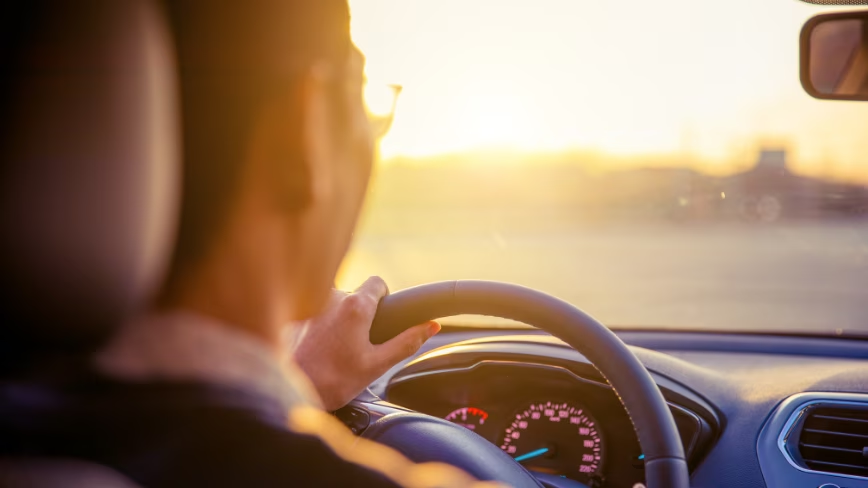
💡Mandatory EU safety laws are driving massive demand for edge-based computer vision and driver monitoring AI models.
⚡ 30-Second TL;DR
What Changed
Mandatory integration of driver distraction warning systems in all new EU vehicles.
Why It Matters
This regulation accelerates the mass adoption of computer vision and edge AI in the automotive sector. Developers should prepare for stricter safety compliance standards in European markets.
What To Do Next
Review the ISO 15005 standard for human-machine interface requirements to ensure your computer vision models meet EU safety compliance.
Key Points
- •Mandatory integration of driver distraction warning systems in all new EU vehicles.
- •Advanced emergency braking systems now required for pedestrian and cyclist safety.
- •Regulatory shift toward AI-driven computer vision for real-time driver monitoring.
🧠 Deep Insight
AI-generated analysis for this event — not the original article.
🔑 Enhanced Key Takeaways
- •The mandate is part of the General Safety Regulation (GSR) (EU) 2019/2144, which aims to reduce road fatalities toward 'Vision Zero' by 2050.
- •Driver Drowsiness and Attention Warning (DDAW) systems must assess the driver's alertness through analysis of vehicle systems or camera-based monitoring.
- •The regulation also mandates the installation of an Event Data Recorder (EDR), often referred to as a 'black box,' to store critical crash data.
- •Intelligent Speed Assistance (ISA) is a parallel requirement, forcing vehicles to use camera data and GPS to inform drivers of speed limits and potentially limit engine power.
- •Privacy concerns have led to strict GDPR compliance requirements, mandating that driver monitoring data be processed in real-time and not stored or transmitted unless necessary for safety.
🛠️ Technical Deep Dive
- Systems typically utilize Near-Infrared (NIR) sensors to ensure functionality in low-light or nighttime conditions.
- Computer vision pipelines employ Convolutional Neural Networks (CNNs) or Vision Transformers (ViTs) to track facial landmarks, eyelid closure rates (PERCLOS), and head pose estimation.
- Integration often involves a Controller Area Network (CAN) bus interface to correlate driver behavior with vehicle dynamics like steering angle, lane deviation, and throttle input.
- Processing is generally performed on dedicated Automotive Grade SoCs (System-on-Chips) to ensure low-latency inference and compliance with ISO 26262 functional safety standards.
🔮 Future ImplicationsAI analysis grounded in cited sources
⏳ Timeline
Weekly AI Recap
Read this week's curated digest of top AI events →
👉Related Updates


AI-curated news aggregator. All content rights belong to original publishers.
Original source: The Next Web (TNW) ↗
This is a summary, not the original. Read the source, or get the weekly briefing.
The weekly digest
One email a week. Unsubscribe anytime.