Escaping Platform and AI Rent
💡AI may improve retail efficiency—but this analysis asks whether it also creates a new layer of merchant rent.
⚡ 30-Second TL;DR
What Changed
Platform, traffic, logistics, and AI costs create a structural “three-tax” burden that individual merchants cannot fully eliminate.
Why It Matters
For AI practitioners, the article highlights a strategic limit of AI-enabled commerce: automation can improve efficiency but may also become another rent-seeking layer. Retail AI products that help merchants retain first-party data, improve staff productivity, and preserve offline relationships may have a stronger value proposition than tools focused only on traffic optimization.
What To Do Next
Prototype a WeChat mini-program with local customer-data storage, then compare repeat purchase rate and total acquisition cost against your current AI-enabled marketplace channel.
Key Points
- •Platform, traffic, logistics, and AI costs create a structural “three-tax” burden that individual merchants cannot fully eliminate.
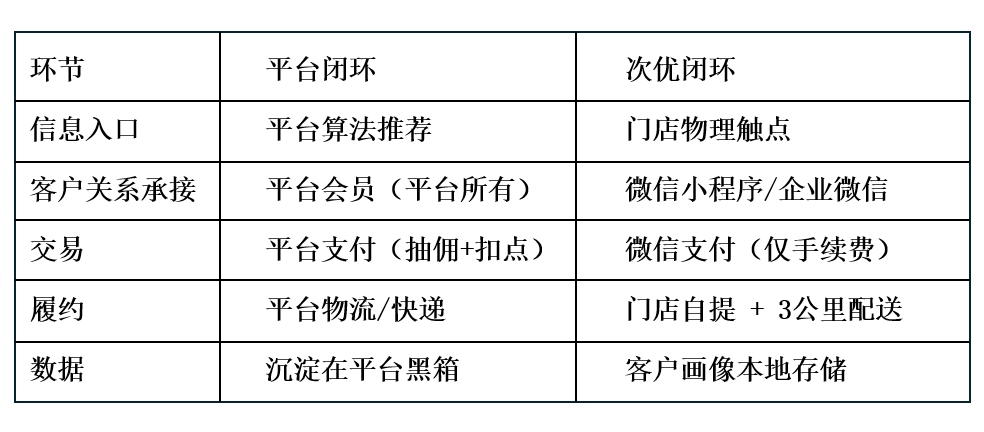
- •A physical-store-plus-WeChat model can shift merchants from paying traffic rent to paying lower payment, cloud, and delivery operating costs.
- •The proposed model prioritizes mini-programs for customer relationships, self-pickup for human interaction, and local or private-cloud storage for transaction data.
- •The approach is best suited to community retail, food service, pet, maternal-and-child, and other businesses with repeat purchases and a roughly 3-kilometer service radius.
🧠 Deep Insight
AI-generated analysis for this event.
🔑 Enhanced Key Takeaways
- •The 'three-tax' burden concept aligns with the broader 'Platform Economy' critique in China, where take rates for major delivery and e-commerce platforms have faced regulatory scrutiny for exceeding 25% in some sectors.
- •WeChat's 'Private Traffic' (私域流量) strategy has evolved into a mature ecosystem where merchants utilize 'Video Accounts' (Channels) to bypass traditional platform search algorithms, effectively reducing customer acquisition costs (CAC) by leveraging social trust.
- •The shift toward 'suboptimal closed loops' is supported by the rise of 'Local Life' (本地生活) services, where platforms like Meituan and Douyin are increasingly competing, forcing merchants to adopt multi-channel strategies to avoid platform lock-in.
- •OpenAI's reported merchant commission model reflects a broader industry trend where AI-native platforms are beginning to charge 'intelligence rent' on top of transaction fees, potentially creating a new layer of overhead for digital storefronts.
- •Data sovereignty concerns are driving small merchants toward decentralized storage solutions, as reliance on platform-hosted cloud data often results in 'data siloing' that prevents merchants from porting customer profiles across different sales channels.
📊 Competitor Analysis▸ Show
| Feature | Traditional Platforms (Meituan/Douyin) | WeChat Private Traffic Model | Independent AI-Native Storefronts |
|---|---|---|---|
| Traffic Source | Algorithmic/Paid | Social/Organic | AI-Driven/Direct |
| Take Rate | 20% - 40% | 0.6% (Payment fees) | 4% - 10% (Estimated) |
| Data Ownership | Platform-owned | Merchant-owned | Variable |
| Customer Retention | Low (Platform-centric) | High (Relationship-centric) | Moderate |
🛠️ Technical Deep Dive
- WeChat Mini-Program Architecture: Utilizes a dual-thread model where the view layer and logic layer run separately to ensure smooth UI performance on low-end devices.
- Data Integration: Merchants often employ middleware (SaaS tools) to sync WeChat order data with local POS systems, bypassing platform-specific cloud APIs.
- AI Implementation: Small merchants are increasingly using local LLM instances or lightweight API wrappers to automate customer service responses within WeChat, reducing reliance on platform-provided AI chatbots.
- Edge Computing: The 'physical store' model leverages local edge devices for inventory management, reducing latency and dependency on centralized platform cloud infrastructure.
🔮 Future ImplicationsAI analysis grounded in cited sources
⏳ Timeline
Weekly AI Recap
Read this week's curated digest of top AI events →
👉Related Updates

AI-curated news aggregator. All content rights belong to original publishers.
Original source: 虎嗅 ↗