Engineering Execution Environments for AI Agents
💡Learn how to move beyond basic demos and build production-ready, reliable Agent execution environments.
⚡ 30-Second TL;DR
What Changed
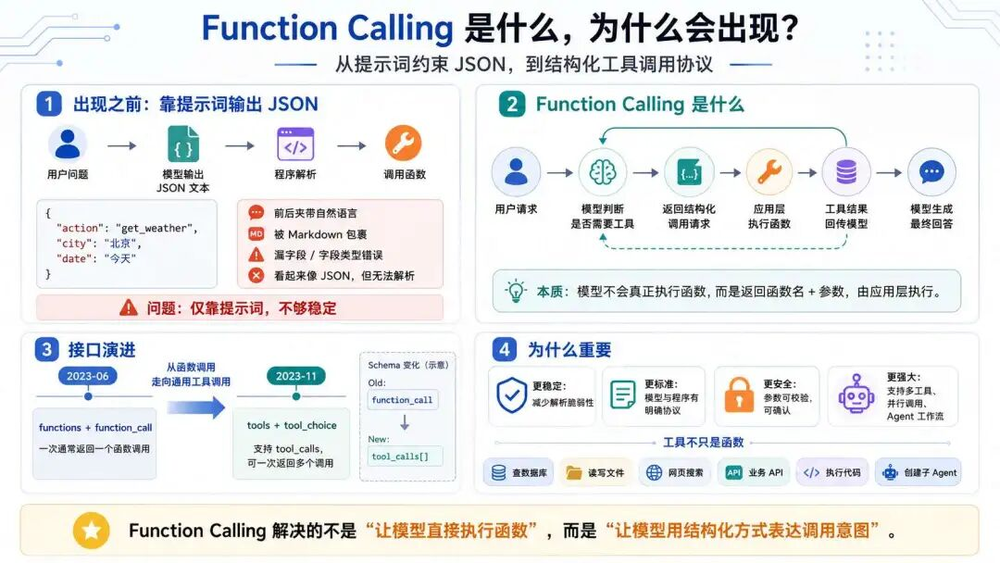
Function Calling is an entry point for structured intent expression, not just a simple API call.
Why It Matters
Shifts the focus from model output to robust runtime engineering, essential for building production-grade AI Agents.
What To Do Next
Implement a robust middleware layer to validate and sanitize tool outputs before executing business logic in your Agent loop.
Key Points
- •Function Calling is an entry point for structured intent expression, not just a simple API call.
- •Reliability requires three layers: format stability (JSON), semantic stability (tool selection), and execution stability (runtime handling).
- •Agent loops must manage state, retries, and high-risk action verification at the application layer.
- •Modern models have evolved from single function calls to parallel 'tool_calls' arrays for better efficiency.
🧠 Deep Insight
Web-grounded analysis with 34 cited sources.
🔑 Enhanced Key Takeaways
- •Function Calling acts as a crucial bridge, transforming LLMs from passive text generators into active agents capable of real-world impact by enabling them to interpret user intent and generate structured outputs for external tool execution.
- •Achieving production-ready AI agents with function calling involves addressing significant challenges beyond model reasoning, including data quality, integration complexity with heterogeneous systems, scalability under concurrent workloads, and robust security measures.
- •Effective state management, distinct from context windows, is fundamental for AI agents to maintain coherence across multi-step tasks, track progress, and recover from failures, often requiring persistent storage and sophisticated orchestration.
- •Parallel tool calling significantly reduces latency in agent workflows by allowing the LLM to identify and request multiple independent external functions simultaneously, with the orchestration layer executing them concurrently and aggregating results.
- •Robust error handling in agent execution environments extends to providing structured error messages back to the LLM, enabling it to reason about failures and adapt its plan, rather with simply crashing or blindly retrying.
📊 Competitor Analysis▸ Show
| Feature/Provider | OpenAI (GPT models) | Anthropic (Claude models) | Google (Gemini models) |
|---|---|---|---|
| Function Calling Name | Function Calling / Tool Calling | Tool Use | Function Calling |
| API Format | tools array with type 'function', evolved from functions and function_call parameters. | Tool definitions with input_schema, distinct response format. | FunctionDeclaration objects wrapped in a Tool object. |
| Reliability (Q1 2026) | 6.3 out of 10 (single-turn accuracy strong) | 8.4 out of 10 (leads for complex tool chains) | 7.9 out of 10 (lowest-latency option with Flash-Lite) |
| Parallel Tool Calls | Supported, best practice to assume multiple calls. | Supported, model can interleave reasoning with tool calls. | Supported, model predicts which functions can be parallelized. |
| Standardization | Adopted Model Context Protocol (MCP), deprecating Assistants API by mid-2026. | Introduced Model Context Protocol (MCP) in November 2024. | Adopted Model Context Protocol (MCP). |
🛠️ Technical Deep Dive
- Function calling involves the LLM generating a structured output (typically JSON) specifying the function name and arguments, which an external application then executes.
- The process is a multi-step conversation: the model receives a prompt along with tool definitions, returns a tool call, the application executes the corresponding function, and then the application returns the tool's output back to the model, which then generates a final response.
- Tool definitions are typically provided as JSON schemas, guiding the model on expected input formats and parameters, and ensuring schema adherence.
- Parallel tool calling works by the model identifying independent operations within a user's prompt and returning multiple tool calls in a single response, which an orchestration layer then runs concurrently to reduce overall latency.
- State management in AI agents relies on persistent data structures (e.g., databases, key-value stores) to track task progress, environment status, and interaction history, thereby compensating for the often-limited context windows of LLMs.
- Error handling strategies include proactive input validation within tools (e.g., using Pydantic for StructuredTool), wrapping external API calls in
try...exceptblocks, providing clear and structured error messages back to the LLM, and implementing retry mechanisms with exponential backoff for transient failures. - Advanced reliability patterns include implementing circuit breakers not just for traditional HTTP failures but also for LLM quality failures (e.g., schema non-conformance), which can trigger a switch to a fallback model after a predefined number of consecutive failures.
🔮 Future ImplicationsAI analysis grounded in cited sources
⏳ Timeline
📎 Sources (34)
Factual claims are grounded in the sources below. Forward-looking analysis is AI-generated interpretation.
- fireworks.ai
- martinfowler.com
- substack.com
- getknit.dev
- arxiv.org
- nurix.ai
- solutelabs.com
- data-flair.training
- jumpcloud.com
- github.com
- systemdesign.one
- airbyte.com
- codeant.ai
- reddit.com
- apxml.com
- machinelearningmastery.com
- apxml.com
- towardsai.net
- kommunicate.io
- sparkco.ai
- digitalapplied.com
- google.dev
- google.com
- openai.com
- towardsdatascience.com
- philschmid.de
- medium.com
- dev.to
- zilliz.com
- leewayhertz.com
- dev.to
- sourcescore.org
- openai.com
- medium.com
Weekly AI Recap
Read this week's curated digest of top AI events →
👉Related Updates



AI-curated news aggregator. All content rights belong to original publishers.
Original source: 虎嗅 ↗