Docker Agentic AI Report Key Findings
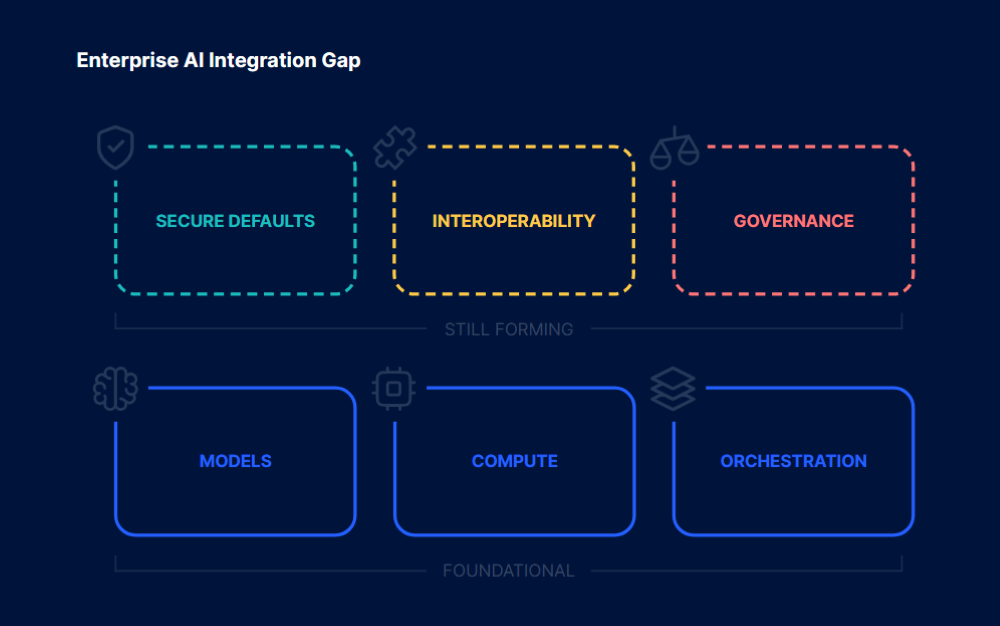
💡800+ dev survey reveals agentic AI scaling trends in orgs—essential benchmarks.
⚡ 30-Second TL;DR
What Changed
Global survey of 800+ developers and decision-makers
Why It Matters
Provides benchmarks for agentic AI adoption trends, aiding practitioners in aligning strategies with industry realities. Highlights organizational challenges in scaling autonomous agents.
What To Do Next
Download Docker’s State of Agentic AI report to assess your team's scaling readiness.
Key Points
- •Global survey of 800+ developers and decision-makers
- •Key findings on agentic AI scaling in organizations
- •Insights from worldwide teams and influencers
🧠 Deep Insight
Background and context from public sources — not the original article. 8 sources cited.
🔑 Enhanced Key Takeaways
- •Agentic AI adoption is accelerating across enterprises, with 67% of industrial organizations prioritizing agentic AI and autonomous operations in 2026[5]
- •Production deployment of agentic systems requires rigorous engineering and strong data governance, with a significant gap between proof-of-concept demos and enterprise-grade implementations[4]
- •Critical security vulnerabilities in agentic AI assistants have been identified, including prompt injection attacks and meta-context injection flaws that can compromise entire development environments[3]
- •Agentic tools are delivering measurable business value, with organizations reducing application upgrade cycles by 3-4x and cutting manual modernization effort by 60-70%[2]
- •Real-time data governance and contextualized data foundations remain key barriers to agentic AI adoption, with organizations lacking adequate infrastructure to support autonomous operations[5]
📊 Competitor Analysis▸ Show
| Aspect | Docker Agentic AI | Microsoft Azure Agentic Tools | Industrial AI Platforms | Enterprise Agents |
|---|---|---|---|---|
| Survey Scope | 800+ global developers/decision-makers | Enterprise modernization focus | Industrial operations (67% adoption target) | Custom enterprise deployments |
| Primary Use Case | Container/DevOps workflows | Application modernization & cloud migration | Autonomous operations & edge computing | Multi-system task execution |
| Key Differentiator | Container-native integration | AI-powered discovery & dependency mapping | Real-time data streaming & digital twins | Velocity & consistency over hours-saved |
| Security Posture | Vulnerable to prompt injection (DockerDash flaw identified) | Guardrails via static analysis & automated testing | Data governance emphasis | SOC 2/ISO-aligned controls |
| Reported ROI | Not specified in available data | 3-4x faster upgrade cycles, 60-70% effort reduction | Operational scale decoupled from headcount | Decision-grade ROI modeling |
🛠️ Technical Deep Dive
• Agentic Architecture: Planner-executor model translating natural-language goals into tool call sequences with semantic environment representation snapshots[1] • Replanning Mechanism: Emerges from interaction loop rather than hard-coded bindings; agents adapt when evidence invalidates assumptions without destabilization over long traces[1] • Security Vulnerabilities: Meta-Context Injection attacks exploit Model Context Protocol (MCP) Gateway's inability to distinguish between informational metadata and pre-authorized runnable instructions; malicious Docker image labels can trigger three-stage attacks without human validation[3] • Data Governance Gap: Automatic world-state maintenance remains fragile; stale information can compromise long-horizon tasks unless mandatory re-perception is enforced under high clutter conditions[1] • Deployment Patterns: Local on-device language models reduce network connectivity reliance; reinforcement-based fine-tuning (agent RFT) shows promise for improving robustness and latency[1] • Integration Patterns: Linear pipeline communication currently dominant, with future exploration of hierarchical delegation and all-to-all interaction models[1]
🔮 Future ImplicationsAI analysis grounded in cited sources
The convergence of agentic AI adoption and identified security vulnerabilities signals a critical inflection point for enterprise software development. While organizations are achieving substantial productivity gains (3-4x faster cycles, 60-70% effort reduction), the DockerDash vulnerability and similar prompt-injection flaws expose a fundamental architectural risk: agentic systems operating without human validation in the software supply chain[2][3]. By 2026, the question shifts from whether to deploy agentic AI to how much autonomy to grant it[4]. However, this autonomy must be balanced against emerging security threats. The gap between demo and production-grade agents requires rigorous engineering and governance frameworks[4]. Industrial organizations prioritizing agentic AI (67%) face a readiness challenge: data quality and governance infrastructure lag ambition[5]. Success will depend on whether enterprises can implement SOC 2/ISO-aligned controls and mandatory re-perception heuristics before malicious actors systematize attacks on agentic workflows. The market is moving toward specialized agent decompositions (separate planner, executor, verification, critique agents) to improve robustness[1], suggesting that monolithic agentic systems will face pressure to fragment into verifiable, auditable components.
⏳ Timeline
📎 Sources (8)
Factual claims are grounded in the sources below. Forward-looking analysis is AI-generated interpretation.
- arXiv — 2602
- techcommunity.microsoft.com — 4490596
- cloudnativenow.com — Noma Security Identifies Security Flaw in Docker AI Assistant
- plavno.io — How AI Agents Are Transforming Enterprise Operations in 2026
- hivemq.com — The Report Accelerating Industrial AI in 2026
- kenhuangus.substack.com — Openclaw Maestro Threat Assessment
- docker.com — State of Agentic AI Key Findings
- sdtimes.com — January 2026 AI Updates From the Past Month
Weekly AI Recap
Read this week's curated digest of top AI events →
👉Related Updates
AI-curated news aggregator. All content rights belong to original publishers.
Original source: Docker Blog ↗
This is a summary, not the original. Read the source, or get the weekly briefing.
Weekly AI briefing
One email a week. Unsubscribe anytime.