🔥PyTorch Blog•Stalecollected in 25m
Disaggregating CPU-GPU for Scalable LLM Serving
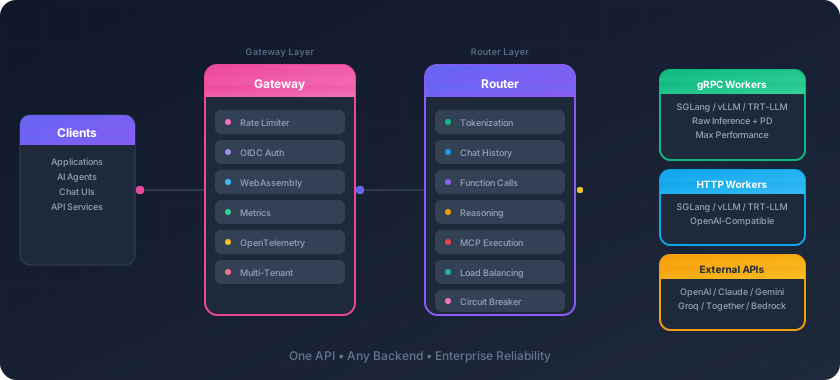
💡PyTorch's fix for GIL in LLM serving: disaggregate CPU/GPU for massive scale
⚡ 30-Second TL;DR
What Changed
Hit GIL wall limiting concurrent threads in LLM serving
Why It Matters
Improves efficiency in AI serving infrastructure, reducing costs for model deployment at scale. Enables handling larger workloads without Python threading constraints.
What To Do Next
Test CPU-GPU disaggregation in your PyTorch serving setup using Shepherd Model Gateway.
Who should care:Developers & AI Engineers
Key Points
- •Hit GIL wall limiting concurrent threads in LLM serving
- •Developed Shepherd Model Gateway for production use
- •Propose CPU-GPU disaggregation for scalability
- •Addresses modest initial goals evolving to large-scale needs
🧠 Deep Insight
AI-generated analysis for this event.
🔑 Enhanced Key Takeaways
- •Shepherd Model Gateway utilizes a C++-based request handling layer to bypass Python's Global Interpreter Lock (GIL), allowing for high-concurrency request scheduling that Python-native frameworks cannot achieve.
- •The disaggregation architecture decouples the request-response lifecycle from the GPU compute kernels, enabling independent scaling of CPU-bound tasks like tokenization and post-processing versus GPU-bound tensor operations.
- •By offloading orchestration to a dedicated gateway, the system achieves lower tail latency (P99) by preventing CPU-bound Python overhead from stalling GPU execution pipelines during high-traffic bursts.
📊 Competitor Analysis▸ Show
| Feature | Shepherd Model Gateway | vLLM | NVIDIA Triton Inference Server |
|---|---|---|---|
| GIL Handling | C++ Gateway bypass | Python-based (limited) | C++ Backend (native) |
| Disaggregation | Explicit CPU/GPU split | Integrated/Monolithic | Modular/Plugin-based |
| Primary Focus | High-throughput serving | Ease of use/Paging | Multi-model/Multi-framework |
🛠️ Technical Deep Dive
- Architecture: Implements a producer-consumer model where the Gateway acts as the producer, managing request queues and state, while GPU workers act as consumers.
- Communication: Utilizes shared memory or high-speed IPC (Inter-Process Communication) between the CPU gateway and GPU workers to minimize serialization overhead.
- GIL Bypass: Moves the request parsing, batching logic, and scheduling into a C++ runtime environment, leaving Python only for high-level API definitions.
- Resource Allocation: Allows for dynamic scaling of CPU worker pools independently of GPU count, optimizing for models with heavy pre-processing requirements.
🔮 Future ImplicationsAI analysis grounded in cited sources
Python-native inference frameworks will lose market share in high-scale production environments.
The inherent limitations of the GIL in Python make it increasingly difficult to match the performance of C++ or Rust-based gateways as model throughput requirements grow.
Hardware-agnostic disaggregation will become the standard for enterprise LLM deployments.
Decoupling compute resources allows organizations to optimize costs by matching specific CPU/GPU ratios to the unique tokenization and inference needs of different model architectures.
⏳ Timeline
2024-05
Initial research into Python GIL bottlenecks for high-concurrency LLM serving.
2025-02
Development of the Shepherd Model Gateway prototype begins.
2025-11
Shepherd Model Gateway deployed to internal production workloads at scale.
2026-04
Public release of the disaggregation architecture and Shepherd documentation.
📰
Weekly AI Recap
Read this week's curated digest of top AI events →
👉Related Updates
AI-curated news aggregator. All content rights belong to original publishers.
Original source: PyTorch Blog ↗