Detecting AI-generated phishing with Amazon Bedrock
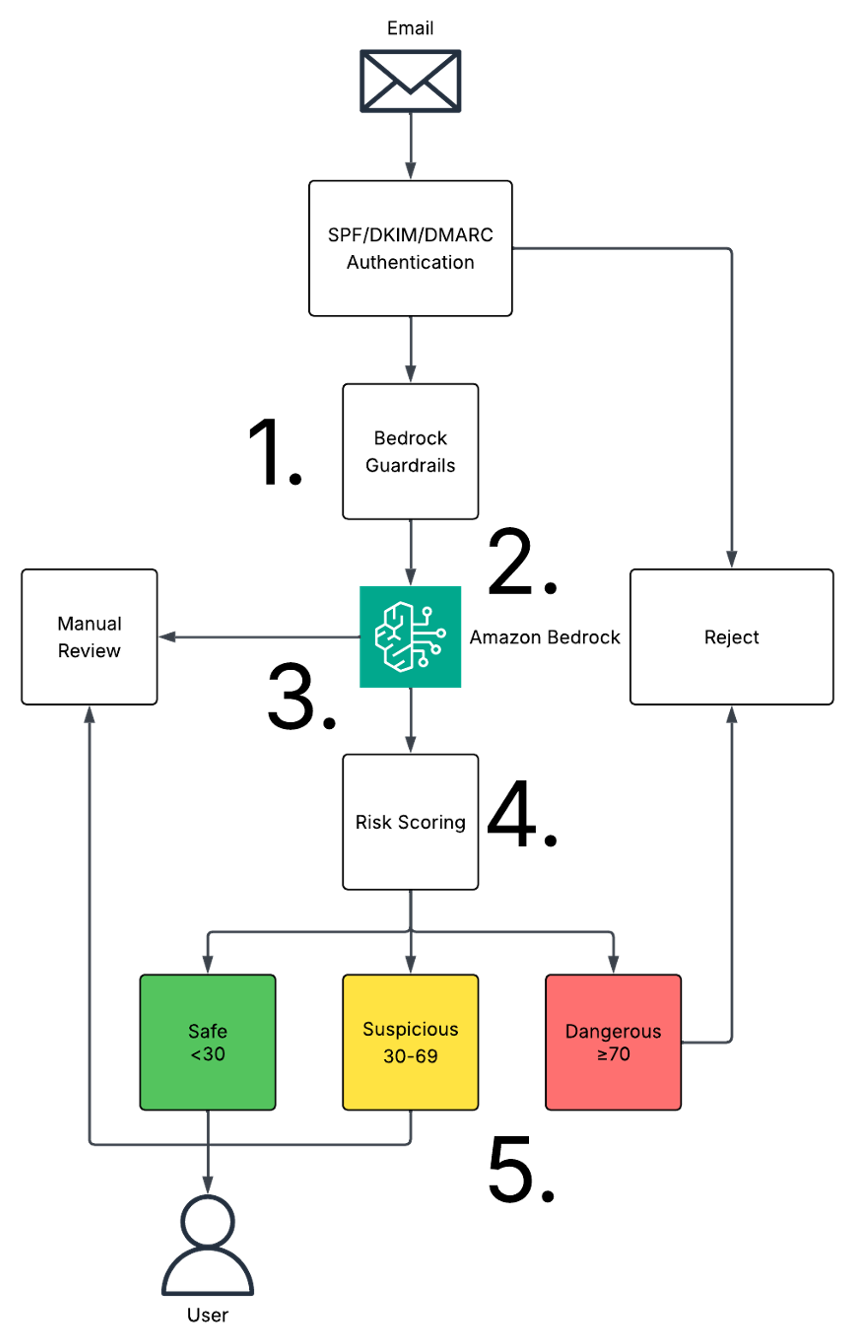
Learn how to use Amazon Bedrock to defend your infrastructure against sophisticated AI-powered phishing attacks.
30-Second TL;DR
What Changed
AI-generated phishing uses OSINT for high-sophistication social engineering
Why It Matters
Helps security practitioners build more resilient email filtering systems against modern, AI-powered social engineering threats.
What To Do Next
Integrate Amazon Bedrock's text analysis APIs into your email security gateway to score incoming messages for AI-generated patterns.
Key Points
- •AI-generated phishing uses OSINT for high-sophistication social engineering
- •Amazon Bedrock provides the infrastructure to analyze and flag malicious email content
- •Security teams can automate detection workflows to counter large-scale phishing campaigns
Deep Insight
AI-generated analysis for this event — not the original article.
Enhanced Key Takeaways
- •Amazon Bedrock's integration allows for the use of multi-modal models to analyze not just text, but also embedded images and QR codes often used in 'quishing' (QR code phishing) attacks.
- •The solution leverages Amazon EventBridge to trigger real-time automated remediation workflows, such as moving suspicious emails to quarantine or revoking compromised user sessions.
- •Bedrock's Guardrails feature is utilized to enforce specific security policies, preventing the LLM from being tricked by prompt injection attacks embedded within the phishing emails themselves.
- •The architecture supports RAG (Retrieval-Augmented Generation) by connecting to internal threat intelligence databases, allowing the model to cross-reference email metadata against known malicious infrastructure in real-time.
- •AWS has introduced specific 'Phishing Detection' blueprints within Bedrock, which provide pre-configured prompt templates optimized for low-latency inference in high-volume email gateway environments.
Competitor Analysis
- Amazon Bedrock (Phishing Detection)
- Bedrock (Claude, Titan, etc.)
- Microsoft Sentinel (AI Threat Intelligence)
- OpenAI GPT-4 / Security Copilot
- Google Cloud Security AI Workbench
- Gemini / Sec-PaLM 2
- Amazon Bedrock (Phishing Detection)
- AWS Native (EventBridge, Lambda)
- Microsoft Sentinel (AI Threat Intelligence)
- Azure/M365 Native
- Google Cloud Security AI Workbench
- Google Workspace/Chronicle Native
- Amazon Bedrock (Phishing Detection)
- Pay-per-token / Provisioned Throughput
- Microsoft Sentinel (AI Threat Intelligence)
- Consumption-based (Sentinel units)
- Google Cloud Security AI Workbench
- Tiered / Per-user security licensing
- Amazon Bedrock (Phishing Detection)
- Model choice & infrastructure flexibility
- Microsoft Sentinel (AI Threat Intelligence)
- Deep M365 ecosystem integration
- Google Cloud Security AI Workbench
- Massive threat intelligence (Mandiant)
| Feature | Amazon Bedrock (Phishing Detection) | Microsoft Sentinel (AI Threat Intelligence) | Google Cloud Security AI Workbench |
|---|---|---|---|
| Core Engine | Bedrock (Claude, Titan, etc.) | OpenAI GPT-4 / Security Copilot | Gemini / Sec-PaLM 2 |
| Integration | AWS Native (EventBridge, Lambda) | Azure/M365 Native | Google Workspace/Chronicle Native |
| Pricing Model | Pay-per-token / Provisioned Throughput | Consumption-based (Sentinel units) | Tiered / Per-user security licensing |
| Key Strength | Model choice & infrastructure flexibility | Deep M365 ecosystem integration | Massive threat intelligence (Mandiant) |
Technical Deep Dive
- Utilizes Amazon Bedrock's API to interface with foundation models like Claude 3.5 Sonnet or Amazon Titan Text for semantic analysis of email headers and body content.
- Implements a serverless pipeline using AWS Lambda to extract features from emails, which are then passed to Bedrock for classification.
- Employs vector databases like Amazon OpenSearch Serverless to store and query historical phishing patterns for similarity matching.
- Uses IAM roles and VPC endpoints to ensure that sensitive email data processed by Bedrock remains within the customer's private AWS environment.
- Integrates with Amazon Simple Email Service (SES) to intercept and analyze inbound traffic before it reaches the end-user mailbox.
Future ImplicationsAI analysis grounded in cited sources
Timeline
- 2023-04AWS announces the launch of Amazon Bedrock to provide managed foundation model access.
- 2023-09Amazon Bedrock becomes generally available, enabling enterprise-scale generative AI applications.
- 2024-05AWS introduces Guardrails for Amazon Bedrock to enhance safety and security controls.
- 2025-02AWS expands Bedrock capabilities to include deeper integration with security-focused data pipelines.
Weekly AI Recap
Read this week's curated digest of top AI events →
Related Updates

AI-curated news aggregator. All content rights belong to original publishers.
Original source: AWS Machine Learning Blog ↗
This is a summary, not the original. Read the source, or get the weekly briefing.
The weekly digest
One email a week. Unsubscribe anytime.