โ˜๏ธStalecollected in 8m

Deploy Voice Agents via Pipecat on Bedrock
Deploy Voice Agents via Pipecat on Bedrock
PostLinkedIn
โ˜๏ธRead original on AWS Machine Learning Blog
#voice-agents#deployment-guideamazon-bedrock-agentcore-runtime

๐Ÿ’กBuild real-time voice agents with Pipecat + Bedrock: WebRTC/telephony code samples ready.

โšก 30-Second TL;DR

What Changed

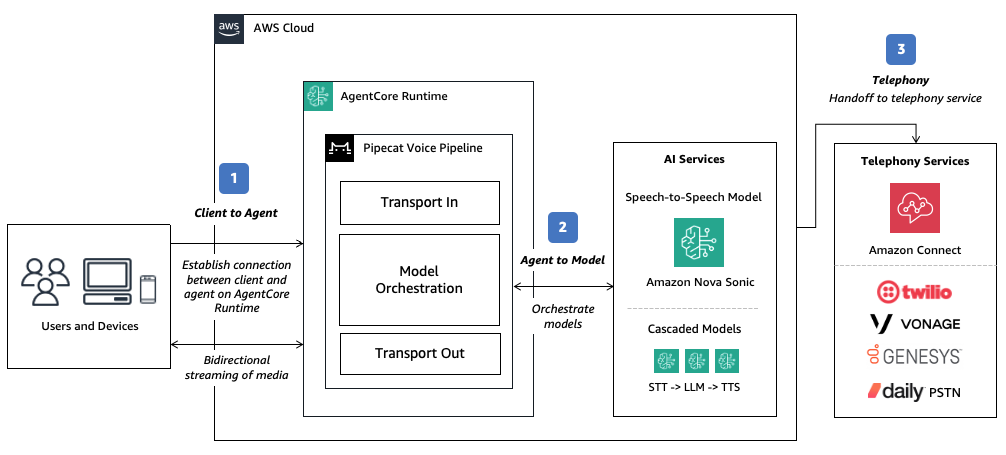
Pipecat voice agents deployed on Bedrock AgentCore Runtime

Why It Matters

Simplifies building low-latency voice AI agents, enabling applications in customer service, virtual assistants, and telephony without managing complex infrastructure.

What To Do Next

Deploy a Pipecat voice agent on Bedrock AgentCore using WebRTC sample code from the AWS ML Blog.

Who should care:Developers & AI Engineers

๐Ÿง  Deep Insight

AI-generated analysis for this event.

๐Ÿ”‘ Enhanced Key Takeaways

  • โ€ขPipecat's integration with Bedrock AgentCore Runtime leverages the 'AgentCore' abstraction layer to standardize state management and tool-calling across diverse LLM backends, reducing the boilerplate code typically required for orchestrating multi-turn voice conversations.
  • โ€ขThe architecture utilizes a modular pipeline approach where Pipecat acts as the orchestration framework, decoupling the transport layer (WebRTC/SIP) from the inference layer (Bedrock), allowing developers to swap models like Claude 3.5 Sonnet or Haiku without refactoring the audio processing logic.
  • โ€ขBy utilizing Bedrock's native streaming capabilities, the implementation minimizes time-to-first-byte (TTFB) by processing partial audio chunks, which is critical for maintaining natural conversational flow and reducing latency in sub-500ms voice interactions.
๐Ÿ“Š Competitor Analysisโ–ธ Show
FeaturePipecat on BedrockVapi.aiRetell AI
DeploymentSelf-hosted/AWS-managedManaged SaaSManaged SaaS
CustomizationHigh (Open Source)Medium (API-driven)Medium (API-driven)
PricingAWS Infrastructure costsPer-minute usagePer-minute usage
LatencyDependent on infra configOptimized (Global edge)Optimized (Global edge)

๐Ÿ› ๏ธ Technical Deep Dive

  • Transport Layer: Uses Pipecat's DailyTransport or WebsocketTransport to handle bidirectional audio streams, interfacing with WebRTC for browser-based clients or SIP for telephony.
  • Orchestration: Employs a 'Frame' based architecture where audio, text, and control signals are passed as discrete objects through a pipeline of processors (STT -> LLM -> TTS).
  • Bedrock Integration: Utilizes the boto3 Bedrock Runtime client with invoke_model_with_response_stream to handle real-time token generation.
  • State Management: Integrates with AgentCore to maintain conversation history and context, allowing the agent to handle interruptions and context-switching dynamically.

๐Ÿ”ฎ Future ImplicationsAI analysis grounded in cited sources

AWS will introduce a managed 'Voice Agent' service tier within Bedrock.
The shift toward providing pre-built orchestration patterns like Pipecat suggests AWS is moving to reduce the operational burden of managing real-time infrastructure.
Latency-optimized regional deployments will become the primary differentiator for voice agent providers.
As voice agent adoption grows, the physical distance between the user and the inference endpoint will become the primary bottleneck for conversational fluidity.

โณ Timeline

2024-05
Pipecat open-source framework gains traction for real-time voice AI orchestration.
2025-02
AWS announces Bedrock AgentCore Runtime to standardize agentic workflows.
2026-03
AWS publishes official guidance on integrating Pipecat with Bedrock for voice agents.
๐Ÿ“ฐ

Weekly AI Recap

Read this week's curated digest of top AI events โ†’

๐Ÿ‘‰Related Updates

AI-curated news aggregator. All content rights belong to original publishers.
Original source: AWS Machine Learning Blog โ†—