DeepSeek-V4 Tops Benchmarks Amid $10B Valuation
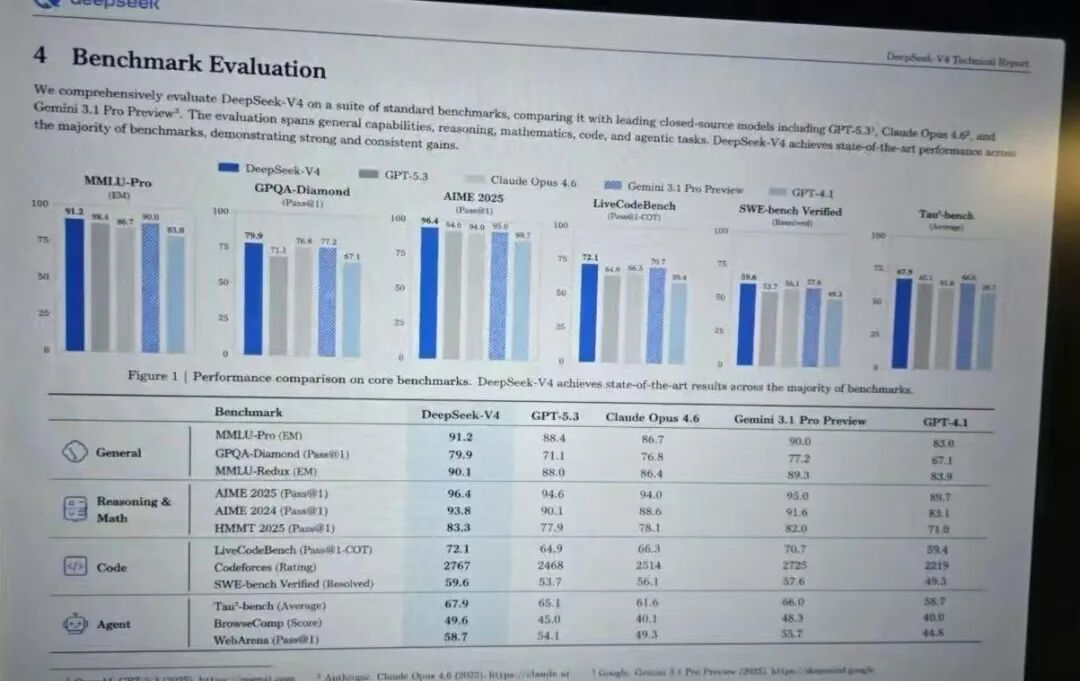
💡V4 crushes GPT-5.3 on evals; $10B raise funds domestic chip pivot
⚡ 30-Second TL;DR
What Changed
Leaked benchmarks: MMLU-Pro 91.2 beats GPT-5.3's 88.4
Why It Matters
Boosts China's AI self-reliance amid chip sanctions, potentially enabling cheaper global inference if migration succeeds. Attracts capital for scaling amid high expectations.
What To Do Next
Benchmark your coding tasks against DeepSeek-V4's SWE-bench 59.6 score.
Key Points
- •Leaked benchmarks: MMLU-Pro 91.2 beats GPT-5.3's 88.4
- •$300M funding round targeting $10B valuation
- •V4 delayed due to full migration to Huawei Ascend from NVIDIA CUDA
- •Focus on ultra-low token costs for 'Token factory' commercialization
🧠 Deep Insight
AI-generated analysis for this event — not the original article.
🔑 Enhanced Key Takeaways
- •DeepSeek's migration to Huawei Ascend chips is part of a broader 'Project Sovereign' initiative aimed at insulating Chinese AI development from potential future US export control tightening on high-end NVIDIA hardware.
- •The $10B valuation reflects investor confidence in DeepSeek's proprietary 'Deep-MoE' routing algorithm, which reportedly achieves 40% higher compute efficiency than standard Mixture-of-Experts implementations.
- •Industry analysts suggest the 'Token factory' strategy aims to commoditize LLM inference by pricing tokens at sub-fractional costs, specifically targeting the integration of AI into low-power edge devices and IoT ecosystems.
📊 Competitor Analysis▸ Show
| Feature | DeepSeek-V4 | GPT-5.3 | Claude 3.5 Opus (Ref) |
|---|---|---|---|
| Architecture | Ascend-native MoE | NVIDIA-based Dense/MoE | Proprietary |
| MMLU-Pro | 91.2 | 88.4 | 86.7 |
| SWE-bench | 59.6 | 62.1 | 58.4 |
| Primary Market | China/Global (Low-cost) | Global (Premium) | Global (Enterprise) |
🛠️ Technical Deep Dive
- •Architecture: Evolution of the Deep-MoE (Mixture-of-Experts) framework, optimized for non-CUDA kernels.
- •Hardware Abstraction: Implementation of a custom software stack to map tensor operations directly to Huawei's CANN (Compute Architecture for Neural Networks) library.
- •Inference Optimization: Utilization of FP8 quantization across the entire model weight set to maximize throughput on Ascend 910B/C clusters.
- •Training Efficiency: Reported use of a novel 'Dynamic Load Balancing' technique to mitigate communication bottlenecks inherent in non-NVIDIA interconnects.
🔮 Future ImplicationsAI analysis grounded in cited sources
⏳ Timeline
Weekly AI Recap
Read this week's curated digest of top AI events →
👉Related Updates

AI-curated news aggregator. All content rights belong to original publishers.
Original source: 虎嗅 ↗
This is a summary, not the original. Read the source, or get the weekly briefing.
The weekly digest
One email a week. Unsubscribe anytime.