🐯虎嗅•Stalecollected in 11m
DeepSeek Tops Christian Theology AI Test
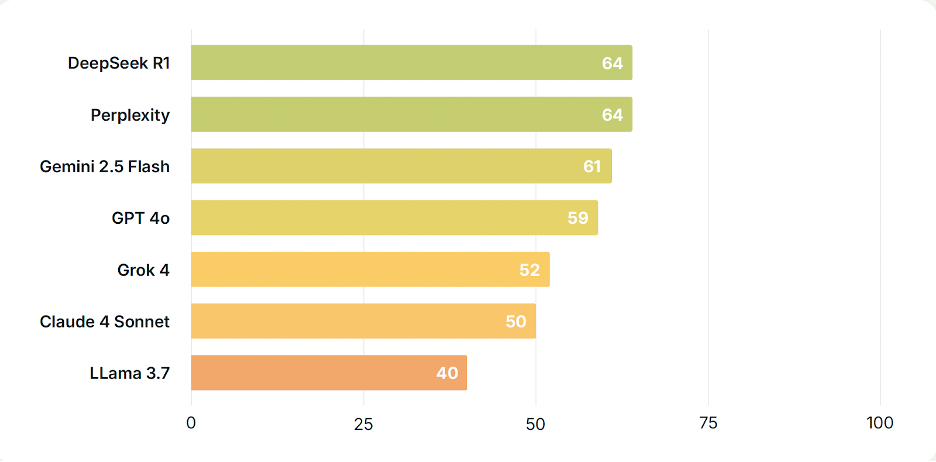
💡DeepSeek beats US LLMs on theology; China costs threaten Valley
⚡ 30-Second TL;DR
What Changed
DeepSeek R1 leads in tests on 'Who is Jesus?', Gospel, God's existence.
Why It Matters
Elevates DeepSeek credibility globally; spurs specialized faith-tuned models. Intensifies US-China AI rivalry, pushing cost scrutiny in apps and developer adoption.
What To Do Next
Test DeepSeek R1 vs GPT-4o on theology prompts in playground.
Who should care:Researchers & Academics
Key Points
- •DeepSeek R1 leads in tests on 'Who is Jesus?', Gospel, God's existence.
- •US LLMs diluted by political correctness filters for neutrality.
- •China AI: low-cost 'good enough' vs US 'expensive leadership'.
- •Anysphere Cursor: $293B valuation using kimi for positive margins.
- •US fears China AI disrupting VC-tech-capital closed loop.
🧠 Deep Insight
AI-generated analysis for this event.
🔑 Enhanced Key Takeaways
- •The theological performance of DeepSeek R1 is attributed to its 'reasoning-first' architecture, which prioritizes logical consistency over the safety-aligned, RLHF-heavy fine-tuning common in US models, which often results in 'hedging' or 'neutrality' responses.
- •The controversy surrounding Anysphere's Cursor involves allegations of unauthorized API usage or 'model arbitrage,' where the company allegedly routed traffic to Kimi (Moonshot AI) to maintain high margins while marketing the product as a premium US-based AI coding assistant.
- •US venture capital firms are increasingly scrutinizing the 'China AI cost-efficiency' model, fearing that the 90/5 (90% performance at 5% cost) ratio will trigger a massive devaluation of US-based foundational model startups that rely on high-compute, high-cost training cycles.
📊 Competitor Analysis▸ Show
| Feature | DeepSeek R1 | GPT-4o | Claude 3.5 Sonnet | Kimi (Moonshot) |
|---|---|---|---|---|
| Primary Focus | Reasoning/Efficiency | Multimodal/General | Reasoning/Safety | Long-context/Chinese |
| Cost Profile | Ultra-Low (API) | Premium | Premium | Low/Competitive |
| Theological Bias | Minimal (Raw Logic) | High (Safety Aligned) | High (Safety Aligned) | Moderate (Cultural) |
🛠️ Technical Deep Dive
- •DeepSeek R1 utilizes a Mixture-of-Experts (MoE) architecture combined with a Reinforcement Learning (RL) training phase that emphasizes chain-of-thought (CoT) generation without extensive human-labeled preference data.
- •The model's 'theological reliability' in tests is likely a byproduct of its training objective, which focuses on internal consistency and factual grounding rather than the 'refusal' mechanisms (safety guardrails) that characterize Western models.
- •Anysphere's integration of Kimi reportedly leverages Kimi's specialized long-context window, which allows for superior code-base indexing compared to standard GPT-4o implementations at a fraction of the token cost.
🔮 Future ImplicationsAI analysis grounded in cited sources
US AI startups will pivot toward 'Reasoning-as-a-Service' to compete with DeepSeek's cost structure.
The market is shifting away from general-purpose chat toward specialized, high-reasoning tasks where cost-per-inference is the primary competitive differentiator.
Increased regulatory scrutiny on 'Model Arbitrage' in US software products.
The Anysphere/Kimi incident will likely lead to stricter transparency requirements regarding which foundational models are powering 'US-made' AI tools.
⏳ Timeline
2024-10
DeepSeek releases initial open-weights models, signaling a shift to high-efficiency training.
2025-01
DeepSeek R1 launch, demonstrating competitive reasoning capabilities at significantly lower compute costs.
2026-03
Reports emerge regarding Anysphere's utilization of Kimi API within the Cursor platform.
📰
Weekly AI Recap
Read this week's curated digest of top AI events →
👉Related Updates
AI-curated news aggregator. All content rights belong to original publishers.
Original source: 虎嗅 ↗