💰钛媒体•Stalecollected in 30m
DeepSeek slashes prices to gain market pricing power
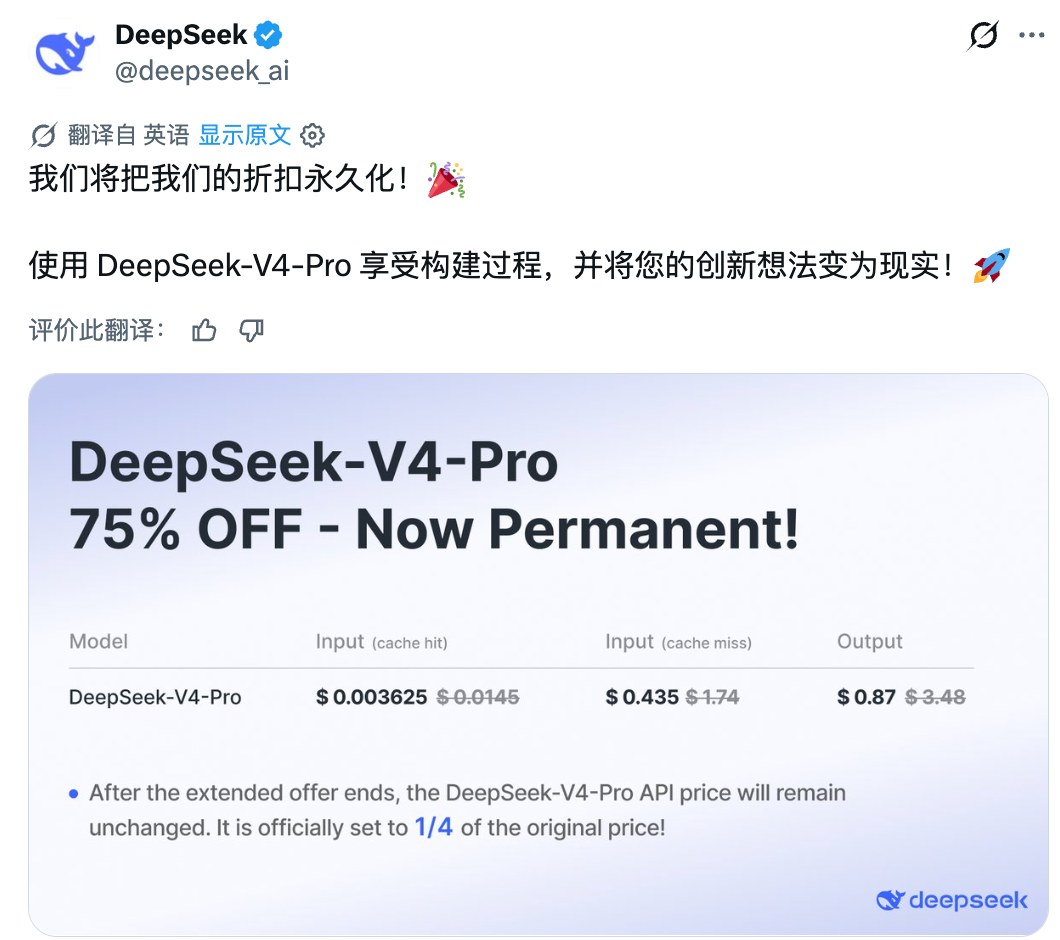
💡DeepSeek's permanent price cuts are forcing a market-wide shift in LLM API costs. Audit your stack now.
⚡ 30-Second TL;DR
What Changed
DeepSeek announced permanent price reductions for its API services
Why It Matters
Aggressive pricing from DeepSeek forces other providers to reconsider their cost structures and API margins.
What To Do Next
Benchmark DeepSeek's new pricing against your current LLM provider to optimize your inference cost-per-token.
Who should care:Developers & AI Engineers
Key Points
- •DeepSeek announced permanent price reductions for its API services
- •The move aims to disrupt current market pricing standards
- •Founder Liang Wenfeng emphasizes the strategic intent behind the pricing shift
🧠 Deep Insight
Web-grounded analysis with 18 cited sources.
🔑 Enhanced Key Takeaways
- •DeepSeek has made a permanent 75% price reduction for its flagship DeepSeek-V4-Pro API, effective May 31, 2026, significantly undercutting competitors like OpenAI's GPT-5 and Anthropic's Claude Opus 4.7.
- •The price cuts also include a 90% reduction for input cache hits across DeepSeek's entire API lineup, which drastically lowers operational costs for developers using repetitive prompts or continuous system instructions.
- •Industry analysts suggest that the price reductions are partly facilitated by the increased availability of Huawei's Ascend 950 AI processors, which helps reduce DeepSeek's operational expenses and boosts its computing capacity.
- •DeepSeek's aggressive pricing strategy aims to attract developers and enterprise users who are reportedly dissatisfied with the restrictive usage caps and higher costs imposed by Western AI providers.
- •The company is reportedly seeking a substantial $45 billion funding round, with founder Liang Wenfeng personally committing RMB 20 billion, indicating a long-term strategic play for market dominance.
📊 Competitor Analysis▸ Show
| Feature/Model | DeepSeek-V4 Pro (New Pricing) | OpenAI GPT-5 | Anthropic Claude Opus 4.7 | Google Gemini 3.5 Flash |
|---|---|---|---|---|
| Input Price (per 1M tokens) | $0.435 (non-cached), $0.028 (cached) | $2.50 | $5.00 | $0.15 |
| Output Price (per 1M tokens) | $0.87 | $10.00 | $25.00 | $0.60 |
| Context Length | 1M tokens | N/A | N/A | N/A |
| Key Architecture | MoE | N/A | N/A | N/A |
| Cost Efficiency | Up to 95% cheaper than GPT-4 Turbo, 10-30x lower than competitors | Higher costs | Higher costs | Competitive pricing |
| Benchmarks (DeepSeek-R1) | HumanEval: 73.78%, GSM8K: 84.1% | Comparable to OpenAI o1 | Comparable to Claude 4 Sonnet (DeepSeek V3.1-0324) | Comparable to Gemini 2.5 Pro (DeepSeek R1-0528) |
🛠️ Technical Deep Dive
- DeepSeek models, including DeepSeek-V2 and DeepSeek-R1, primarily leverage a Mixture-of-Experts (MoE) architecture, which allows only a subset of the total parameters to be activated for any given task, significantly reducing computational costs.
- DeepSeek-R1, released in January 2025, features 671 billion total parameters but activates only 37 billion per token during inference, contributing to its cost efficiency.
- DeepSeek-V2, launched in May 2024, has 236 billion total parameters with 21 billion active per token, and introduced Multi-Head Latent Attention (MLA) to support extended context lengths up to 128,000 tokens using the YARN technique.
- The initial DeepSeek LLM (V0), released in November 2023, utilized a Transformer decoder model, with the 7B variant employing Multi-Head Attention (MHA) and the 67B variant using Grouped-Query Attention (GQA), trained on a dataset of 2 trillion tokens in English and Chinese.
- DeepSeek's training cost for its R1 model was reported to be $6 million, a fraction of the estimated $100 million cost for OpenAI's GPT-4, demonstrating its efficiency in model development.
🔮 Future ImplicationsAI analysis grounded in cited sources
The AI market will experience intensified price competition, potentially leading to a commoditization of LLM services.
DeepSeek's aggressive and permanent price cuts will pressure competitors to lower their own prices to retain market share, especially for high-volume or less complex tasks, as seen with Google's repeated Gemini price cuts.
DeepSeek will gain significant market share, particularly among developers and enterprises sensitive to cost.
Its substantially lower pricing, coupled with competitive performance and higher usage limits, offers a compelling alternative to more expensive Western models, attracting users dissatisfied with current offerings.
The reliance on Chinese hardware could lead to a bifurcation of the AI market along geopolitical lines.
Increased availability of domestic AI processors like Huawei's Ascend 950 enables lower operational costs for Chinese companies like DeepSeek, potentially creating distinct economic tiers for AI services and influencing adoption based on origin.
⏳ Timeline
2023-07
DeepSeek spun off as an independent AI company from the hedge fund High-Flyer.
2023-11
DeepSeek LLM (V0) released, an open-source model with 7B and 67B parameters.
2024-05
DeepSeek-V2 released, introducing Mixture-of-Experts (MoE) architecture and Multi-Head Latent Attention (MLA) with a 128k token context window.
2025-01
DeepSeek-R1 model and its eponymous chatbot launched, quickly becoming a top downloaded app.
2026-04
DeepSeek launched its V4 models (Pro and Flash), aiming for 'cost-effective 1M context length'.
2026-05
DeepSeek announced permanent 75% price cuts for its flagship DeepSeek-V4-Pro API and 90% for input cache hits.
📎 Sources (18)
Factual claims are grounded in the sources below. Forward-looking analysis is AI-generated interpretation.
📰
Weekly AI Recap
Read this week's curated digest of top AI events →
👉Related Updates

AI-curated news aggregator. All content rights belong to original publishers.
Original source: 钛媒体 ↗