DeepSeek Joins China’s Poetry Review Pipeline
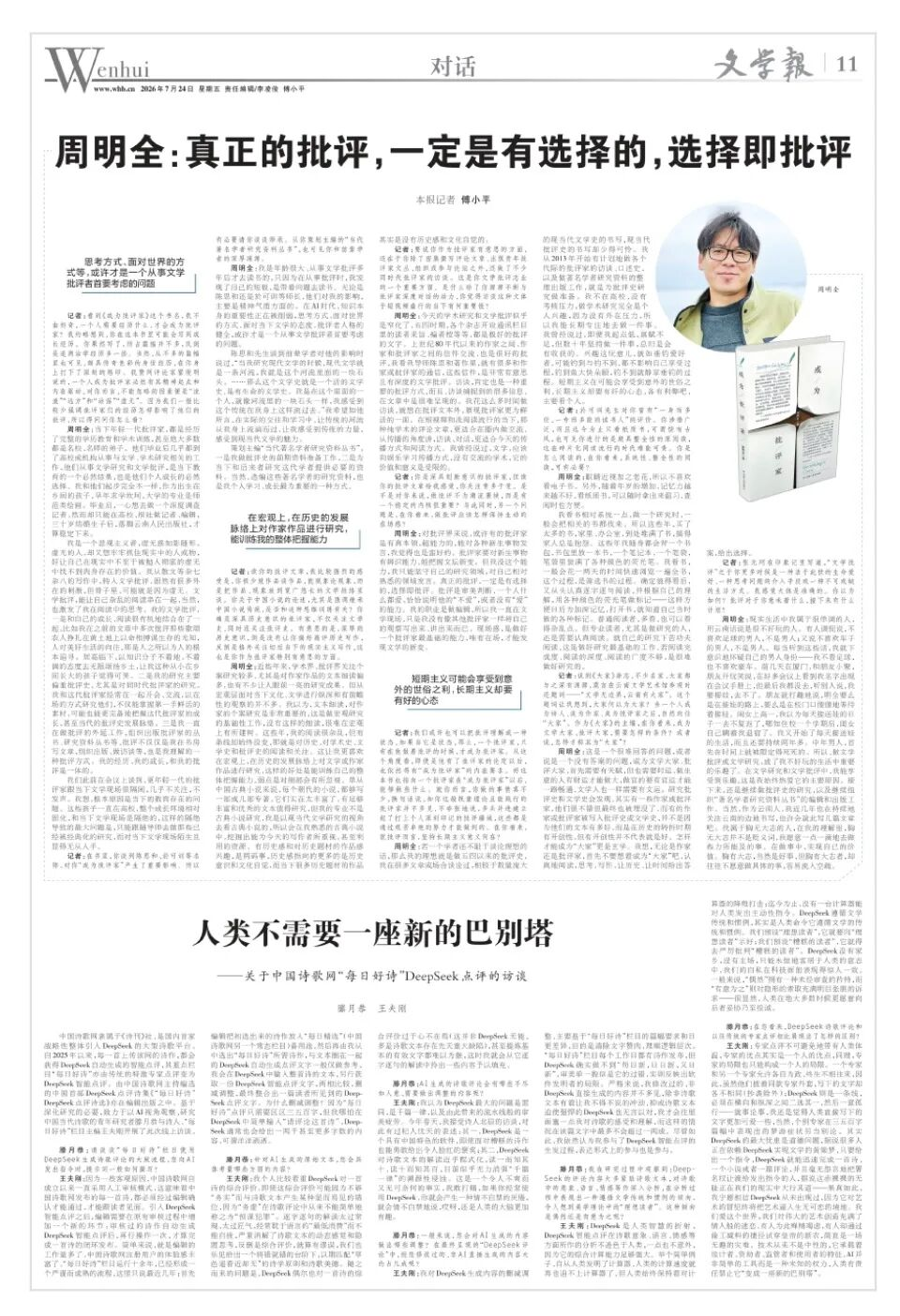
💡China’s major poetry platform reveals what LLMs gain—and lose—when they enter editorial production.
⚡ 30-Second TL;DR
What Changed
Every poem uploaded to China Poetry Net receives an automatically generated DeepSeek critique after editorial screening.
Why It Matters
This is a notable example of human-in-the-loop LLM deployment in a cultural publishing workflow. It demonstrates that automation can expand review coverage, but quality control, stylistic diversity, attribution, and evaluation remain essential for public-facing creative applications.
What To Do Next
Prototype a human-in-the-loop DeepSeek evaluation pipeline that scores factual grounding, repetition, excessive praise, and editor acceptance before publishing generated reviews.
Key Points
- •Every poem uploaded to China Poetry Net receives an automatically generated DeepSeek critique after editorial screening.
- •For the Daily Good Poem column, editors compare generated drafts, remove verbosity, correct logic, and publish a 300–500-word version.
- •Human-authored revisions usually account for no more than 10–20% of the final commentary, except when a poem demands substantial interpretation.
- •The editor identifies repetitive aesthetics, excessive praise of weak poems, and potential misuse of AI-generated content and authorship.
🧠 Deep Insight
AI-generated analysis for this event.
🔑 Enhanced Key Takeaways
- •The integration of DeepSeek into China Poetry Net is part of a broader 'AI + Literature' pilot program supported by regional cultural bureaus to modernize traditional literary critique platforms.
- •DeepSeek's model was fine-tuned on a proprietary dataset consisting of over 50 years of archives from the 'Poetry Periodical' (Shi Kan) to mimic the specific stylistic nuances of Chinese literary criticism.
- •The platform has implemented a 'Human-in-the-Loop' (HITL) verification layer where AI-generated critiques are flagged for 'hallucinated metaphors'—a common issue where the model invents imagery not present in the original poem.
- •China Poetry Net reports a 400% increase in daily editorial throughput since the implementation, allowing the platform to process submissions that were previously backlogged for months.
- •Legal experts in China are currently debating whether the AI-generated critiques on the platform qualify for copyright protection under the 2026 revisions to the Copyright Law regarding AI-assisted works.
🛠️ Technical Deep Dive
- The implementation utilizes a RAG (Retrieval-Augmented Generation) architecture that pulls from a vector database of classical and contemporary Chinese poetry theory.
- The system employs a multi-agent framework where one agent generates the critique, a second agent acts as a 'critic' to check for logical consistency, and a third agent performs stylistic alignment.
- The model leverages DeepSeek's long-context window to analyze the entire corpus of a poet's previous submissions to ensure consistency in the critique's tone and depth.
- Fine-tuning was conducted using LoRA (Low-Rank Adaptation) to minimize computational overhead while maintaining high-fidelity literary analysis capabilities.
🔮 Future ImplicationsAI analysis grounded in cited sources
⏳ Timeline
Weekly AI Recap
Read this week's curated digest of top AI events →
👉Related Updates


AI-curated news aggregator. All content rights belong to original publishers.
Original source: 虎嗅 ↗