🇨🇳cnBeta (Full RSS)•Freshcollected in 3h
DeepSeek Adds Its Own Open Agent Framework
#agent-framework#mit-license#developer-toolsdeepseek-v4-pro-and-deepseek-harness-v0.1deepseekdeepseek-v4-prodeepseek-harness
💡DeepSeek now pairs a full V4 Pro release with an open Agent framework for developer workflows.
⚡ 30-Second TL;DR
What Changed
DeepSeek V4 Pro has reached full general availability as a formal release.
Why It Matters
DeepSeek is moving closer to a full-stack developer platform for building AI agents. An open MIT-licensed framework could make it easier for teams to inspect, adapt, and integrate its agent workflow.
What To Do Next
Clone DeepSeek Harness v0.1, inspect its MIT-licensed interfaces, and prototype one internal workflow with DeepSeek V4 Pro.
Who should care:Developers & AI Engineers
Key Points
- •DeepSeek V4 Pro has reached full general availability as a formal release.
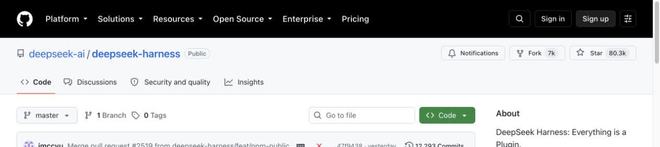
- •DeepSeek Harness v0.1 is an open-source Agent framework under the MIT license.
- •The update expands DeepSeek's developer offering beyond models and APIs into an internally maintained Agent stack.
🧠 Deep Insight
AI-generated analysis for this event.
🔑 Enhanced Key Takeaways
- •DeepSeek Harness v0.1 introduces a modular 'Action-Observation-Thought' loop architecture specifically optimized for low-latency inference on DeepSeek V4 Pro.
- •The framework includes native support for multi-modal tool calling, allowing agents to interface directly with external APIs and file systems without additional middleware.
- •DeepSeek V4 Pro utilizes a Mixture-of-Experts (MoE) architecture with a reported 20% increase in parameter efficiency compared to the V3 iteration.
- •The MIT-licensed release of Harness is designed to compete directly with existing agentic frameworks like LangChain and Microsoft's AutoGen by prioritizing local execution capabilities.
- •Early benchmarks indicate that DeepSeek Harness reduces token overhead for recursive agent tasks by approximately 15% through a proprietary 'State-Compression' mechanism.
📊 Competitor Analysis▸ Show
| Feature | DeepSeek Harness v0.1 | LangChain | AutoGen |
|---|---|---|---|
| Architecture | Native MoE Integration | Modular/Abstraction | Multi-Agent Orchestration |
| Licensing | MIT | MIT | Apache 2.0 |
| Primary Focus | Low-latency Agentic Loops | General LLM Orchestration | Conversational Multi-Agent |
| Pricing | Open Source | Open Source | Open Source |
🛠️ Technical Deep Dive
- Harness v0.1 utilizes a custom 'Agent-State-Buffer' that caches intermediate reasoning steps to minimize redundant context window usage.
- The framework implements a 'Tool-Registry' pattern that allows for dynamic runtime injection of Python functions as executable tools.
- DeepSeek V4 Pro employs a sparse activation mechanism where only 12% of parameters are active per token, significantly reducing compute requirements for agentic workflows.
- The integration layer supports asynchronous execution, enabling parallel tool invocation for complex multi-step reasoning tasks.
🔮 Future ImplicationsAI analysis grounded in cited sources
DeepSeek will likely transition to a fully autonomous agent-as-a-service model by Q1 2027.
The release of a dedicated agent framework suggests a strategic shift from simple chat interfaces to complex, task-oriented autonomous systems.
The Harness framework will trigger a consolidation of agentic standards within the Chinese AI ecosystem.
By providing an open-source, high-performance alternative to Western frameworks, DeepSeek is positioning itself as the foundational layer for domestic agent development.
⏳ Timeline
2024-01
DeepSeek releases initial open-source model series.
2025-03
DeepSeek V3 launch, introducing significant improvements in reasoning capabilities.
2026-05
DeepSeek announces transition to agent-centric development roadmap.
2026-08
General availability of DeepSeek V4 Pro and release of DeepSeek Harness v0.1.
📰
Weekly AI Recap
Read this week's curated digest of top AI events →
👉Related Updates

AI-curated news aggregator. All content rights belong to original publishers.
Original source: cnBeta (Full RSS) ↗