💰钛媒体•Stalecollected in 58m
Deepi Tech: Enterprise Agent Implementation
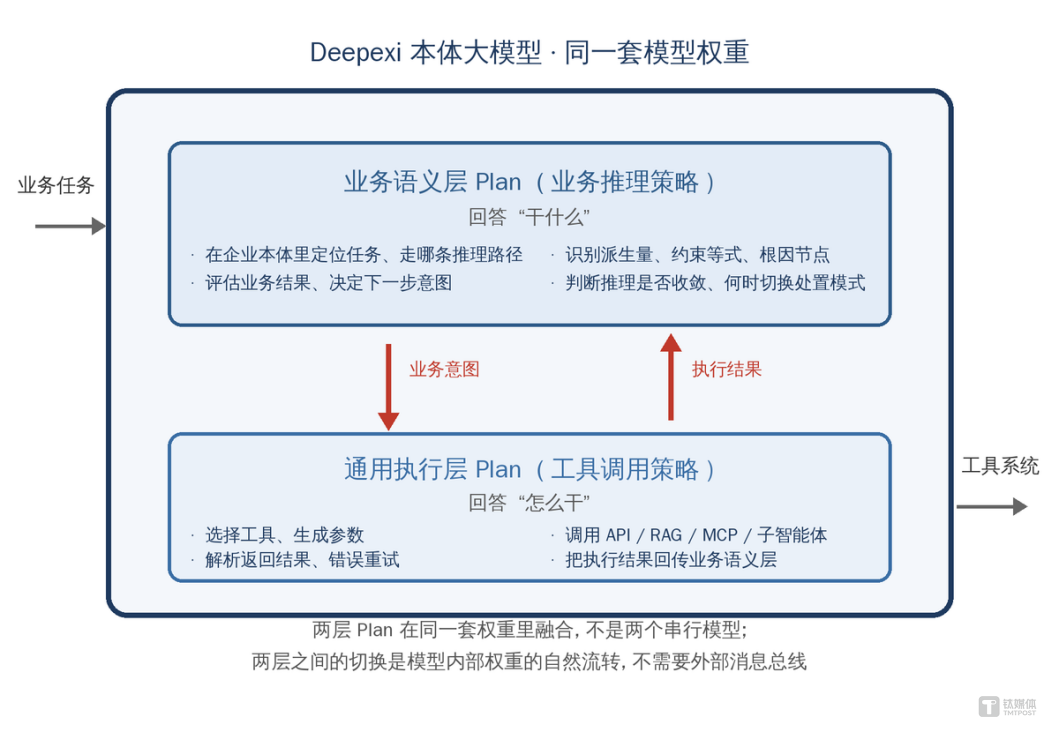
💡Learn how to move beyond generic LLMs to build reliable, domain-specific enterprise agents.
⚡ 30-Second TL;DR
What Changed
Introduction of Ontology LLM concept for enterprises
Why It Matters
Provides a framework for enterprises to build domain-specific AI agents that integrate deeply with existing business logic.
What To Do Next
Evaluate your current knowledge management system to see if it can support an ontology-based RAG architecture.
Who should care:Enterprise & Security Teams
Key Points
- •Introduction of Ontology LLM concept for enterprises
- •Challenges of moving from general AI to enterprise-specific agents
- •Focus on productization of intelligent agent workflows
🧠 Deep Insight
Web-grounded analysis with 12 cited sources.
🔑 Enhanced Key Takeaways
- •Deepi Tech's proprietary "DeepClaw" enterprise-level intelligent agent has been successfully deployed, notably powering "Feng Xiaozhi," China's first AI-powered government service assistant in Zhongguancun Fengtai Park.
- •Ontology LLMs are critical for mitigating common enterprise AI challenges such as hallucination, domain drift, and ensuring regulatory compliance by providing a formal, three-layered semantic grounding that includes Role, Domain, and Interaction ontologies.
- •The Chinese enterprise AI agent market is projected for explosive growth, with active agent deployments expected to exceed 350 million by 2031, driven by government initiatives like the "AI Plus action plan" and the increasing adoption of low-code/no-code platforms.
- •The industry focus for enterprise AI is shifting from raw model capabilities to the operational maturity, product delivery, and ecosystem depth of integrated agent systems, where ontologies serve as a crucial semantic control layer to enhance understanding and reasoning.
🛠️ Technical Deep Dive
- Ontologies are formal, machine-readable specifications of concepts, relationships, and rules within a specific domain, often implemented as knowledge graphs.
- They function as a "semantic control layer" for LLM-based agents, enabling them to comprehend concepts, relationships, rules, and constraints, and to identify when knowledge is incomplete.
- A proposed neurosymbolic architecture for enterprise agentic systems incorporates a three-layer ontological framework: Role, Domain, and Interaction ontologies.
- This framework provides formal semantic grounding, which constrains agent inputs (e.g., context assembly, tool discovery, governance thresholds) and outputs (e.g., response validation, reasoning verification, compliance checking).
- Ontology-driven agents leverage specialized tools such as Gap Capture, Question, Assumption, and Validation tools to operate responsibly within complex enterprise environments, thereby enhancing trust, explainability, reusability, governance, and scalability.
- The integration of ontology-backed knowledge graphs with LLMs is instrumental in reducing hallucinations by grounding AI model output and facilitating traceability of information.
🔮 Future ImplicationsAI analysis grounded in cited sources
Enterprise AI agent adoption will be significantly accelerated by the development and widespread availability of low-code/no-code platforms.
Such platforms lower barriers to entry, enabling a broader range of businesses and developers to build and deploy AI agents without extensive coding expertise, as predicted for the Chinese market.
The 'Ontology LLM' approach will become a standard for ensuring trustworthiness and compliance in enterprise AI applications.
By providing explicit semantic grounding and rule-based constraints, ontologies directly address critical enterprise concerns like hallucination, explainability, and regulatory adherence, which are key for widespread adoption.
⏳ Timeline
2025-12
Zhao Jiehui, CEO of Deepi Tech, spoke at the WISE 2025 Business King Conference, highlighting productization as the core direction for AI in the next three years.
2026-05
Deepi Tech (Dipu Technology) partnered with Zhongguancun Fengtai Park to unveil 'Feng Xiaozhi,' China's first AI-powered government service assistant, leveraging DeepClaw.
📎 Sources (12)
Factual claims are grounded in the sources below. Forward-looking analysis is AI-generated interpretation.
📰
Weekly AI Recap
Read this week's curated digest of top AI events →
👉Related Updates
AI-curated news aggregator. All content rights belong to original publishers.
Original source: 钛媒体 ↗