Curvine Extends LLM KV Cache Beyond GPUs
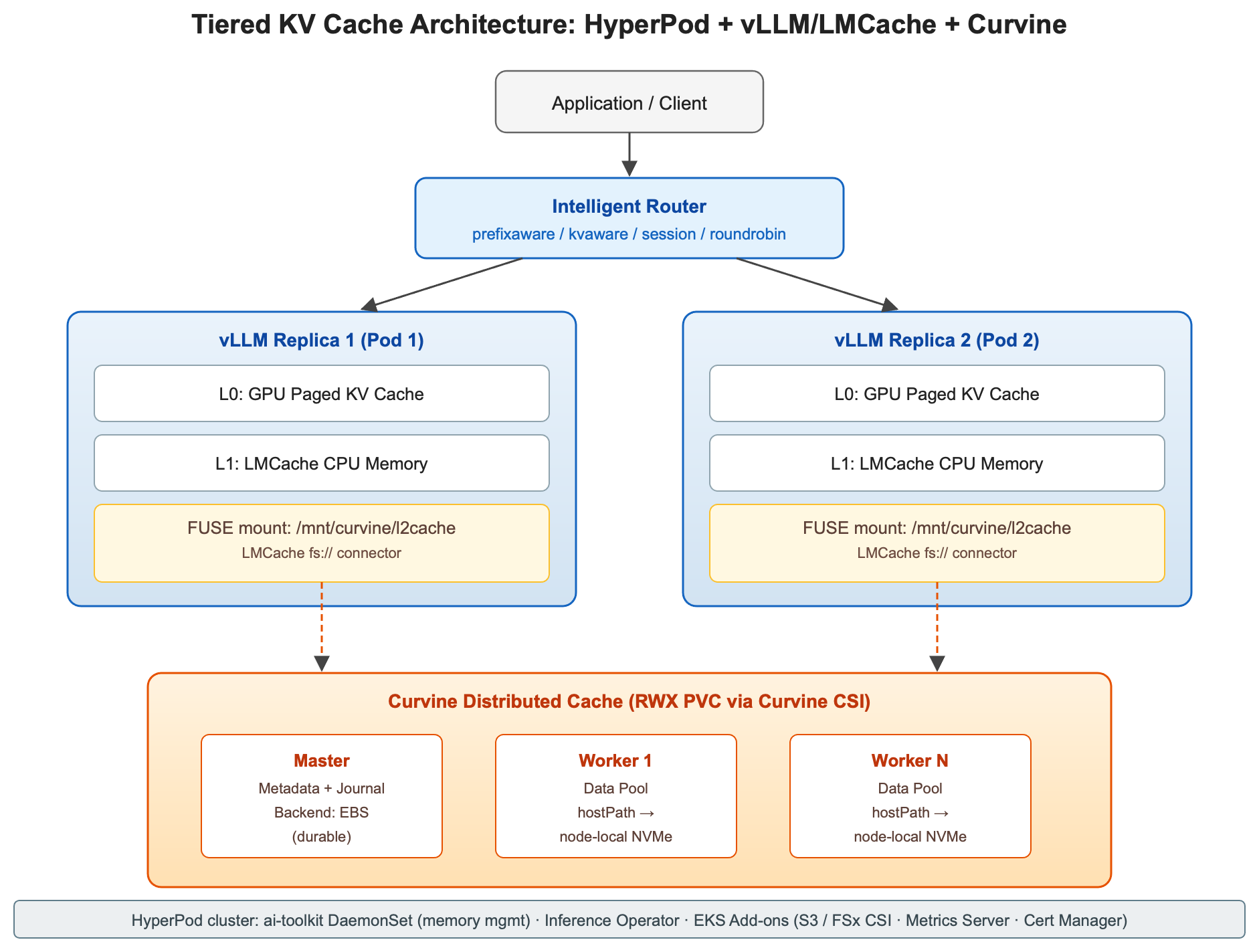
💡See how shared NVMe KV caching can reduce GPU costs without sacrificing near-local cache speed.
⚡ 30-Second TL;DR
What Changed
Builds a tiered KV cache for large-model inference on SageMaker HyperPod
Why It Matters
Shared KV caching can improve inference economics by reducing duplicated cache construction across replicas and avoiding unnecessary GPU memory capacity. The approach is especially relevant to high-throughput serving systems where time-to-first-token and instance cost are major constraints.
What To Do Next
Benchmark Curvine-backed tiered KV caching on SageMaker HyperPod using your production prompt mix and compare time-to-first-token against GPU-only caching.
Key Points
- •Builds a tiered KV cache for large-model inference on SageMaker HyperPod
- •Uses Curvine to provide a shared, distributed NVMe cache pool
- •Allows replicas to reuse KV cache across inference instances
- •Targets faster time-to-first-token on more cost-efficient GPU instances
🧠 Deep Insight
AI-generated analysis for this event.
🔑 Enhanced Key Takeaways
- •Curvine utilizes a proprietary RDMA-based fabric to minimize latency when fetching KV cache blocks from the distributed NVMe pool to GPU memory.
- •The architecture integrates with SageMaker HyperPod's orchestration layer to dynamically adjust cache allocation based on real-time inference request volume.
- •By offloading KV cache to NVMe, the solution enables support for significantly longer context windows (up to 2M+ tokens) without requiring proportional increases in GPU VRAM.
- •The system implements a predictive pre-fetching algorithm that anticipates token generation patterns to mask the latency of moving data from NVMe to GPU.
- •Curvine's implementation supports multi-tenant isolation, ensuring that shared KV cache pools do not leak sensitive prompt data between different inference endpoints.
📊 Competitor Analysis▸ Show
| Feature | Curvine (SageMaker) | vLLM (PagedAttention) | NVIDIA TensorRT-LLM |
|---|---|---|---|
| Cache Location | Distributed NVMe Pool | GPU VRAM / System RAM | GPU VRAM |
| Scaling | Horizontal (Cluster-wide) | Vertical (Node-local) | Vertical (Node-local) |
| Cost Efficiency | High (Reduces GPU count) | Medium (Optimizes VRAM) | Low (Requires high VRAM) |
| Latency | Near-local NVMe | Ultra-low (Memory speed) | Ultra-low (Memory speed) |
🛠️ Technical Deep Dive
- Architecture utilizes a tiered memory hierarchy: L1 (GPU VRAM), L2 (Local NVMe), and L3 (Curvine Distributed NVMe Pool).
- Employs a custom block-swapping manager that interfaces with the PyTorch/TensorFlow runtime to handle asynchronous data transfers.
- Uses a specialized cache eviction policy based on Least Recently Used (LRU) combined with sequence priority scoring.
- Supports GPUDirect Storage (GDS) to bypass CPU bottlenecks during data transfer between the NVMe fabric and GPU memory.
- Implements a unified namespace for KV cache blocks, allowing any node in the HyperPod cluster to access cached states from any other node.
🔮 Future ImplicationsAI analysis grounded in cited sources
⏳ Timeline
Weekly AI Recap
Read this week's curated digest of top AI events →
👉Related Updates
AI-curated news aggregator. All content rights belong to original publishers.
Original source: AWS Machine Learning Blog ↗