🐯虎嗅•Stalecollected in 21m
Ctrip's AI Strategy vs Disruption
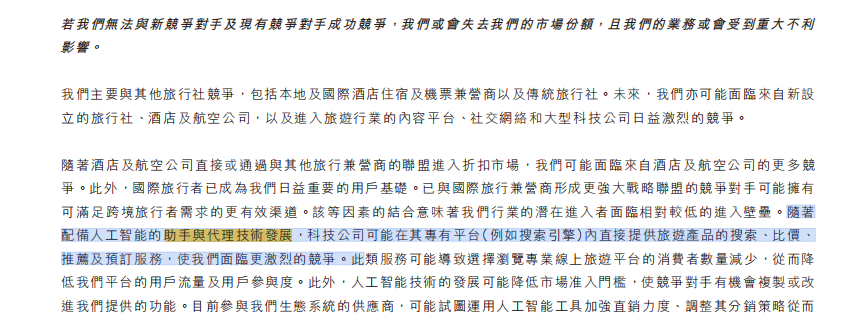
💡Ctrip exposes AI as OTA growth engine + existential threat from ChatGPT agents
⚡ 30-Second TL;DR
What Changed
AI integrated deeply via TripGenie assistant and Trip.Planner for itinerary optimization.
Why It Matters
Highlights OTAs' need to evolve into AI-powered platforms to counter agentic AI threats. Signals shift in travel industry where AI redefines traffic and moats. Ctrip's global push strengthens but faces pricing pressures.
What To Do Next
Review Ctrip's 20-F report for AI defense strategies against agentic disruption in apps.
Who should care:Founders & Product Leaders
Key Points
- •AI integrated deeply via TripGenie assistant and Trip.Planner for itinerary optimization.
- •Fears competition from AI agents on platforms like Siri or ChatGPT handling full bookings.
- •Accommodation revenue up 21% to 26.1B RMB, driving growth.
- •Traffic tickets proportion declines to 36% amid supplier controls.
🧠 Deep Insight
AI-generated analysis for this event.
🔑 Enhanced Key Takeaways
- •Ctrip (Trip.com Group) has shifted its R&D focus toward 'Vertical AI' models, specifically fine-tuning large language models on proprietary travel-industry datasets to reduce hallucinations in itinerary generation compared to general-purpose LLMs.
- •The company is actively pursuing a 'Global AI Strategy' by integrating TripGenie across its international Trip.com brand, aiming to capture higher-margin outbound travel demand from Asian markets as a hedge against domestic market saturation.
- •Ctrip's financial reporting indicates a strategic pivot toward 'High-Frequency to High-Margin' conversion, utilizing AI-driven personalized recommendations to increase cross-selling of ancillary services (tours, insurance, local experiences) to offset the declining revenue share of standardized traffic tickets.
📊 Competitor Analysis▸ Show
| Feature | Ctrip (Trip.com) | Expedia Group | Booking Holdings |
|---|---|---|---|
| AI Strategy | Vertical AI (TripGenie) | Romie (AI Travel Assistant) | AI Trip Planner (GenAI) |
| Primary Focus | Integrated Travel Ecosystem | B2B/B2C Hybrid | Accommodation-First |
| Market Strength | Asia-Pacific Dominance | North American/European Scale | Global Hotel Inventory |
🛠️ Technical Deep Dive
- •Implementation of a 'Travel-Specific Knowledge Graph' that maps real-time inventory (flights, hotels, attractions) to LLM prompts to ensure factual accuracy in booking availability.
- •Utilization of a multi-agent architecture where specialized agents handle distinct tasks: one for semantic search/intent recognition, another for constraint-based itinerary optimization, and a third for secure transaction processing.
- •Deployment of RAG (Retrieval-Augmented Generation) pipelines that prioritize low-latency access to Ctrip's proprietary historical booking data and user preference profiles to personalize search results.
🔮 Future ImplicationsAI analysis grounded in cited sources
Ctrip will transition from an OTA to a 'Travel AI Orchestrator' by 2027.
The integration of AI agents into the booking flow suggests a shift toward managing the entire travel lifecycle rather than just facilitating individual transactions.
Direct-booking AI agents will force Ctrip to lower commission rates for hotel partners.
As AI agents reduce the discovery value provided by OTAs, hotels will exert pressure on intermediaries to maintain price parity and reduce distribution costs.
⏳ Timeline
2023-07
Ctrip officially launches TripGenie, an AI-powered travel assistant integrated into its app.
2024-03
Ctrip reports record-breaking international travel recovery, heavily supported by AI-driven marketing tools.
2025-05
Ctrip announces the expansion of its AI-driven 'Trip.Planner' to support multi-destination complex itinerary building.
📰
Weekly AI Recap
Read this week's curated digest of top AI events →
👉Related Updates




AI-curated news aggregator. All content rights belong to original publishers.
Original source: 虎嗅 ↗