Cost-Efficient Text-to-SQL with Nova Micro
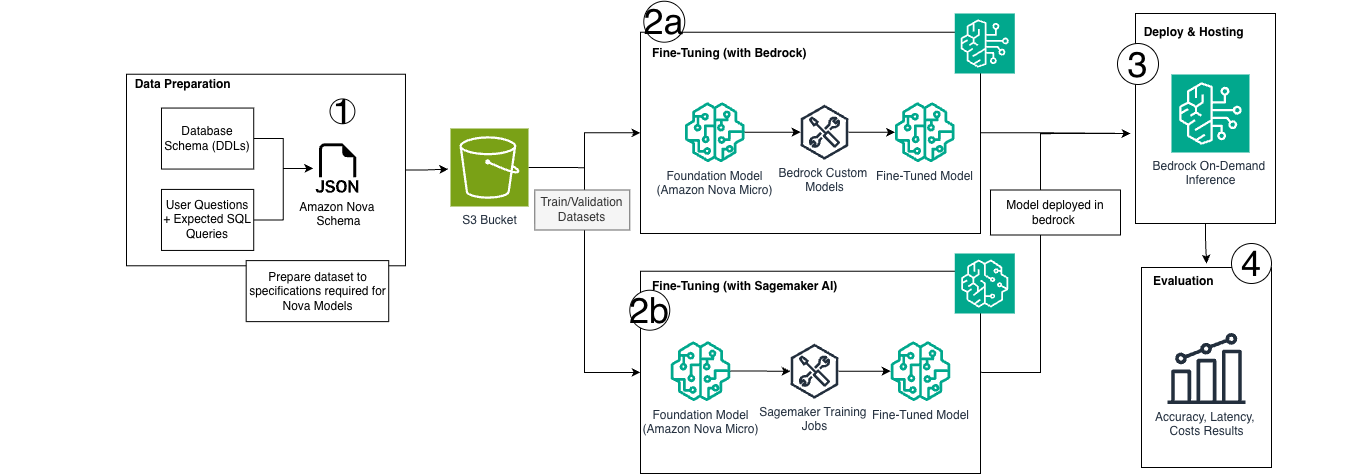
💡Unlock cheap, production-ready text-to-SQL via Nova Micro fine-tuning on Bedrock
⚡ 30-Second TL;DR
What Changed
Two fine-tuning methods for custom SQL dialects
Why It Matters
Developers can deploy affordable, high-performance text-to-SQL models, reducing infrastructure costs while scaling to production workloads in data-heavy applications.
What To Do Next
Fine-tune Amazon Nova Micro on your SQL dataset using Bedrock's on-demand inference.
Key Points
- •Two fine-tuning methods for custom SQL dialects
- •Integrates Amazon Bedrock on-demand inference
- •Balances cost savings and production performance
- •Targets text-to-SQL generation efficiency
🧠 Deep Insight
AI-generated analysis for this event — not the original article.
🔑 Enhanced Key Takeaways
- •Amazon Nova Micro is positioned as a lightweight, high-throughput model specifically optimized for low-latency tasks, distinguishing it from the larger Nova Pro and Premier variants in the Amazon Nova foundation model family.
- •The fine-tuning approaches leverage Amazon Bedrock's managed fine-tuning service, which allows users to create custom model versions without managing underlying infrastructure, directly addressing data privacy and security requirements for enterprise database schemas.
- •The cost-efficiency model relies on the architectural design of Nova Micro, which utilizes a smaller parameter count to reduce token-per-second latency and inference costs compared to general-purpose LLMs when applied to structured SQL generation tasks.
📊 Competitor Analysis▸ Show
| Feature | Amazon Nova Micro | GPT-4o-mini | Claude 3 Haiku |
|---|---|---|---|
| Primary Use Case | Enterprise SQL/Structured Data | General Purpose/Low Latency | Low Latency/High Throughput |
| Fine-tuning | Supported via Bedrock | Supported via OpenAI API | Supported via Bedrock/Anthropic |
| Pricing Model | On-demand/Provisioned | On-demand/Batch | On-demand/Provisioned |
| SQL Benchmarks | Optimized for custom dialects | Strong zero-shot SQL | Strong zero-shot SQL |
🛠️ Technical Deep Dive
- Model Architecture: Nova Micro is a multimodal foundation model designed for high-speed, low-latency inference, utilizing a distilled architecture optimized for instruction-following in structured data environments.
- Fine-tuning Mechanism: Utilizes Amazon Bedrock's fine-tuning API, which supports supervised fine-tuning (SFT) on custom datasets, allowing for the injection of proprietary SQL dialect syntax and schema-specific patterns.
- Inference Optimization: Supports both on-demand throughput and provisioned throughput, enabling predictable performance for high-volume text-to-SQL applications.
- Context Window: Optimized for short-to-medium context lengths typical of database schema definitions and query generation prompts.
🔮 Future ImplicationsAI analysis grounded in cited sources
⏳ Timeline
Weekly AI Recap
Read this week's curated digest of top AI events →
👉Related Updates
AI-curated news aggregator. All content rights belong to original publishers.
Original source: AWS Machine Learning Blog ↗
This is a summary, not the original. Read the source, or get the weekly briefing.
The weekly digest
One email a week. Unsubscribe anytime.