Colleagues.Skill Hype Debunked
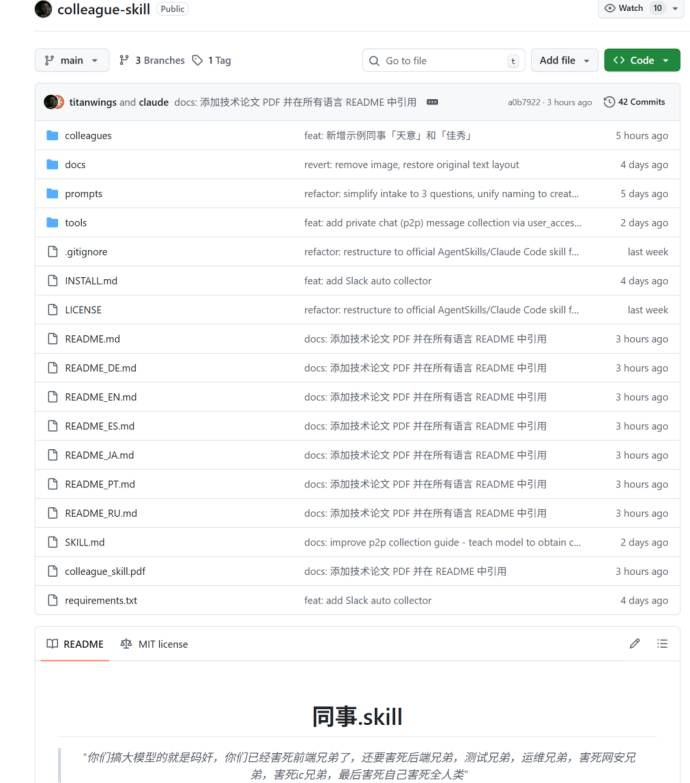
💡Viral tool mimics colleagues via prompts—exposes limits & legal risks for agent builders.
⚡ 30-Second TL;DR
What Changed
Python scripts crawl Feishu, DingTalk, WeChat, emails to generate persona.md, work.md files.
Why It Matters
Debunks overhyping of persona agents as colleague replacements, stressing technical limits and data privacy compliance needs.
What To Do Next
Clone colleagues.Skill GitHub repo to prototype custom persona agents with prompt engineering.
Key Points
- •Python scripts crawl Feishu, DingTalk, WeChat, emails to generate persona.md, work.md files.
- •Claude uses 5-layer persona prompts for role-play; no model training or vector database.
- •Limitations: GIGO effect, expert paradox, no intuition or complex decision-making capture.
- •Legal violation: Post-employment data use without consent breaches Personal Information Protection Law.
🧠 Deep Insight
AI-generated analysis for this event — not the original article.
🔑 Enhanced Key Takeaways
- •The project gained traction primarily within Chinese developer communities on GitHub as a 'digital twin' experiment, sparking intense debate regarding the ethics of 'data scraping' one's own professional history for AI training.
- •Security researchers identified that the project's reliance on local, unencrypted Markdown files creates significant data leakage risks if the host machine is compromised or if the files are synced to insecure cloud storage.
- •The tool's architecture lacks RAG (Retrieval-Augmented Generation) capabilities, meaning it cannot dynamically query the historical data, forcing the model to rely entirely on the context window, which leads to rapid token exhaustion and degradation of persona consistency.
🛠️ Technical Deep Dive
- •Implementation relies on a series of Python-based scrapers targeting local application data directories for Feishu (Lark), DingTalk, and WeChat PC clients.
- •Data processing pipeline converts proprietary chat logs into structured Markdown files (persona.md, work.md) using regex-based parsing.
- •The 'persona' is injected via a static system prompt template that instructs the LLM (specifically Claude 3.5 Sonnet/Opus via API) to adopt the tone and vocabulary found in the parsed files.
- •Lacks a vector database or embedding layer, resulting in a stateless interaction model where the AI has no long-term memory of previous sessions.
🔮 Future ImplicationsAI analysis grounded in cited sources
⏳ Timeline
Weekly AI Recap
Read this week's curated digest of top AI events →
👉Related Updates

AI-curated news aggregator. All content rights belong to original publishers.
Original source: 虎嗅 ↗
This is a summary, not the original. Read the source, or get the weekly briefing.
Weekly AI briefing
One email a week. Unsubscribe anytime.