Cloudflare partners with major browsers on privacy-first anti-bot protocol
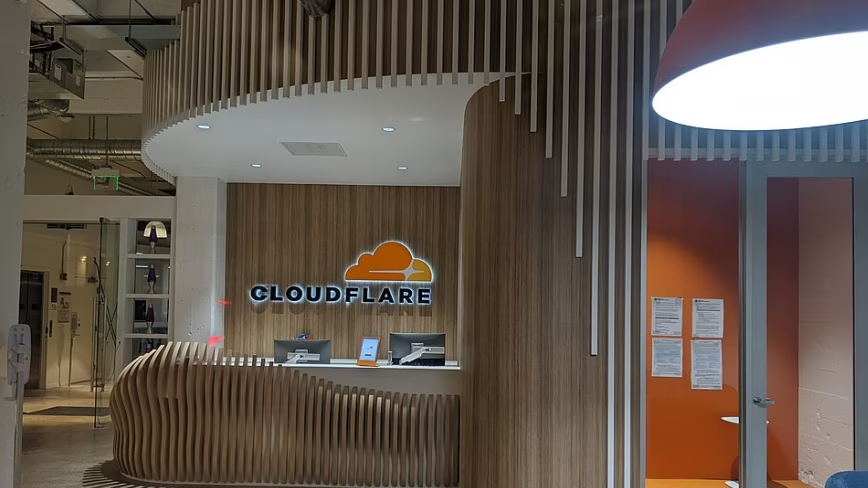
Learn how a new browser-native protocol will replace CAPTCHAs and change how bots interact with the web.
30-Second TL;DR
What Changed
Joint initiative between Cloudflare, Google, Mozilla, and Microsoft.
Why It Matters
This protocol could significantly reduce friction in web interactions and improve data privacy standards for AI-driven web scraping and bot management.
What To Do Next
Monitor the implementation of Private Access Control Tokens to ensure your web scraping or data collection bots remain compliant with new verification standards.
Key Points
- •Joint initiative between Cloudflare, Google, Mozilla, and Microsoft.
- •Replaces CAPTCHAs with anonymous cryptographic tokens to verify human users.
- •Enhances user privacy by eliminating the need for tracking-based bot detection.
Deep Insight
AI-generated analysis for this event — not the original article.
Enhanced Key Takeaways
- •The protocol utilizes the Privacy Pass extension standard, which leverages Blind Signatures to allow servers to validate user authenticity without learning the user's identity.
- •This initiative is part of the broader IETF (Internet Engineering Task Force) standardization efforts under the Privacy Pass working group to create interoperable anti-bot mechanisms.
- •The system operates by having the browser perform a background cryptographic challenge-response with the issuer (e.g., Cloudflare) before the user even reaches the destination site.
- •It significantly reduces latency compared to traditional CAPTCHAs, as the token validation happens at the edge network layer without requiring user interaction.
- •The protocol is designed to be 'attestation-based,' meaning the browser provides proof that the device environment is secure and not running known bot automation frameworks.
Competitor Analysis
- Cloudflare Private Access Tokens
- Zero-knowledge/Anonymous
- hCaptcha (Enterprise)
- Data-collection based
- Akamai Bot Manager
- Behavioral/Fingerprinting
- Turnstile (Cloudflare)
- Privacy-focused/Non-interactive
- Cloudflare Private Access Tokens
- None (Background)
- hCaptcha (Enterprise)
- Low to High
- Akamai Bot Manager
- Low
- Turnstile (Cloudflare)
- None
- Cloudflare Private Access Tokens
- Cryptographic Tokens
- hCaptcha (Enterprise)
- Visual/Logic Challenges
- Akamai Bot Manager
- ML/Fingerprinting
- Turnstile (Cloudflare)
- Browser Attestation
| Feature | Cloudflare Private Access Tokens | hCaptcha (Enterprise) | Akamai Bot Manager | Turnstile (Cloudflare) |
|---|---|---|---|---|
| Privacy Model | Zero-knowledge/Anonymous | Data-collection based | Behavioral/Fingerprinting | Privacy-focused/Non-interactive |
| User Friction | None (Background) | Low to High | Low | None |
| Primary Mechanism | Cryptographic Tokens | Visual/Logic Challenges | ML/Fingerprinting | Browser Attestation |
Technical Deep Dive
- Uses the HTTP Authentication Scheme 'PrivateToken' as defined in RFC 9497.
- Employs VOPRF (Verifiable Oblivious Pseudo-Random Function) to ensure the issuer cannot link the token issuance to the token redemption.
- The browser acts as a client that requests a token from an issuer, which is then presented to the origin server (the 'redeemer').
- The redemption process involves a double-spend protection mechanism to prevent a single token from being used across multiple sessions.
- Supports hardware-backed attestation (e.g., TPM or Secure Enclave) to verify the integrity of the browser environment.
Future ImplicationsAI analysis grounded in cited sources
Timeline
- 2021-09Cloudflare announces the first implementation of Privacy Pass to replace CAPTCHAs.
- 2022-05Apple integrates Private Access Tokens into iOS and macOS to support Cloudflare's initiative.
- 2023-08Cloudflare launches Turnstile, a non-interactive CAPTCHA alternative utilizing similar cryptographic principles.
- 2024-02IETF publishes RFC 9497, standardizing the Privacy Pass protocol for global browser adoption.
Weekly AI Recap
Read this week's curated digest of top AI events →
Related Updates


AI-curated news aggregator. All content rights belong to original publishers.
Original source: The Next Web (TNW) ↗
This is a summary, not the original. Read the source, or get the weekly briefing.
The weekly digest
One email a week. Unsubscribe anytime.