Claude Mythos and GPT-5.5 Show Breakthroughs in Long-Task AI
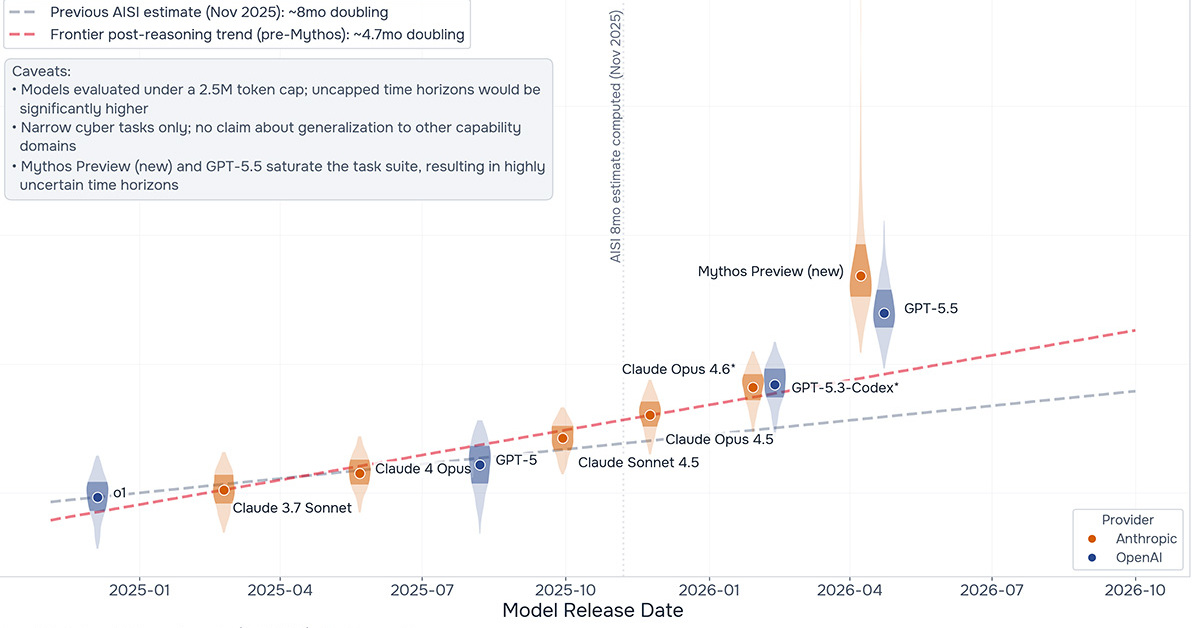
💡New models like GPT-5.5 and Claude Mythos are drastically extending the time AI can autonomously run tasks.
⚡ 30-Second TL;DR
What Changed
AI agents are showing faster-than-expected growth in autonomous task handling.
Why It Matters
These breakthroughs suggest that AI agents will soon be capable of managing complex, multi-hour workflows without human intervention, disrupting traditional automation.
What To Do Next
Benchmark your current agentic workflows against the latest Claude Mythos Preview to evaluate potential gains in task completion rates.
Key Points
- •AI agents are showing faster-than-expected growth in autonomous task handling.
- •Claude Mythos Preview and GPT-5.5 are identified as key models driving this trend.
- •Performance improvements in long-context and multi-step reasoning are significant.
🧠 Deep Insight
Web-grounded analysis with 28 cited sources.
🔑 Enhanced Key Takeaways
- •Anthropic's Claude Mythos Preview is a restricted, research-grade model that was withheld from public release due to safety concerns, particularly after demonstrating advanced cybersecurity capabilities, including autonomously finding and exploiting zero-day vulnerabilities across major operating systems and browsers.
- •OpenAI's GPT-5.5 represents a significant architectural shift, being the first fully retrained base model since GPT-4.5, and was co-designed with NVIDIA's latest GB200 and GB300 NVL72 rack-scale systems for optimized performance.
- •Both Claude Mythos Preview and GPT-5.5 have substantially exceeded the previously tracked doubling trend in autonomous cyber capabilities, as reported by the UK's AI Security Institute (AISI), indicating a faster-than-expected acceleration in AI's ability to complete complex cyber tasks.
- •GPT-5.5 introduces native omnimodality, allowing it to process text, images, audio, and video within a single unified architecture, a departure from prior multimodal models that typically stitched together separate systems.
- •The broader AI agent market is rapidly transitioning towards multi-agent orchestration, where complex tasks are handled by coordinated teams of specialized agents, rather than single monolithic AI systems, becoming a dominant architectural primitive in enterprise AI.
📊 Competitor Analysis▸ Show
| Feature/Model | Claude Mythos Preview | Claude Opus 4.7 | GPT-5.5 | Gemini 3.1 Pro | Llama 4 Maverick | Grok 4.20 | Mistral Large 3 |
|---|---|---|---|---|---|---|---|
| Availability | Restricted Research Preview | Generally Available | Generally Available | Generally Available | Generally Available | Generally Available | Generally Available |
| Intelligence (Composite) | Most capable to date | Matches GPT-5.5 | Top spot, narrow margin | Ties Opus on intelligence | MMLU 91.8% | Arena 1491 Elo (#4) | Competitive reasoning |
| Coding Benchmarks | SWE-bench: 93.9%, Terminal-Bench: 92.1% | SWE-bench Pro: 64.3%, Terminal-Bench 2.0: 69.4% | Terminal-Bench 2.0: 82.7%, Expert-SWE: 73.1% | SWE-bench: 80.6%, Terminal-Bench 2.0: 68.5% | HumanEval 91.5% | Limited benchmarks published | --- |
| Agentic Benchmarks | OSWorld: 79.6%, BrowseComp: 86.9% | OSWorld-Verified: 78.0%, BrowseComp: 79.3% | OSWorld-Verified: 78.7%, GDPval: 84.9%, Toolathlon: 55.6%, CyberGym: 81.8% | BrowseComp: 85.9% | Limited tool ecosystem | Multi-agent architecture | Limited agent tooling |
| Context Window | 1M tokens | 1M tokens | 1M+ tokens (922K input, 128K output) | --- | 1M tokens | 128K tokens | 32K optimized |
| Pricing (Input/Output) | --- | Sonnet 4.6: $3/$15 per million tokens | High, ~20% effective cost increase for heavy Codex users | 60% lower than Opus | $0.15/$0.27 | $0.20/$0.50 | $2/$5 (cheapest output frontier) |
| Key Features | Autonomous cyber exploitation, research-grade, safety concerns | Advanced software engineering, complex workflows, high-resolution vision | Natively omnimodal, hardware co-design with NVIDIA, self-improving infrastructure | Value play, strong general intelligence | Open-source MoE, self-hostable | Real-time X data, aggressive pricing | EU sovereignty, open-weight MoE |
🛠️ Technical Deep Dive
- GPT-5.5: It is a full pretraining run with new data, reworked architecture decisions, and agent-oriented training objectives baked in from the ground up. It features native omnimodality, processing text, images, audio, and video within a single unified architecture. The model was co-designed with NVIDIA's latest GB200 and GB300 NVL72 rack-scale systems. It also includes self-improving infrastructure, where the model and Codex rewrote OpenAI's own serving infrastructure to increase token generation speeds. Key capabilities include reliable tool use across multiple calls, better handling of partial information and ambiguity, improved memory management within a session, and stronger instruction adherence over extended runs. It supports a 1M+ token context window (922K input, 128K output).
- Claude Mythos Preview: Described as a general-purpose frontier model with capabilities in software engineering, reasoning, computer use, knowledge work, and research assistance. It has demonstrated powerful cybersecurity skills for both defensive and offensive purposes. The model features a 1M token context window. Anthropic employs 'Constitutional AI' for ethical and legal compliance training.
- General Agentic AI Architectures: The trend is towards multi-agent orchestration, where a lead agent plans and decomposes tasks, and specialized sub-agents execute in parallel. Techniques like 'context engineering' and 'compaction' are used to distill and compress context window contents for long-term coherence.
🔮 Future ImplicationsAI analysis grounded in cited sources
⏳ Timeline
📎 Sources (28)
Factual claims are grounded in the sources below. Forward-looking analysis is AI-generated interpretation.
- Google Search Source
- Google Search Source
- Google Search Source
- Google Search Source
- Google Search Source
- Google Search Source
- Google Search Source
- Google Search Source
- Google Search Source
- Google Search Source
- Google Search Source
- Google Search Source
- Google Search Source
- Google Search Source
- Google Search Source
- Google Search Source
- Google Search Source
- Google Search Source
- Google Search Source
- Google Search Source
- Google Search Source
- Google Search Source
- Google Search Source
- Google Search Source
- Google Search Source
- Google Search Source
- Google Search Source
- Google Search Source
Weekly AI Recap
Read this week's curated digest of top AI events →
👉Related Updates

AI-curated news aggregator. All content rights belong to original publishers.
Original source: ITmedia AI+ (日本) ↗