Claude Cowork Adds a Built-In Browser
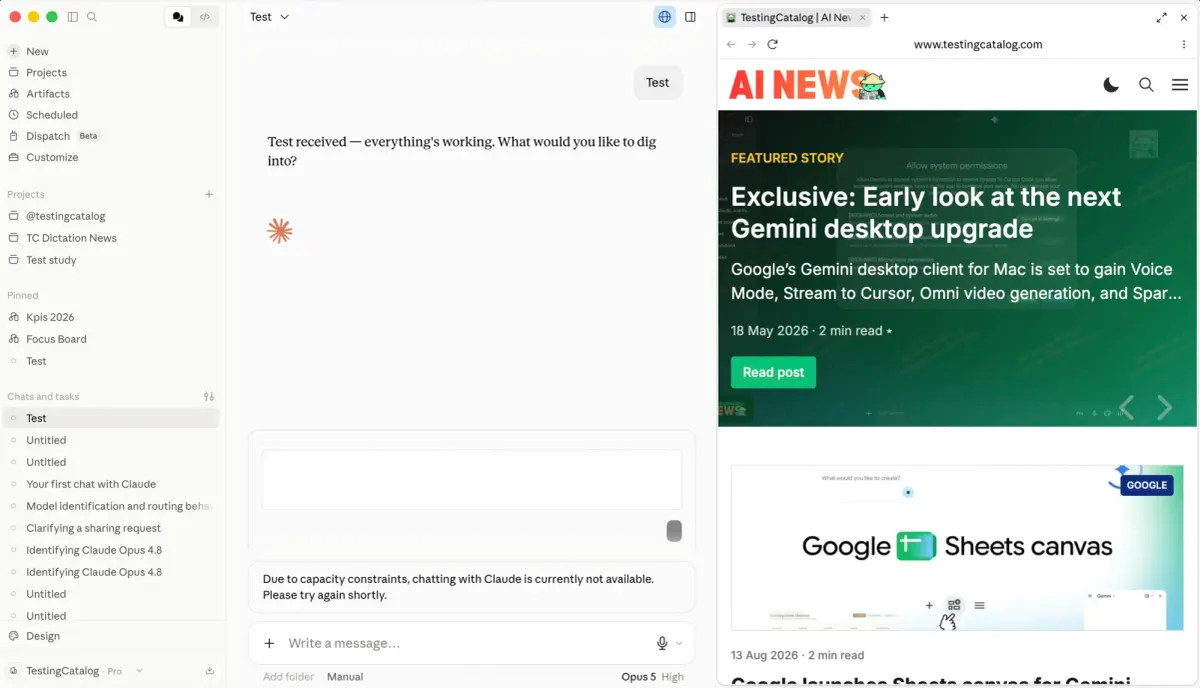
💡Claude Cowork may gain native web access and a new way to compare model outputs.
⚡ 30-Second TL;DR
What Changed
A built-in web browser is being developed for Claude Desktop Cowork sessions.
Why It Matters
A browser-native Cowork experience could make Claude more useful for research, automation, and multi-step computer tasks. Model comparison could also support more systematic evaluation when selecting Claude variants for workflows.
What To Do Next
Review your Cowork workflows and identify browser-dependent tasks to test when Anthropic releases the built-in browser.
Key Points
- •A built-in web browser is being developed for Claude Desktop Cowork sessions.
- •The browser would expand Cowork's ability to interact with web-based information and tools.
- •A comparison mode is also in development for assessing Claude model outputs.
🧠 Deep Insight
AI-generated analysis for this event.
🔑 Enhanced Key Takeaways
- •The 'Cowork' feature is part of Anthropic's broader strategy to transition Claude from a chatbot into an autonomous agent capable of executing multi-step workflows on a user's local machine.
- •The built-in browser is designed to bypass traditional API limitations by allowing Claude to interact directly with web interfaces, effectively enabling 'Computer Use' capabilities within the desktop environment.
- •Comparison mode is expected to leverage Anthropic's 'Model Switching' architecture, allowing users to run prompts through different versions (e.g., Claude 3.5 Sonnet vs. future iterations) side-by-side to evaluate reasoning quality.
- •This development aligns with Anthropic's 'Agentic' roadmap, which prioritizes reducing latency in tool-use scenarios by keeping the browser session state persistent within the desktop application.
- •The integration is being built with a focus on security sandboxing, ensuring that Claude's browser interactions are isolated from the user's primary system files and credentials.
📊 Competitor Analysis▸ Show
| Feature | Claude (Cowork) | OpenAI (Operator) | Google (Project Jarvis) |
|---|---|---|---|
| Primary Focus | Desktop Agentic Workflow | Web-based Task Automation | Browser-integrated Assistance |
| Browser Integration | Built-in Desktop Browser | External/Integrated Browser | Chrome-native Integration |
| Model Comparison | Native Side-by-Side | Limited/Third-party | Not natively supported |
🛠️ Technical Deep Dive
- The browser implementation utilizes a Chromium-based headless engine integrated directly into the Claude Desktop Electron wrapper.
- Agentic interactions are facilitated via a custom WebDriver protocol that translates Claude's natural language commands into DOM-level actions.
- Comparison mode utilizes a multi-threaded inference pipeline that caches prompt tokens to reduce redundant processing when switching between models.
- The system employs a 'Human-in-the-loop' (HITL) verification layer that requires user confirmation for high-stakes browser actions like form submissions or payments.
🔮 Future ImplicationsAI analysis grounded in cited sources
⏳ Timeline
Weekly AI Recap
Read this week's curated digest of top AI events →
👉Related Updates
AI-curated news aggregator. All content rights belong to original publishers.
Original source: TestingCatalog ↗