⚛️Ars Technica•Stalecollected in 18h
Claude Agents Add 'Dream' Feature, Double Code Limits
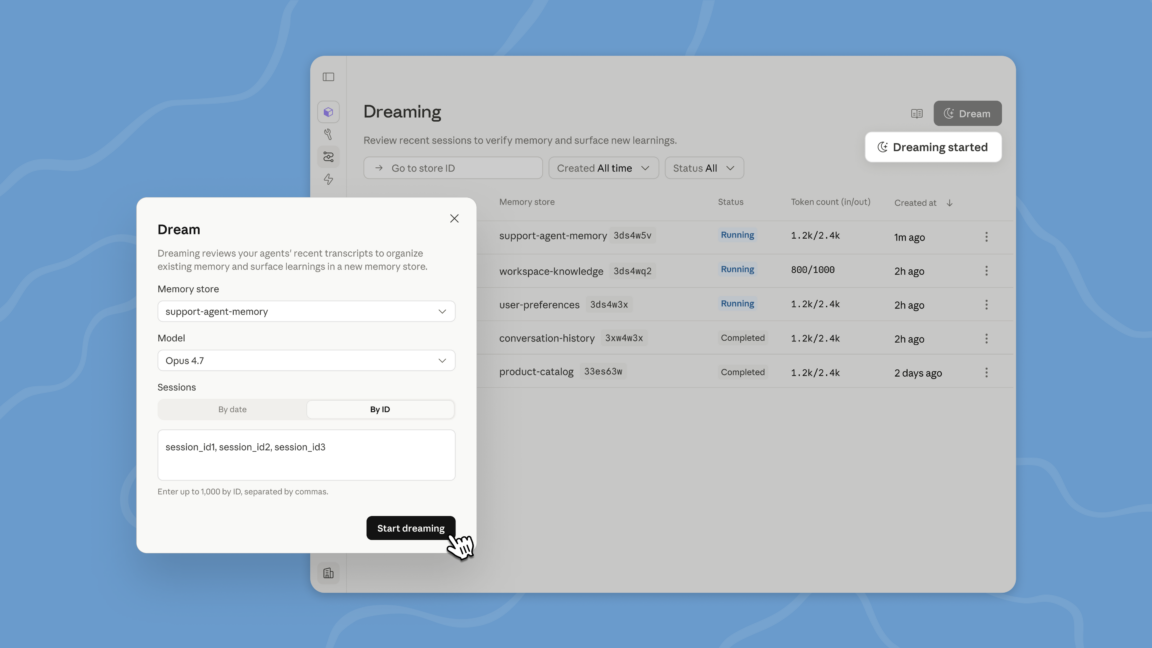
💡Dreaming agents + doubled Code limits unlock better AI dev productivity
⚡ 30-Second TL;DR
What Changed
Claude Managed Agents gain 'dream' functionality
Why It Matters
Agents improve via reflective 'dreaming,' boosting autonomy. Extended Code limits aid sustained dev sessions for pro users.
What To Do Next
Test the 'dream' feature in your Claude Managed Agents configuration now.
Who should care:Developers & AI Engineers
Key Points
- •Claude Managed Agents gain 'dream' functionality
- •5-hour limits double for Pro/Max Claude Code users
- •'Dream' enables sort-of reflection during idle periods
🧠 Deep Insight
AI-generated analysis for this event.
🔑 Enhanced Key Takeaways
- •The 'dream' feature utilizes a background compute process that allows agents to perform iterative self-correction and plan refinement without consuming active user-session tokens.
- •The doubling of code limits for Pro/Max tiers is a strategic response to increased token consumption patterns observed in long-running autonomous coding tasks.
- •Anthropic has integrated 'dream' states with their latest model iteration, Claude 3.7 Opus, which specifically optimizes for the reasoning-heavy workloads required by these autonomous agents.
📊 Competitor Analysis▸ Show
| Feature | Claude Managed Agents | GitHub Copilot Workspace | Cursor (Composer) |
|---|---|---|---|
| Autonomous Reflection | 'Dream' (Idle-time compute) | Limited/None | Iterative planning (active) |
| Pricing Model | Tiered (Pro/Max) | Subscription | Subscription + Usage |
| Primary Focus | Agentic reasoning | IDE integration | Codebase context awareness |
🛠️ Technical Deep Dive
- •The 'dream' mechanism functions as a low-priority background process that triggers during agent idle states to perform 'thought-chain pruning' and 'state-space exploration'.
- •It leverages a specialized latent-space buffer that stores intermediate reasoning steps, allowing the agent to resume complex tasks with pre-computed context.
- •The limit increase is supported by a new dynamic token-allocation architecture that prioritizes 'reasoning tokens' over 'output tokens' for agentic workflows.
🔮 Future ImplicationsAI analysis grounded in cited sources
Autonomous agent workflows will shift from synchronous to asynchronous execution models.
The success of 'dream' features suggests that background processing will become the standard for managing complex, multi-step coding tasks.
Token-based pricing will become secondary to 'compute-time' pricing for agentic platforms.
As agents perform more background 'thinking', traditional per-token billing becomes less reflective of actual infrastructure costs.
⏳ Timeline
2024-03
Anthropic releases Claude 3 family, establishing the foundation for agentic capabilities.
2024-10
Anthropic introduces 'Computer Use' capability, allowing Claude to interact with software interfaces.
2025-02
Launch of Claude Code, the command-line interface for autonomous software development.
2026-02
Anthropic releases Claude 3.7 Opus, optimized for high-reasoning agentic tasks.
📰
Weekly AI Recap
Read this week's curated digest of top AI events →
👉Related Updates
AI-curated news aggregator. All content rights belong to original publishers.
Original source: Ars Technica ↗