Chinese Robotaxis Accelerate Global Rollouts
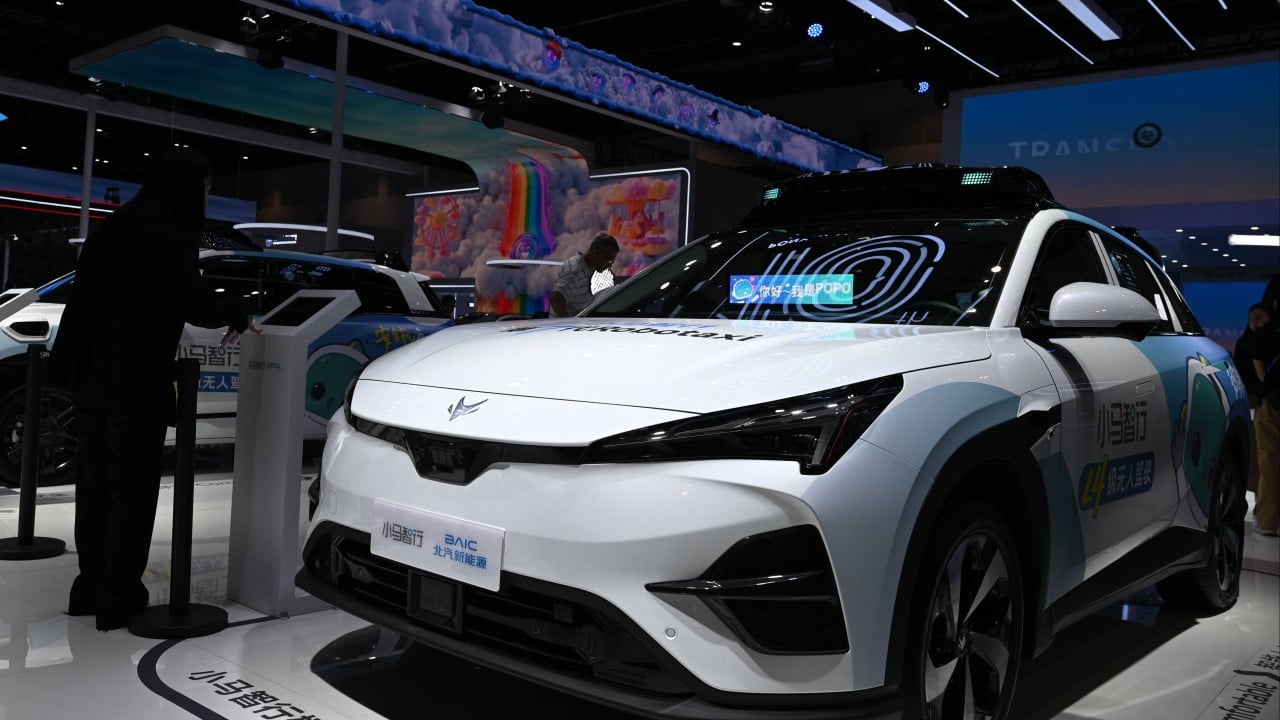
💡China robotaxis <$34K drive global expansion, cost edge vs Waymo
⚡ 30-Second TL;DR
What Changed
Pony AI and WeRide accelerating international robotaxi fleet rollouts
Why It Matters
Lower costs challenge Western AV firms like Waymo, potentially speeding global robotaxi adoption. AI practitioners gain insights into supply chain's role in scaling embodied AI deployments.
What To Do Next
Benchmark Pony.ai Gen7 costs against your AV hardware stack for supply chain optimization.
Key Points
- •Pony AI and WeRide accelerating international robotaxi fleet rollouts
- •Pony.ai Gen7 robotaxi total cost <230,000 yuan ($33,700) via NEV chain
- •Cost includes base vehicle, battery, and autonomous driving kit
- •China's supply chain provides global cost competitiveness
🧠 Deep Insight
AI-generated analysis for this event — not the original article.
🔑 Enhanced Key Takeaways
- •Pony.ai has secured strategic partnerships with major automotive OEMs like Toyota and GAC Group to integrate its autonomous driving systems directly into mass-produced vehicle platforms, significantly reducing per-unit manufacturing costs.
- •WeRide has successfully diversified its autonomous portfolio beyond passenger robotaxis to include autonomous street sweepers and mini-buses, allowing for cross-application of sensor fusion and perception algorithms to improve overall system robustness.
- •Chinese robotaxi firms are increasingly targeting markets in the Middle East and Southeast Asia, leveraging favorable regulatory environments and local government support to bypass the more stringent and slower-moving certification processes in the US and EU.
📊 Competitor Analysis▸ Show
| Feature | Pony.ai (Gen7) | Waymo (6th Gen) | Tesla (Cybercab) |
|---|---|---|---|
| Hardware Strategy | Integrated NEV supply chain | Proprietary sensor suite | Vision-only (FSD) |
| Estimated Cost | ~$33,700 | >$100,000 (est.) | <$30,000 (target) |
| Primary Market | China/Global Emerging | North America | Global |
| Sensor Suite | LiDAR/Camera/Radar | LiDAR/Camera/Radar | Camera-only |
🛠️ Technical Deep Dive
- Pony.ai Gen7 utilizes a multi-modal sensor fusion architecture incorporating solid-state LiDARs for long-range detection and high-resolution cameras for semantic segmentation.
- The system is powered by high-compute automotive-grade SoCs (System-on-Chips) capable of processing multi-terabyte datasets for real-time path planning and obstacle avoidance.
- WeRide's software stack employs a 'Sensor-to-Decision' deep learning pipeline that minimizes latency between perception and actuation, critical for urban navigation in dense traffic environments.
🔮 Future ImplicationsAI analysis grounded in cited sources
⏳ Timeline
Weekly AI Recap
Read this week's curated digest of top AI events →
👉Related Updates

AI-curated news aggregator. All content rights belong to original publishers.
Original source: SCMP Technology ↗
This is a summary, not the original. Read the source, or get the weekly briefing.
The weekly digest
One email a week. Unsubscribe anytime.