Chinese AI Chips Rise Against Nvidia
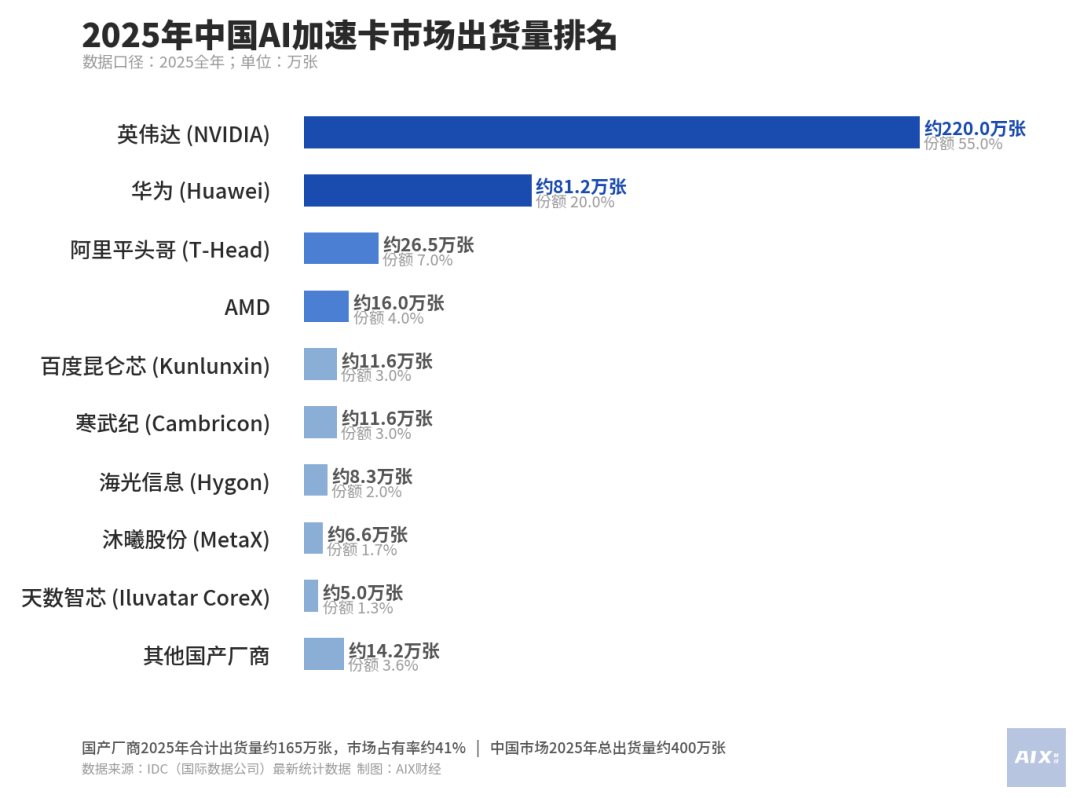
💡China's chip factions splitting Nvidia's share—key for hardware diversification.
⚡ 30-Second TL;DR
What Changed
Three major Chinese AI chip factions gaining traction
Why It Matters
Intensifies global AI chip competition, potentially cutting costs and easing supply chain risks for AI deployments outside US dominance.
What To Do Next
Benchmark chips from China's top three AI factions versus Nvidia H100 for inference efficiency.
Key Points
- •Three major Chinese AI chip factions gaining traction
- •Challenging Nvidia's market dominance directly
- •Domestic alternatives eroding Nvidia's invincibility
🧠 Deep Insight
AI-generated analysis for this event — not the original article.
🔑 Enhanced Key Takeaways
- •The three factions are categorized by their origin: tech giants (e.g., Huawei/Ascend), specialized AI chip startups (e.g., Biren Technology, Moore Threads), and state-backed research institutes, each targeting different segments of the training and inference market.
- •US export controls on high-end GPUs like the H100 and A100 have acted as a catalyst, forcing Chinese cloud providers and enterprises to adopt domestic silicon to ensure supply chain continuity.
- •Software ecosystem maturity remains the primary bottleneck; while hardware performance is closing the gap, Chinese manufacturers are heavily investing in proprietary software stacks to improve compatibility with PyTorch and TensorFlow.
📊 Competitor Analysis▸ Show
| Feature | Nvidia H20 (China-specific) | Huawei Ascend 910B | Biren BR100 |
|---|---|---|---|
| Architecture | Hopper (Cut-down) | Da Vinci | Big Island |
| FP16/BF16 TFLOPS | ~148 | ~320 | ~512 |
| Memory Bandwidth | 900 GB/s | 1.2 TB/s | 2 TB/s |
| Software Stack | CUDA | CANN | BIRENSUPA |
🛠️ Technical Deep Dive
- •Huawei Ascend 910B utilizes a 7nm process node and is optimized for large-scale cluster training, supporting high-speed interconnects (HCCS) to rival NVLink.
- •Biren Technology's BR100 employs a chiplet architecture, allowing for higher yields and scalability in high-performance computing (HPC) workloads.
- •Most domestic chips are shifting focus from pure raw compute to high-bandwidth memory (HBM) integration to mitigate the memory wall bottleneck in LLM training.
- •Development of 'CANN' (Compute Architecture for Neural Networks) by Huawei serves as the direct alternative to CUDA, providing a library of operators specifically tuned for Ascend hardware.
🔮 Future ImplicationsAI analysis grounded in cited sources
⏳ Timeline
Weekly AI Recap
Read this week's curated digest of top AI events →
👉Related Updates



AI-curated news aggregator. All content rights belong to original publishers.
Original source: 钛媒体 ↗
This is a summary, not the original. Read the source, or get the weekly briefing.
The weekly digest
One email a week. Unsubscribe anytime.