China’s Robot Traffic Police Can’t Stop Cars
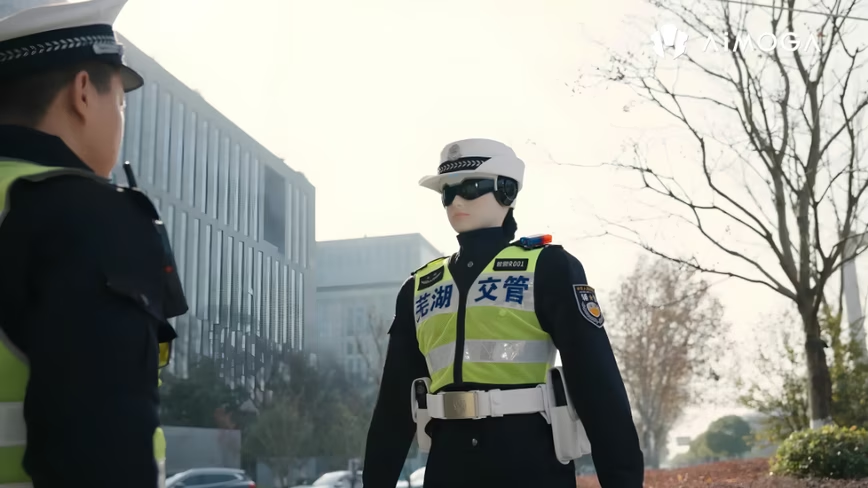
💡China’s deployment shows how embodied AI can operate in public spaces with deliberately limited autonomy.
⚡ 30-Second TL;DR
What Changed
The robots can direct traffic and interact with pedestrians.
Why It Matters
The deployment illustrates how embodied AI can support public-facing, low-risk traffic operations without replacing human enforcement authority. For robotics teams, the use case highlights the value of constrained autonomy, human oversight, and clear safety boundaries.
What To Do Next
Prototype a ROS 2 traffic-assistance workflow with explicit no-intervention constraints, logging every warning and escalation to a human operator.
Key Points
- •The robots can direct traffic and interact with pedestrians.
- •They can reprimand jaywalkers and provide metro directions to tourists.
- •Hangzhou has deployed 15 humanoid robots in a traffic-policing context.
- •The inability to stop people or vehicles is an intentional design limitation.
🧠 Deep Insight
Web-grounded analysis with 21 cited sources.
🔑 Enhanced Key Takeaways
- •The robots, such as "Hangxing No. 1" in Hangzhou and the T2 model, stand approximately 1.8 to 1.88 meters tall and weigh around 98 kilograms.
- •Equipped with high-definition cameras, millimeter-wave radar, LiDAR, and ultrasonic sensors, these robots can detect specific violations like helmetless e-bike riders, e-bikes carrying passengers, and vehicles stopping beyond marked lines.
- •Upon detecting an infraction, the robots issue polite, pre-recorded verbal warnings and log the incident data to a central police early warning center for human officers to review and decide on further action.
- •The design limitation preventing robots from physically stopping individuals or vehicles is intentional, adhering to Chinese policing law which reserves coercive powers for human officers and mitigating risks of autonomous system misidentification.
- •Developed by companies like SUPCON Information, these robots are designed to operate autonomously for 8-9 hours daily, moving between designated intersections, and SUPCON claims a violation-detection accuracy exceeding 95%.
🛠️ Technical Deep Dive
- Robot Models: Notable models include "Hangxing No. 1" in Hangzhou, the T2 robot developed by SUPCON Information, and "Wuyou Zhijing R001" in Wuhu. Other models like EngineAI's PM01 (Shenzhen) and Logan Technology's RT-G (Wenzhou) are also in use.
- Sensors: The robots are equipped with high-definition cameras, millimeter-wave radar, LiDAR, and ultrasonic sensors, some featuring 360-degree panoramic capabilities.
- AI Capabilities: They utilize visual recognition algorithms for real-time detection of traffic violations and large speech models for providing navigation and answering public inquiries.
- Movement: Many models, such as Hangxing No. 1 and the T2, move on omnidirectional wheels, allowing them to navigate intersections.
- Interaction: Robots perform a standardized set of traffic command gestures (up to eight types) synchronized with traffic lights, blow digital whistles, and issue pre-recorded audio warnings. They also feature interactive screens for tourist assistance and an emergency function to connect users with local police.
- Data Handling: Detected violations are logged to police databases or early warning centers, and real-time data feeds into public infrastructure dashboards, providing integrated analytics for urban planning.
- Operational Endurance: The robots can operate autonomously for 8-9 hours on a single battery charge before requiring a swap.
- Environmental Limitations: While designed for various conditions, their cameras and radar systems can still be affected by strong sunlight, heavy rain, and extreme temperatures.
🔮 Future ImplicationsAI analysis grounded in cited sources
⏳ Timeline
📎 Sources (21)
Factual claims are grounded in the sources below. Forward-looking analysis is AI-generated interpretation.
Weekly AI Recap
Read this week's curated digest of top AI events →
👉Related Updates


AI-curated news aggregator. All content rights belong to original publishers.
Original source: The Next Web (TNW) ↗